
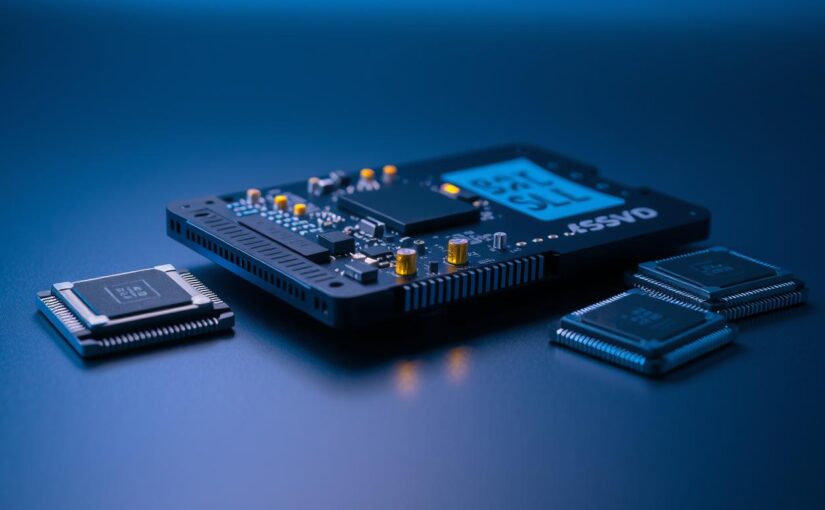
Let’s uncover what powers your storage. It’s not magic, but many think it is. It’s not just about speed.
The controller is like the brain of your device. It’s the middle manager that keeps data flowing. Imagine it like an air traffic controller at JFK during holidays. If it’s slow, everything gets backed up.
NAND comes in different types. The TLC vs QLC debate is about how many bits each cell holds.
TLC holds three bits per cell, while QLC holds four. It’s like trying to fit your family in a small apartment. You save money, but it’s cramped.
The best NVMe SSD 2025 will have top controllers and TLC NAND. But, some cheaper options might use QLC to save money.
DRAM cache, HMB, TLC/QLC trade‑offs
Welcome to the world of storage, where every choice has a trade-off. You’re not just picking speed or size. You’re deciding how your data will live and breathe.
DRAM cache
DRAM is like your SSD’s memory. It instantly knows where everything is. Without it, finding files becomes a game of hide-and-seek. Performance drops quickly when this memory is lost.
HMB
Host Memory Buffer is a smart fix. It lets your SSD use RAM like a neighbor borrowing sugar. It’s not perfect, but it works well enough.
The TLC vs QLC debate is next. TLC is like a sports car – fast and durable. QLC is like a big truck – holds a lot but is slower and less durable.
Endurance TBW is key here. Heavy users might see QLC drives wear out fast. Pick based on your needs – family photos or 4K video editing.
Gen5 vs Gen4 Reality
Welcome to the spec sheet thunderdome, where numbers battle for your attention. Marketing departments hope you won’t look too closely at real-world performance.
PCIe Gen5 promises speeds that would make Usain Bolt jealous. It offers 64GB/s bandwidth, compared to Gen4’s 32GB/s. But, most apps can’t use these speeds in real life.
It’s like having a hypercar in Manhattan traffic. It’s impressive on paper but frustrating in real life. Gen5 might matter with Microsoft’s DirectStorage technology. It could change game loading by avoiding storage bottlenecks.
The best NVMe SSD 2025 options need to show real benefits, not just benchmark scores. Gen4 drives are great for most users. Gen5 is the cutting-edge tech that’s figuring out its place.
Sequential vs game load benefits
Let’s dive into the world of Storage Specs vs Actual Performance. It’s like comparing supercars to your daily commute. Manufacturers show off sequential speeds, but your games load like your daily drive.
Sequential
Sequential speeds are the big numbers – 7,000 MB/s read, 6,500 MB/s write. They look great in ads and benchmarks. These speeds are perfect for big tasks like 4K video editing or moving your Steam library.
But games don’t load like that. They’re not just one big file. They’re many small files scattered around your drive.
Game Load Benefits
Game loading is all about random read performance. It’s how fast your SSD can find those small files. A Gen4 drive with great random performance might feel faster than a Gen5 drive, even if it’s faster for big files.
Microsoft’s DirectStorage technology changes the game. It lets your GPU access storage data directly, making sequential speeds matter for gaming. This could change how games load assets, making storage speed even more important.
When picking the best NVMe SSD 2025 for gaming, don’t just look at sequential numbers. Check the random read performance too. Real-world tests show the difference between Gen3 and Gen4 drives in game loading times is smaller than expected.
| Performance Metric | Benchmark Impact | Real-World Gaming Impact | DirectStorage Benefit |
|---|---|---|---|
| Sequential Read | Very High | Moderate | High (Potencial) |
| Random Read (4K QD1) | Moderate | Very High | Critical |
| Mixed Workloads | High | High | Significant |
| Sustained Performance | Moderate | Critical | Essential |
The truth? The best NVMe SSD 2025 for gaming needs to balance sequential and random performance. It’s the drive that keeps you gaming while others are loading.
Thermals & Cooling
Welcome to the digital sauna party inside your computer case. Your storage drive isn’t just storing data. It’s generating enough heat to make a political debate look chilly.
When temperatures soar, performance plummets. This thermal throttling is your drive’s desperate attempt to avoid cooking itself into early retirement. It’s like trying to run a marathon during a heatwave—you start strong but eventually crawl to prevent catastrophe.
High-performance models consume power that would make a space heater jealous. This heat directly impacts your drive’s endurance TBW and consistent performance. Proper cooling isn’t luxury—it’s necessity.
Quality heatsinks transform your drive from overheating drama queen to cool, collected performer. They preserve both speed and longevity, ensuring your investment doesn’t thermal throttle itself into obsolescence.
Because nothing says “premature tech retirement” like a drive that can’t handle the heat.
Heatsinks, airflow, active fans, throttling
Let’s talk about keeping your SSD cool. Nothing kills performance faster than an SSD overheating. Here’s how to prevent your storage from getting too hot.
Heatsinks
Motherboard manufacturers have made heatsinks fashionable. Some look like art, others like skyscrapers. But do they work? Yes, they do.
Aluminum spreads heat well, while copper conducts it better but costs more. The best NVMe SSD 2025 options often come with built-in heatsinks. Aftermarket solutions range from simple plates to massive copper blocks.
Airflow
Your case ventilation is key. A well-placed fan can cool better than any passive heatsink in stagnant air. Airflow is like the hero of cooling – it makes a big difference.
Proper fan placement is important. Front-to-back or bottom-to-top airflow patterns work best. Good case design can also help keep temperatures down.
Active Fans
Active fans are the cooling overachievers. They move air across heatsinks, providing active cooling. They’re like a personal trainer for your SSD.
Some high-end motherboards and SSDs have tiny fans. These fans spin up under load, preventing thermal throttling.
Throttling
When cooling fails, throttling kicks in. Your SSD slows down to avoid overheating. It’s like saying “I’m fine” while visibly sweating.
Modern drives manage this well, balancing performance and protection. The best NVMe SSD 2025 models keep temperatures in check, so you rarely see throttling.
Good cooling is about more than peak performance. It’s about keeping things running smoothly and lasting longer. Your future self will thank you for keeping things cool.
Capacity & Endurance
Imagine choosing between a sports car that needs constant care and a dependable sedan. Storage technology faces a similar choice: capacity versus how long it lasts.

Endurance TBW shows how much data a drive can handle before it needs to retire. It’s like asking, “how long will it last?” in the storage world.
The TLC vs QLC debate is serious. TLC NAND has better endurance because it uses less space per cell. It’s like having private rooms instead of shared bunk beds.
Drives with more capacity also last longer. They have more cells to share the wear and tear. It’s like having a bigger team to handle the workload, so everyone lasts longer.
TBW, DWPD, SMART tools
Welcome to SSD longevity 101. Here, TBW isn’t a streaming service, and DWPD isn’t about writing every day. These metrics show which storage is reliable and which isn’t.
Endurance ratings are like insurance for your drive. They tell you how much data you can write before it fails.
TBW: Your Drive’s Mileage Counter
TBW (Total Bytes Written) shows how much data you can write over your drive’s life. It’s like an odometer for SSDs, counting cat videos and work documents.
Most drives have 600-1800 TBW ratings. Professional ones go up to 3000 TBW. The average user writes 10-20TB a year. Your drive will likely get old before it hits its TBW limit.
Higher TBW ratings mean better NAND flash and controllers. They help find the top NVMe SSDs for 2025.
DWPD: The Daily Stress Test
DWPD (Drive Writes Per Day) shows how much you can write daily during the warranty. It’s a tough test for endurance.
Consumer drives have 0.3-1 DWPD. Enterprise ones have 3-10 DWPD. Unless you’re running a big data center, you won’t reach these limits.
DWPD is key for content creators and database admins. For others, it’s just bragging rights.
SMART Tools: Your Drive’s Annual Physical
SMART tools are your SSD’s health check. They watch reallocated sectors, wear leveling counts, and temperature.
The best NVMe SSDs for 2025 have SMART tools that give clear info. Look for software that explains technical data in simple terms.
Key SMART attributes to watch:
- Media Wear Indicator (percentage of life remaining)
- Available Spare Blocks (emergency storage reserves)
- Uncorrectable Error Count (failure warning)
| Endurance Metric | What It Measures | Consumer Range | Professional Range | Why It Matters |
|---|---|---|---|---|
| TBW | Total lifetime writes | 600-1800TB | 2000-5000TB+ | Overall drive lifespan estimation |
| DWPD | Daily write endurance | 0.3-1x capacity | 3-10x capacity | Workload intensity handling |
| Media Wear Indicator | Percentage life remaining | 100-0% scale | 100-0% scale | Real-time health monitoring |
Understanding these metrics makes you a smart buyer. You’ll know how much stress your storage can take before it needs a break.
The top NVMe SSDs for 2025 will have great TBW ratings and easy-to-use SMART tools. Knowing your drive’s end date is key to being prepared.
Firmware Features
Think firmware is just boring code? Think again. It’s the secret sauce that makes the difference in the storage world.
Your drive’s firmware acts like an operating system for your storage controller. It handles tasks like garbage collection and wear leveling. Good firmware makes your drive perform well. Bad firmware? It’s like giving a Ferrari to someone who only knows how to drive a golf cart.
Modern firmware introduces game-changing features like DirectStorage support. This technology lets your GPU talk directly to your storage, avoiding the CPU bottleneck. It’s like building a private highway for your data.
The best NVMe SSD 2025 options will also have smart power management. Because not everyone wants their storage to suck power like it’s trying to single-handedly support the local grid.
Regular firmware updates can unlock new features later. It’s like getting free performance upgrades for your car’s engine management system. Who doesn’t love free horsepower?
OPAL, power states, field updates
Most people focus on how fast something is. But true quality lies in the features. It’s like the difference between a sports car with basic features and one with all the bells and whistles.
These advanced features set professional storage apart from everyday options. They keep your data safe, your battery charged longer, and your drive up-to-date.
OPAL: Your Data’s Fort Knox
OPAL (TCG Storage Security Subsystem Class: Opal) is serious about security. It uses hardware encryption, unlike software that’s not as reliable.
Think of it as a bank vault for your data. It’s encrypted right away, making it hard to access without the right key. For those handling sensitive info, this is a must-have.
The top NVMe SSDs for 2025 have OPAL 2.0 and AES 256-bit encryption. They offer top security without slowing you down.
Power States: The Art of Strategic Laziness
Power states control how your drive acts when it’s not in use. They can save battery life in laptops.
SSDs have different power states:
- PS0: Full performance mode – the drive is awake and ready to party
- PS1-3: Various low-power states – the drive is napping but can wake quickly
- PS4: Sleep mode – basically comatose until called upon
Smart drives switch between these states smoothly. They save power without affecting performance. It’s like having a butler who turns off lights when no one’s around.
Field Updates: Because Nobody Likes RMA Paperwork
Firmware updates are a big deal. They let you upgrade your drive without sending it back. It’s a sign of modern tech that keeps getting better.
Manufacturers can send updates for better performance and security. It’s like your drive gets smarter over time.
Some updates are easy; others are a challenge. The best NVMe SSDs for 2025 make updates simple.
| Feature | Consumer Grade | Professional Grade | Why It Matters |
|---|---|---|---|
| Encryption | Software-based | OPAL hardware | Real security without performance hit |
| Power Management | Basic states | Multiple optimized states | Better battery life, smarter operation |
| Firmware Updates | Limited or none | Field-updatable | Future-proofing, bug fixes |
| Management Tools | Basic utilities | Comprehensive suites | Better control, monitoring |
When picking the best NVMe SSD for 2025, look beyond speed. These advanced features are what make your investment worthwhile. In 2025, we expect our tech to keep up with us.
Install & Migration
So you’ve picked your best NVMe SSD 2025. Now, it’s time to put it in your computer.
Installing it is where theory meets real-world trouble. The manual says to insert it at a 30-degree angle, like it’s surgery. But in reality, you’re trying to fit it in while avoiding a tiny screw.
After that, you face the digital migration. This is when cloning software can be your hero or your worst nightmare. Will it move your operating system smoothly? Or will it copy all your computer’s quirks to the new drive?
We’ve gone through this so you don’t have to. Let’s make that hardware upgrade a success, not a struggle.
Slot choice, BIOS, cloning
You’ve picked the perfect drive, but now it’s time to make it work. It’s like buying a Ferrari but finding your garage door too short. The installation process can be a test of patience.
Not All Slots Are Created Equal
Motherboard makers often hide PCIe lanes. The top M.2 slot might look the same as the bottom one, but they differ. Using both can slow down your performance.
Some slots only support certain PCIe generations. Your Gen5 drive might run at Gen3 speeds. Always check your motherboard manual to unlock your storage’s full power.
The BIOS Dance
BIOS menus are old, like from the Clinton era. You’ll find options that seem from MS-DOS. Look for:
- PCIe generation selection (Auto/Gen4/Gen5)
- NVMe configuration
- CSM/UEFI mode settings
Setting these wrong is like using premium gas but not starting the engine. Your drive will work, but not fully.
Cloning Without the Baggage
Cloning your old drive to a new SSD is like moving. You can pack carefully or just throw everything in boxes.
Most drive makers offer cloning software, but third-party tools are often better. They’re like professional movers, handling everything for you.
Remember, a clean Windows install usually beats cloning. It’s like spring cleaning versus just rearranging.
Getting these three right makes your best NVMe SSD 2025 fast. It’s where theory meets reality.
Tiered Recommendations
Let’s cut through the marketing hype and get real about storage. Not everyone needs a Formula 1 drive when a reliable sedan gets you to work just fine.

Budget options make smart compromises. They often use QLC technology and deliver solid performance for everyday tasks. Think of them as the sensible Toyota Camry of storage.
Mid-range drives hit that sweet spot. They typically feature TLC NAND and offer excellent performance without breaking the bank. This is where most people should be shopping.
Then we have the flagship models. These push performance boundaries for those who need every last drop of speed. They’re the Ferraris of the storage world – spectacular but expensive.
The TLC vs QLC debate often determines which tier a drive occupies. Understanding this difference helps you find the perfect balance between performance and price for your needs.
Budget Gen4, high‑value TLC, flagship Gen5
Choosing storage is like picking wine at a fancy restaurant. You have budget wines, mid-range bottles, and expensive vintages. These options are like digital storage choices.
Budget Gen4
Budget Gen4 drives are like digital box wines. They’re affordable and get the job done. They use QLC NAND, similar to a reliable economy car.
The TLC vs QLC debate is key here. QLC offers more storage for less money but is slower. These drives often lack heatsinks, making them good for basic tasks.
High-Value TLC
High-value TLC drives are the best value. They’re like that perfect restaurant wine. They offer great performance without a high price.
They have better controllers and speeds than budget drives. These are the workhorses for gaming and content creation.
Flagship Gen5
Flagship Gen5 drives are like digital supercars. They’re fast and impressive. They require big heatsinks to manage heat.
They offer speeds that make old drives seem slow. When we talk about the best NVMe SSD 2025, this is the top choice. But only if you need that much power.
RAID & Scratch Drives
Sometimes, one fast storage device isn’t enough for our digital needs. We’ve moved past the days of single-drive performance feeling quaint.
RAID 0 setups with today’s drives can double performance through data striping. It’s like juggling chainsaws – impressive when it works, catastrophic when it doesn’t. If one drive fails, all data is lost.
Scratch drives are the heroes of creative work. They handle endless write/erase cycles that would break other storage.
The best NVMe SSD 2025 for scratch use focuses on long-term performance and high endurance TBW ratings. A slow scratch drive can ruin a creative project.
When it helps (and when it doesn’t)
In the world of storage, some options are stars, while others are just extras. Let’s figure out which ones are worth it for your setup.
Too many people spend too much on storage they don’t really use. It’s like buying a sports car for grocery runs. The right choice depends on your needs.
When it helps
RAID setups are amazing for big files. Video editors working with 8K footage will love RAID’s speed.
DirectStorage is also making the most of this speed. Game developers are now using it for next-gen games.
Creators of 4K/8K content will see a huge difference. It’s like switching from a bike to a train for file transfers.
Data scientists and developers with big files also benefit a lot. Premium storage is a big help for them.
and when it doesn’t
Most people don’t need top-notch storage. Browsing the web, writing documents, or gaming? A good single drive is enough.
Some users spent thousands on RAID arrays for simple tasks. It’s like using a flamethrower for a birthday candle – too much.
Even gaming doesn’t always need the best storage. Once a game loads, the storage’s job is mostly done until the next load.
For everyday tasks, simple SSDs are fine. Word processing, spreadsheets, and web browsing don’t need the best NVMe SSD 2025.
It’s important to know what you really need. Don’t buy based on what you think you might need.
Best Uses Matrix
Let’s play storage therapist for a moment. Why does everyone assume they need the fastest drive on the market? It’s like buying a Ferrari for grocery runs.
Gamers crave that DirectStorage magic and snappy random reads. But do you really need record-breaking sequential speeds? Not unless you’re racing digital cars for real.
Content creators are different beasts. They need both massive file throughput and sustained write performance. That TLC vs QLC debate suddenly becomes very relevant when rendering 4K footage.
For everyday computing? Even budget options feel like rocket ships compared to old hard drives. The best NVMe SSD 2025 isn’t about biggest numbers – it’s about perfect pairing.
Gaming, creation, capture
Gamers, creators, and content capturers have different needs. Each group wants something special from their drive. It’s like three siblings fighting over the TV, each with their own show to watch.
Gaming
Gamers want fast loading times, like their pizza. They need drives that handle lots of small files quickly. This is key for fast gameplay.
DirectStorage is a game-changer for gamers. It lets games talk directly to the drive, skipping the CPU. It’s like getting VIP access to your storage.
Many gaming drives now have built-in heatsinks. This is because long gaming sessions can make drives get too hot. No one wants their game to slow down during a critical moment.
The top NVMe SSD for gaming is fast and reliable. It’s not about winning speed contests. It’s about quick load times that keep you in the game.
Creation
Content creators work with big files and tight deadlines. They need drives that can handle long tasks well. It’s like a marathon, not a sprint.
Video editors need drives that can handle huge files without slowing down. They can’t afford to wait for their drive to catch up. Consistent speed is key.
Creators benefit from TLC NAND and strong controllers. These features help drives stay fast even when things get tough. It’s the difference between a drive that performs and one that just promises.
Capture
Capture apps, like video recording and streaming, are vital. They need drives that can write data constantly without issues. Any problem means lost frames or corrupted files.
Imagine recording 4K gameplay and streaming it live. Your drive is writing a lot of data non-stop. Any slowdown means trouble.
These apps value endurance and constant write speed most. They’re the backbone of storage, working hard behind the scenes. They might not be the fastest, but they’re reliable.
The best NVMe SSD for capture might not win speed tests. But it won’t let you down when you need it most. Sometimes, being reliable is the most important thing.
Final Picks & Value Scores
We’ve explored many specs and promises. Now, we find the best NVMe SSD 2025 for you. It’s not just about speed. It’s about endurance and keeping cool too.
For gamers, Samsung’s 990 Pro is top-notch. Content creators should look at WD’s Black SN850X. It has great heatsinks. And for those on a budget, Crucial’s P5 Plus is a great choice.
Gen5 drives like Sabrent’s Rocket 5 are impressive but pricey. Gen4 options are better. They offer great performance and value. Choose one that fits your needs and budget.