

The Locust Horde officially broke through the surface this week, and the technical foundation powering their arrival sets a new benchmark for third-person shooters. Gears of War: E-Day abandons older engine architectures, forcing players to upgrade their hardware to survive Emergence Day. Built entirely on Unreal Engine 5, The Coalition’s latest release trades cross-generation compromises for pure visual fidelity. We break down how the developers optimized this massive 130 GB download for the Xbox Series X and modern PC builds, highlighting the rendering tricks keeping Kalona running smoothly.
Advanced Shader Delivery Banishes PC Stutter
PC gamers constantly battle shader compilation stutter during major releases, but The Coalition tackles this issue head-on. Gears of War: E-Day introduces a brand-new system called Advanced Shader Delivery (ASD). Instead of forcing your processor to compile shaders locally while the game runs, ASD identifies your specific graphics card and driver configuration during installation. It then fetches pre-compiled Pipeline State Objects directly from cloud servers.
This cloud-based pipeline reduces the initial game startup to a brief validation pass, completely eliminating the frame drops that normally plague PC ports during heavy combat sequences. To take advantage of these new rendering pipelines, players need up-to-date hardware. You can explore the latest PC components and gaming technology to make sure your rig meets these heavy demands. Eliminating stutter allows you to track fast-moving enemies with perfect clarity, turning frantic chainsaw duels into smooth, responsive encounters.
MegaLights and the Xbox Series X Experience
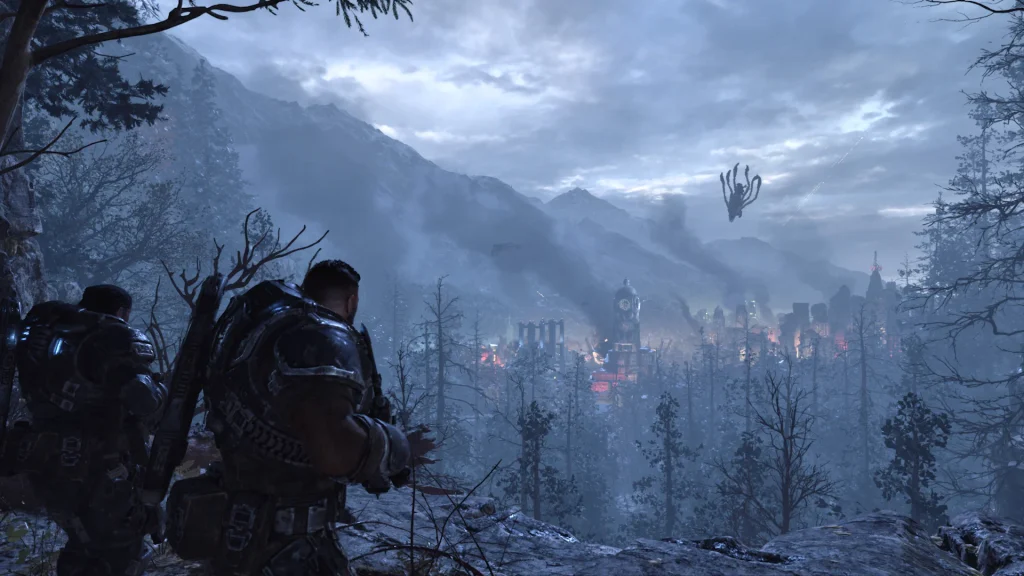
Console players get their own share of technical wizardry. On the Xbox Series X, the development team locked in a rock-solid 60 frames per second target for the campaign, while pushing the competitive multiplayer modes up to a blistering 120 frames per second. Achieving this required heavily optimizing Epic Games’ new MegaLights system. This lighting technology generates dynamic, high-contrast shadows that stretch across the ruined streets of Kalona, perfectly capturing the horror-adjacent tone of the original 2006 title.
The developers even found clever workarounds for the less capable Xbox Series S. Rather than gutting the visual features, the engine aggressively taps into the console’s solid-state drive to stream textures instantly, solving memory bottleneck issues. Players can track the game’s overall critical reception and technical breakdowns on the Gears of War E-Day Wikipedia page to see how these optimizations landed with reviewers.
Scaling the Horde for Your Hardware
Running Gears of War: E-Day requires a graphics card capable of hardware-accelerated ray tracing. Older architectures simply cannot launch the game. The Coalition scales the experience nicely for those who meet the minimum threshold, but hitting that 60 FPS sweet spot at higher resolutions demands some serious graphical muscle.
| Hardware Tier | Processor Requirements | Graphics Card (GPU) | Minimum RAM |
| Minimum | AMD Ryzen 5 2600X / Intel i5-10400 | NVIDIA RTX 5050 / RTX 2060 / AMD RX 6600 | 12 GB |
| Recommended | AMD Ryzen 5 5600 / Intel i5-11600K | NVIDIA RTX 5060 / RTX 3060 Ti / AMD RX 6700 XT | 16 GB |
Storage speeds remain the final hurdle. The game demands up to 130 GB of space, and a solid-state drive is strictly mandatory. Installing the game on an older spinning hard drive will break the texture streaming and cause massive audio desyncs during cutscenes. Fans looking to grab the game digitally can check the official Steam store page for regional pricing and complete patch notes. The fight for Kalona looks incredible, provided your hardware can handle the heat.