

Graphics card deals in October 2026 look less like easy discounts and more like damage control. The big change is that “sale price” no longer means “good value” by default. Some cards are discounted from inflated listings, some are close enough to MSRP to be worth shortlisting, and some flagship models are so far from launch pricing that raw speed alone cannot rescue the value case. For PC gamers building around 1080p, 1440p, or entry-level 4K play, the smarter move is to judge the card against MSRP, VRAM capacity, software support, warranty terms, and the rest of the build budget.
The current market is being shaped by price pressure on Nvidia’s RTX 50-series, uneven Radeon RX 9000-series availability, and a renewed interest in Intel Arc as a value play. Tom’s Hardware reported that RTX 50-series prices had spiked in U.S. listings, with the RTX 5070 showing a 36% median hike and the RTX 5060 up 27% at the median of Newegg listings, tied to Blackwell price pressure and supply strain Tom’s Hardware reported. TechRadar also cited warnings from a U.S. PC maker that GPU pricing was set to climb significantly, with pressure linked to supply and high-end GeForce availability TechRadar noted.
Why Graphics Card Deals Need A New Value Check
Graphics Card Deals Are Not Just Discounts
The first mistake is reading a crossed-out price as proof of value. A Gigabyte Windforce RTX 5050 dropping to $309.99 from $399.99 sounds useful because the reduction is clear. A PNY GeForce RTX 5060 OC at $439 is harder to judge: the research notes list the RTX 5060 MSRP at $299, so that price is still roughly 47% above MSRP even if it is competitive against other cards in the same class during a tight market. That is the 2026 GPU problem in one line: a decent deal can still be expensive.
This is why recent graphics card deals need two comparisons. First, compare the current price with the launch MSRP or stated MSRP where available. Second, compare it with the realistic alternatives that are actually in stock. If every RTX 5060 listing has moved above the old baseline, the lowest bad price may still be the least painful buy for a GeForce-focused system. That does not make it cheap. It only means the buyer should be honest about what is being sacrificed elsewhere.
MSRP Is Now A Practical Warning Light
From August through October 2026, the research points to a market where MSRP or a modest premium has become rare enough to matter. That changes how buyers should read listings. A card sitting close to MSRP may deserve attention even without a dramatic sale label. A card with a huge percentage discount may still be poor value if its “was” price was already inflated.
The Radeon RX 9070 GRE 12GB at $569.99 against a $549 MSRP is a good example of a card that appears close enough to MSRP to be considered seriously, based on the research notes. By contrast, RX 9070 XT custom cards hovering around $680 are harder to treat as clean value unless the buyer specifically wants that tier and has verified competing prices. This does not mean one model is automatically right for every build. It means the starting point should be the real shelf price against the card’s role in the PC, not brand preference.
Where Nvidia, AMD, And Intel Value Split
Nvidia Features Carry Weight, But Pricing Hurts
Nvidia’s RTX cards still carry strong appeal for players who care about software features, upscaling, frame generation, ray-tracing reputation, streaming tools, or creator-adjacent workflows. The research notes specifically flag upscaling and frame-generation features such as DLSS, FSR, and XeSS as increasingly important in judging price-to-performance. That matters because a GPU no longer wins only through raw raster output on a spec sheet.
The issue is that inflated pricing can overpower those benefits. The RTX 5060 Ti 16GB being listed at about $777 against a $429 MSRP in the research notes is the sort of gap that should make buyers pause. More VRAM can be useful, and Nvidia’s software stack has real appeal, but almost doubling MSRP pushes a midrange card into a different budget class. If the price jump forces cuts to the monitor, PSU, case airflow, or storage, the system may end up worse balanced even if the graphics card itself is desirable.
Radeon Can Still Work When The Price Is Close
AMD’s Radeon RX 9000-series looks more interesting where pricing stays near MSRP. The RX 9070 GRE 12GB example from the research notes is the cleanest case: $569.99 against a $549 MSRP is not a bargain-bin number, but it is at least within a range where the buyer can weigh VRAM, target resolution, and competing Nvidia prices without starting from a heavily inflated baseline.
The risk is that Radeon value depends heavily on the final store price. If an RX 9070 XT custom model is sitting around $680, the buyer needs to ask what else that money could buy. A cheaper Radeon may free up cash for a better monitor or bigger SSD. A pricier Radeon may still make sense for a player who prioritizes traditional raster performance and does not put as much weight on Nvidia’s software features. The right answer is tied to the games, the display, and the upgrade cycle.
Intel Arc Is The Budget Disruptor
Intel Arc B580 stands out in the research notes because it is described as a strong value pick with 12GB of VRAM, retail pricing around $249, and occasional discounts around $239. That puts it in the conversation for budget-focused PC gamers who want a new card without chasing inflated RTX or Radeon listings. The notes also point to Intel XeSS and newer frame-generation support as part of the value argument.
There are still normal buyer checks. Game compatibility, driver maturity for the titles you actually play, power requirements, case clearance, and return policy all matter. But in a market where midrange GeForce and Radeon prices can drift sharply above MSRP, a lower-cost Arc card can be a rational shortlist candidate rather than an afterthought.
How To Balance Quality, Features, And Price
Start With Resolution, Not The GPU Name
A 1080p player does not need to shop like a 4K player. For esports-heavy and lighter-game use, the best deal may be the card that keeps total platform cost sane. For 1440p, VRAM and software scaling become more important because modern games can pressure memory and settings more quickly. For 4K, high-end pricing is the main obstacle, and the research notes show why: the RTX 5090 has been listed around $7,177 against a $1,999 MSRP, with regular supply described as nearly non-existent.
That flagship example is not a normal buying recommendation; it is a warning. A top-end GPU can be technically impressive and still make little sense at a severe premium. Buyers should avoid treating the fastest card as the best card unless the budget is unusually flexible and the price is verified across several reputable retailers. For most gaming PCs, the quality target should be smooth play at the monitor’s native resolution, not owning the most expensive silicon in the case.
Use Features As A Tiebreaker, Not A Blank Check
Software features now affect value in a real way. Upscaling and frame generation can help extend the useful life of a card, especially when game requirements rise faster than GPU budgets. Nvidia’s DLSS ecosystem, AMD’s FSR support, and Intel’s XeSS each matter differently depending on the games you play. The buyer error is paying any premium just to get the feature logo on the box.
A practical test is simple: if two cards are close in price and both meet your VRAM and resolution needs, software support can break the tie. If one card is hundreds of dollars higher, the feature advantage needs to be worth an actual sacrifice elsewhere in the build. A better monitor, quieter cooling, a higher-quality PSU, or more storage may improve daily gaming more than moving up one overpriced GPU tier.
- Check MSRP distance: a sale price that is still far above MSRP needs extra justification.
- Match VRAM to use: do not buy less memory than your resolution and game library require just to chase a discount.
- Read the warranty terms: open-box and refurbished cards can be good buys only if coverage is clear.
- Protect the build balance: avoid cutting PSU quality, airflow, or monitor quality to fund an inflated card.
- Compare real stock: judge against cards you can actually buy, not prices that vanished weeks ago.
Open-Box And Used Cards Deserve Careful Checks
Savings Are Useful, But Risk Moves To The Buyer
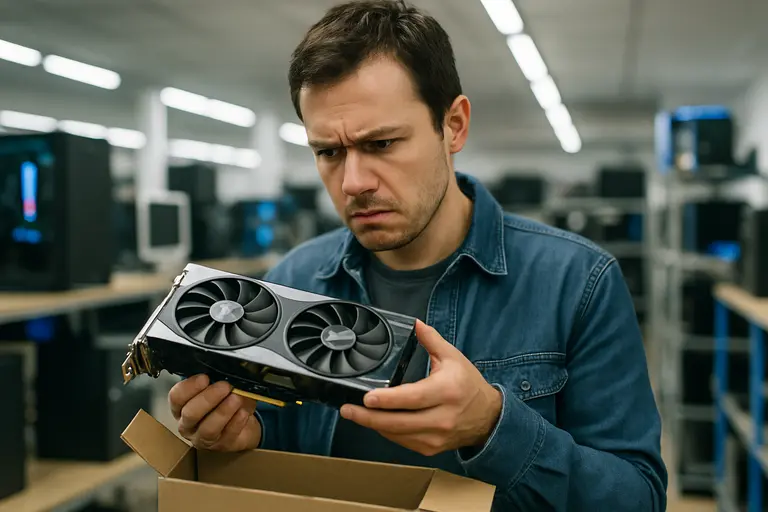
The research notes say open-box, refurbished, clearance, and local sales can save $100 to $400 on many GPUs. That is meaningful in a market where a new RTX 5070-class or RX 9070 XT-class card may be inflated. But those savings are not free. Warranty length, return windows, missing accessories, coil whine, cooler condition, and previous use all need checking before the card becomes a safe buy.
For local purchases, avoid vague claims and inspect the card where possible. For retailer open-box units, read whether the original manufacturer warranty still applies or whether coverage is handled by the store. Refurbished can be a fair route when the seller is reputable and the return policy is clear. Unknown marketplaces can erase the saving quickly if the card arrives with thermal issues, damaged fans, or no recourse.
Used Pricing Should Track New Pricing
A used GPU is only a deal if it is priced below a realistic new alternative. If a used RTX 5060 or Radeon RX 9000-series card is only slightly cheaper than a new model with a full warranty, the used card is carrying too much risk. The same applies to older high-end cards. Scarcity can inflate discontinued models, but scarcity alone does not make them smart buys.
This is where a buyer’s parts list matters. If you are still unsure how far to stretch a lower-cost card, our related piece on budget GPU deals covers the common traps around VRAM, platform limits, and power requirements. Broader deal coverage from nearby sites such as the related Rave Tech site in the same network can also be useful for comparing how PC component pressure is affecting setup choices outside the GPU aisle.
Timing Your Graphics Card Deals In October 2026
Waiting For Black Friday Is Not Automatically Safer
Black Friday 2026 falls across November 27-30, 2026, but the research notes warn that waiting may not guarantee a better GPU buy. With prices already climbing in several segments, a decent mid-tier card in stock during October may beat a later “deal” if supply tightens or retailers raise the baseline first. That is not an argument for panic-buying. It is an argument for setting a target price now.
For graphics card deals, a target price should include three numbers: the price you would buy at immediately, the price you would consider if stock is thin, and the price where you walk away. This keeps the decision grounded when a timer, coupon, or low-stock warning appears. It also helps separate a real value buy from a card that simply feels urgent.
Quality And Value Need The Same Scorecard
The best graphics card deals in late 2026 are not defined by the largest percentage cut. They are the cards that fit the target resolution, stay close enough to MSRP, offer enough VRAM, include the software features you will use, and avoid forcing weak choices elsewhere in the system. That may be an Intel Arc B580 for a budget build, a near-MSRP Radeon RX 9070 GRE for a value-focused 1440p setup, or an Nvidia card if DLSS and the broader GeForce stack justify the price in your games.
The cards to avoid are easier to spot: extreme flagship premiums, midrange models priced like upper-tier hardware, used cards without enough discount, and “sale” listings that hide an inflated starting point. In October 2026, quality still matters, but value is won by checking the whole setup before paying for the GPU.