

The Gaming Tech Awards picture in 2026 was less about flashy concept hardware and more about parts that solved real buyer problems: cheaper performance, denser storage, better handheld graphics, smarter displays, and peripherals that tried something new. Tom’s Hardware published its Innovation Awards 2026 on August 21, 2026, under the theme “Progress Amid Turmoil,” and the list reflected a PC market squeezed by memory pricing, AI investment priorities, and uneven GPU progress. The award set is useful because it does not read like a normal spec sheet. It shows which products pushed practical design forward at a time when many gamers were already second-guessing upgrade timing, display targets, and platform costs, according to the Tom’s Hardware report.
For PC gamers, the value here is not treating every winner as an automatic buy. Some awards went to expensive hardware, some went to niche form factors, and some pointed to market pressure rather than clean progress. The better read is to ask what each category says about the next build, the next handheld, or the next desk setup. If you want a CPU-only angle, our related look at practical CPU wins breaks out the processor side in more detail.
What The Gaming Tech Awards Tell PC Buyers
CPU Value Was Not Just About Flagship Parts
The most buyer-friendly signal came from the CPU category. Intel’s Core Ultra 5 250K Plus won with a listed $220 MSRP and reported sale pricing around $155. Tom’s Hardware said it matched the $260 Core i5-14600K in multithreaded workloads, while posting single-threaded performance about 5.6% ahead of AMD’s Ryzen 5 9600X and multithreaded performance about 70% higher. Those figures matter because midrange gaming PCs are often built around compromise. If a cheaper CPU can hold up in productivity while keeping strong per-core speed, it gives players more room for GPU, monitor, SSD, or cooling spend.
The high-end desktop award went in the other direction. AMD’s Ryzen 9 9950X3D2 launched at $1,000 and was listed around $890 in the report. Tom’s Hardware described it as offering “no-compromise performance,” matching the Ryzen 9 9950X3D in applications and staying close to the 9800X3D in modern games. That is not a mainstream gaming recommendation for most buyers, but it does show where AMD’s stacked-cache strategy kept pressure on the high-end PC market. For streamers, creators, and players who also render, encode, or run heavy multitasking workloads, that kind of part explains why HEDT is still being judged on mixed-use strength rather than gaming alone.
Platform Parts Became A Bigger Deal
Motherboard innovation went to Gigabyte’s Z890 Aorus Elite Duo X. The award centered on support for CQDIMMs up to 128GB per stick, five M.2 sockets including PCIe 5.0, Wi-Fi 7, 2.5GbE, and signal-integrity improvements through topology changes. The listed MSRP was about $279.99. That feature set is not automatically needed in a gaming rig, but it points to a larger trend: the motherboard is becoming a capacity and connectivity decision again, not just a socket adapter.
The SSD award followed the same practical thread. Corsair’s MP700 Micro 4TB used a DRAM-less Phison E31T controller in a single-sided M.2 2242 form factor. Tom’s Hardware listed up to 10,000 MB/s sequential reads, 8,500 MB/s sequential writes, and peaks around 1.3 million random read IOPS and 1.4 million random write IOPS. The key detail is not just speed. A compact 2242 drive with 4TB capacity is useful for small PCs and handheld-style devices, where storage expansion is often constrained by board layout and thermals.
Gaming Tech Awards Signals For Handhelds
Intel’s Handheld Win Was About Integrated Graphics
The GPU and handheld category was one of the more interesting Gaming Tech Awards results because the win did not go to a desktop graphics card. Intel’s Arc G3 Extreme platform, specifically the Arc B390 integrated GPU, stood out in the MSI Claw 8 EX AI+ handheld. Tom’s Hardware said it delivered up to 50% higher performance than AMD’s Ryzen Z2 Extreme at demanding 1920×1200 resolutions, while bringing Xe3 graphics architecture and access to Intel’s latest XeSS 3 upscaler.
That does not mean every handheld buyer should switch brands on one award. Battery behavior, game compatibility, drivers, cooling noise, display quality, ergonomics, and pricing still shape the real experience. The award does suggest that handheld gaming PCs are no longer just a side branch of laptop APUs. They are becoming a serious test bed for integrated graphics, upscaling, and compact thermal design. For players who split time between local hardware and cloud play, our network’s insights on service and distribution at GameCloudNetwork are increasingly essential to handheld PC buying decisions.
Discrete GPU Stagnation Was The Warning Sign
Tom’s Hardware also called out “discrete GPU stagnation” as a dishonorable mention, saying innovation had slowed compared with AI-driven investment priorities across the industry. That framing fits what many PC gamers felt through 2026: desktop GPU progress was still important, but it was not the clean, easy upgrade story buyers wanted. The awards list did not claim that desktop GPUs stopped mattering. It showed that some of the more striking movement was happening around integrated graphics, upscaling, memory pressure, and compact devices.
Displays, Laptops, And Peripherals Had The Most Visible Changes
OLED And VRR Improvements Were Easy To Understand
The Alienware AW3426DW won for display innovation, and its spec mix was directly gaming-facing: a 34-inch Penta Tandem OLED panel with five emitters instead of the usual three, V-Stripe RGB subpixels, 3440×1440 resolution, 1800R curve, 280Hz refresh rate, and HDR boost up to 1,300 nits in a 3% window. The reported pricing was under $800. On paper, that is the kind of monitor award that players can understand quickly because refresh rate, OLED behavior, ultrawide resolution, and HDR headroom all affect the desk experience.
Dell’s XPS 14 (2026) was recognized for a different display reason. Its 1920×1200 variable refresh rate panel could drop as low as 1Hz and climb to 120Hz. In Tom’s Hardware battery testing, the model with that screen lasted over 20 hours. That is not a gaming laptop claim, but it is relevant to the broader PC market. Display refresh behavior is becoming a power-management tool, not just a smoothness feature.
Mouse Makers Tried Riskier Ideas
The gaming mouse category had two winners, and both were unusual. The Pulsar Feinmann F01 Noctua Edition was a roughly 73g wireless mouse with a built-in Noctua fan, four fan speeds, a 42,000 DPI XS-2 sensor, and 8,000Hz polling over wired and wireless modes. The Logitech G Pro X2 Superstrike took another route with H.I.T.S., or Haptic Inductive Trigger System, enabling adjustable actuation and rapid trigger behavior so the user did not need to fully release a button before the next click. Its listed specs included a 44,000 DPI Hero 2 sensor, 61g weight, and 8,000Hz polling.
Both products show why peripheral innovation can be polarizing. A fan inside a mouse sounds strange until you frame it as comfort under long sessions. Rapid-trigger mouse buttons sound niche until you connect them to competitive click timing. Neither idea should be treated as a universal need, but both are more interesting than another shell shape with a higher DPI number.
Cooling, Memory Pressure, And The Cost Of Progress
Noctua’s Liquid Cooler Win Matched The 2026 Mood
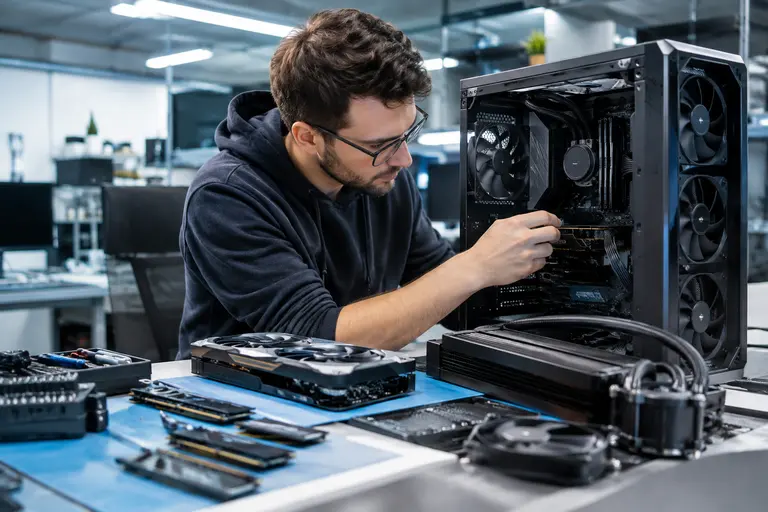
Noctua’s NL-LC1-36 won for cooling innovation. It used Asetek’s Emma Gen8 V2 pump and NF-A12x25 G2 fans, with Tom’s Hardware highlighting strong thermal performance and very quiet operation. Pricing was listed at $220 to $250. That makes it a premium cooler, not a default pick for every build, but the category win fits the year. Modern CPUs can be fast, power-dense, and sensitive to sustained thermals. Quiet cooling is not just a luxury if the PC also sits next to a microphone, OLED monitor, or living-room setup.
The less cheerful part of the awards was the memory market. Tom’s Hardware named the resurgence of DDR4 platforms as a dishonorable mention, tied to DDR5 price hikes. That is a strange outcome for a market that is supposed to move forward generation by generation. If older memory platforms regain attention because new memory pricing gets painful, innovation becomes less linear. Buyers may start comparing total platform cost instead of simply choosing the newest socket and RAM standard.
- Budget builders should weigh CPU and motherboard value before chasing premium features.
- Handheld buyers should compare graphics performance with battery, thermals, controls, and driver maturity.
- Monitor shoppers should treat OLED specs, refresh rate, HDR behavior, and price as one package.
- Peripheral buyers should test whether new click or cooling features help their grip and play style.
What The 2026 Awards Say About PC Gaming Tech
The 2026 Gaming Tech Awards story was not that every category moved forward at the same pace. CPUs looked competitive across value and high-end desktop tiers. Handheld graphics became more serious. Compact SSDs gained speed and capacity. OLED monitors kept pushing specs gamers can feel. Mice became weirder in a useful way. Cooling stayed important because high-performance PCs still need quiet thermal control.
The same list also carried warnings. DDR5 pricing helped pull attention back to DDR4. Discrete GPU progress looked less exciting than the industry’s AI push. Laptop and handheld wins showed that some of the most meaningful gaming-adjacent ideas may come from efficiency, packaging, and upscaling rather than bigger desktop cards.
For buyers, the practical read is simple: use award lists as a map, not a shopping cart. The best part in a category may not be the right part for your budget, case, monitor, or games. The stronger lesson from these Gaming Tech Awards is that 2026 rewarded hardware that made constraints easier to live with. In a year shaped by component costs and uneven GPU momentum, that kind of progress mattered more than raw spec bragging.