

GPU price trends have moved from annoying store-page noise to a real build-planning problem for DIY gamers in 2026. The clearest evidence came in August 2026, when Tom’s Hardware reported sharp median U.S. retail increases for Nvidia’s RTX 50-series cards, including the RTX 5070 rising about 36% from roughly $660 in June to roughly $900 in August, while the RTX 5060 rose about 27% over the same period Tom’s Hardware reported. That does not mean every card in every store moved by the same amount, but it shows why a parts list built around old GPU assumptions can fall apart fast.
This is a market review rather than a lab benchmark review. The useful question is not whether one graphics card can hit a certain frame-rate target in a controlled test. It is whether the current pricing pattern lets a DIY builder assemble a balanced gaming PC without gutting the rest of the system. By November 1, 2026, the buying problem was less about one bad listing and more about how GPU markups, memory pressure, and fewer at-MSRP options were changing the shape of a sensible PC build.
Why GPU Price Trends Hurt DIY Builds
The Graphics Card Sets The Budget Ceiling
A DIY build usually starts with a display target: 1080p high refresh, 1440p, ultrawide, or 4K. After that, the GPU tends to become the anchor part. If that one component jumps by a few hundred dollars, the builder has to claw money back from the CPU, motherboard, case, cooling, storage, power supply, or monitor. That is where the damage shows up.
GPU price trends are especially painful because the graphics card is not an isolated purchase for most players. A higher-end GPU may need a stronger power supply, a case with enough clearance and airflow, and a display that can make the card feel worthwhile. If the card price inflates after the rest of the build has been planned, the buyer can end up with a lopsided PC: expensive GPU, weaker support parts, and less upgrade room later.
MSRP Is A Weaker Planning Tool
MSRP still matters as a reference point, but it is not enough on its own in this market. GPU Drip’s August 2026 U.S. priority panel tracked 17 cards and found average pricing at 26.0% above launch MSRP, with a 20.1% median gap. The same panel had only one card below MSRP, zero at MSRP, and 16 above MSRP GPU Drip tracked. For a builder, that means a spec sheet and launch price can be less useful than checking actual retail pricing by model, cooler, memory configuration, and store.
The gap also changes how reviews should be read. A card that looked fair at launch can look weak if it sits far above MSRP. A less flashy model can become more attractive if it stays closer to a realistic price. The performance story and the buying story are no longer the same thing.
The August 2026 Price Spike
GPU Price Trends In The RTX 50 Stack
The August 2026 RTX 50 movement hit the middle of the market in a way that matters for mainstream builders. Tom’s Hardware reported that the RTX 5070’s median Newegg listing rose about 36% from June to August 2026, and that the RTX 5060 rose about 27%. The RTX 5060 Ti 16GB saw an even larger 39% median listing increase over that same period, according to the same report.
Those models are not obscure halo parts. They sit in the zone many players would normally consider for 1080p and 1440p gaming PCs. That is why the spike matters more than a luxury-card increase. If a midrange GPU climbs hard, the classic $1,000 to $1,500 DIY build becomes harder to price cleanly. The builder may still complete the PC, but the trade-offs become sharper.
Why Median Pricing Matters
Single-store deals can make a bad market look better than it is. One discounted card does not help much if it sells out quickly, uses a weaker cooler, has an awkward warranty situation, or is not the memory configuration the buyer needs. Median listing data is useful because it gives a rougher view of the shelf, not just the one deal a fast shopper might catch.
That does not make median pricing perfect. Listings can include premium factory-overclocked cards, oversized coolers, and models with different board designs. Availability can shift during the day. Still, the direction in August 2026 was clear enough: many newer GPUs were not behaving like normal MSRP products. For builders, the safer move is to price the exact card they would buy rather than relying on a launch number from a review chart.
How Builders Are Changing Parts Lists
The GPU Budget Now Eats The Build
A practical DIY parts list now needs more slack than it did when graphics cards were closer to launch pricing. If the GPU budget was set too tightly, any increase forces cuts elsewhere. That can mean a smaller SSD, a lower-tier case, fewer fans, a cheaper motherboard, or a power supply with less headroom than the builder originally wanted.
Some cuts are easier to live with than others. Dropping decorative extras is harmless. Buying less storage can be acceptable if the build has open M.2 slots for a future upgrade. Cutting too hard on the power supply, case airflow, or motherboard features can be more frustrating because those parts often stay through multiple GPU cycles. A graphics card can be replaced later; a cramped or noisy platform can annoy the owner every day.
This is also where broader game-market habits feed back into hardware decisions. Big installs, live-service libraries, high-resolution texture packs, and regular updates all make storage and platform planning more relevant to players; related coverage at GameCloud Network highlights how evolving gaming habits affect PC hardware needs.
Used Cards And Prebuilts Need Checks
The used market is not an automatic escape hatch if newer cards remain expensive. The research provided for this review showed used GPU pricing rising over the 28-day period ending November 1, 2026, across more models than it fell. That narrows the gap between second-hand risk and new-card warranty comfort. Used cards can still make sense, but the buyer has to inspect condition, seller reputation, return terms, power connector wear, and the exact model history.
Prebuilt systems also deserve a second look during a GPU-price squeeze. System integrators can sometimes work from bulk purchasing or earlier inventory, which may let a full system undercut a DIY cart built from individual retail parts. The catch is that prebuilts vary heavily in power supply quality, motherboard features, cooling, RAM configuration, and case airflow. A cheap prebuilt is only a win if the full parts list is clear enough to judge.
- Price the exact GPU model, not just the chip name.
- Check whether the card is near MSRP, far above it, or only discounted from an inflated listing.
- Keep PSU, case airflow, and storage from becoming afterthoughts.
- Compare DIY carts against prebuilts with known component details.
- For more buying tactics, Cooler Master Gaming has covered Blackwell GPU buyer moves in a related market piece.
What I Would Review Before Buying
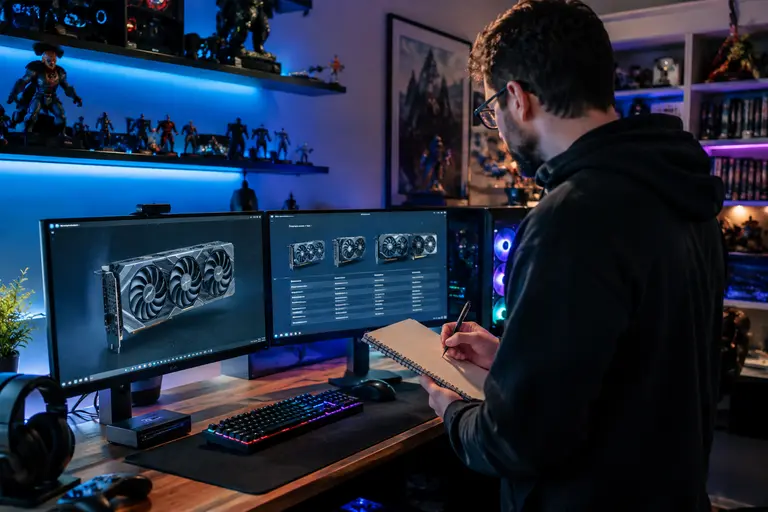
Set A Display Target First
The cleanest way to avoid overbuying is to start with the monitor. A 1080p esports-focused system does not need the same GPU class as a 1440p high-refresh build or a 4K setup. No buyer should expect a card to deliver guaranteed performance across every game and setting, but the display target still sets the rough tier.
For 1080p, the question is whether the buyer can accept lower graphics settings in demanding games to keep the build balanced. For 1440p, VRAM capacity and card longevity become harder to ignore. For 4K, the graphics card budget can dominate the entire PC, especially if newer high-end models remain above MSRP. This is why GPU price trends now affect monitor choice as much as graphics-card choice.
Protect Platform Parts
I would avoid sacrificing the parts that make the system stable and livable. A known-good power supply, an airflow-friendly case, enough storage, and a motherboard with the needed I/O can outlast the first GPU. If the graphics card market is still uncomfortable, building a strong platform around an existing GPU can be more rational than forcing an overpriced card into a compromised rig.
The other review step is timing. Buying sooner can reduce exposure to later increases, but panic buying is still a poor plan. A builder should set a maximum fair price for the target GPU, choose one fallback card, and decide which features are non-negotiable. If the store price crosses that ceiling, wait or change the build rather than chasing a bad listing.
GPU Price Trends And DIY Builds In 2026
GPU price trends in 2026 have made DIY PC building less predictable, not impossible. The August 2026 data showed that RTX 50-series median pricing could move sharply in only two months, while GPU Drip’s MSRP tracking showed that above-MSRP pricing was not confined to one card. For buyers, that changes the review process: price behavior now has to sit beside performance, thermals, noise, features, warranty, and platform fit.
The practical answer is to build with more discipline. Start with the games and display, then pick a GPU tier, then protect the support parts that keep the machine useful for years. If a card is too far above MSRP, do not pretend the launch review still reflects the deal in front of you. If a prebuilt is cheaper, check every component before treating it as better value. If a used card looks tempting, price the risk as well as the savings.
DIY gaming PCs are still worth building for players who want control over parts and upgrade paths. The change is that the graphics card can no longer be treated as a fixed line item. In late 2026, a good build review starts with the shelf price, not the launch slide.