
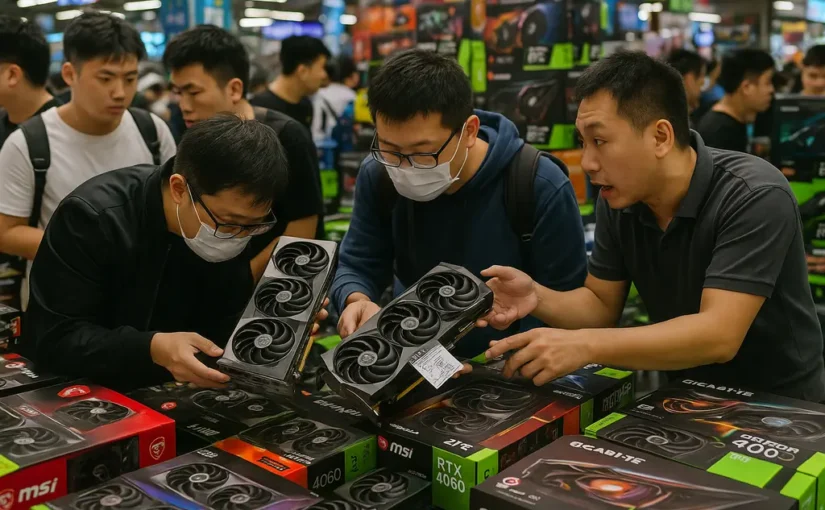
GPU Price Hikes in China are no longer a local retail problem. The latest reports point to a chain reaction that touches U.S. RTX 50-series pricing, older entry-level cards, VRAM costs, and the timing of full gaming PC builds. In July 2026, TechSpot reported that MSI increased the RTX 5080 Shadow 3X OC in China from 9,999 yuan to 11,999 yuan, a 20% jump, while some retailers were stockpiling graphics cards in expectation of more increases TechSpot report. That is the kind of regional movement PC buyers should watch, because graphics-card supply does not stay neatly inside one country.
The pressure is showing up in the U.S. too. Tom’s Hardware reported in August 2026 that GeForce RTX 50-series GPUs had median price increases of up to 39% in U.S. listings, with the RTX 5070 rising 36% to $899.99 and the RTX 5060 up 27% at the median of Newegg listings Tom’s Hardware pricing analysis. Those figures do not guarantee the next shelf price at every retailer, but they show why gamers should treat graphics-card pricing as a moving target rather than a fixed MSRP story.
Why GPU Price Hikes In China Matter
China Is A Major Signal For Retail Supply
China is a key graphics-card market, but the bigger issue is its role as a pricing signal. If board partners and retailers in one large region adjust prices sharply, buyers in other regions often start seeing related pressure through inventory replacement, distributor pricing, and retailer expectations. A card already sitting in a warehouse may not move immediately. The next shipment can be a different story.
The China report matters because it did not only describe a premium card moving upward. It also said older models were being pulled into the same pattern, with the RTX 3050 climbing above $350 in China and the GT 1030 approaching $100. That is uncomfortable for budget builders because older low-end cards normally act as the cheap escape route when current-generation GPUs get expensive. If those cards rise too, the fallback plan weakens.
GPU Price Hikes And Retailer Behavior
Retailer stockpiling changes the feel of the market. If shops hold inventory because they expect higher prices later, visible supply can tighten even before demand from gamers increases. That can make a price jump feel sudden at the consumer level, even if the pressure was building earlier through memory contracts, distributor costs, and board-partner pricing.
For players, the practical risk is buying under panic. A listing that looks scarce may be genuinely limited, or it may be part of a short retail cycle before a new batch arrives. The safer move is to track the same model across several reputable retailers, compare it against nearby alternatives, and avoid treating one expensive listing as proof that every card in that tier is now worth the premium.
How GPU Price Hikes Reach U.S. Buyers
Median Pricing Can Move Before Every Model Does
The U.S. numbers reported for RTX 50-series cards are useful because they look at median listing behavior rather than one headline model. Median movement can reveal a broader reset in the market, even if a few cards still appear near expected pricing. That is where shoppers get caught: the deal card sells out, the next cheapest option is far higher, and the practical buying price shifts.
This does not mean every RTX 50 card is equally poor value, or that every retailer is moving in lockstep. Availability changes daily, and board-partner designs vary by cooler, factory overclock, warranty terms, and power design. It does mean a buyer should check the real cart price, shipping, tax, return window, and model quality before deciding whether a listing is acceptable.
AI Demand Adds Another Layer
The research links part of the pressure to AI-related hardware demand and rising memory costs. For gaming buyers, that matters because the same broad component supply can affect graphics cards, system RAM, SSDs, and prebuilts. A gamer may not be buying AI hardware, but they can still feel the pricing pressure when memory and GPU supply get tighter.
That wider cost pressure is why a GPU-only budget can become misleading. If the graphics card eats more of the build, a buyer may cut the power supply, case airflow, cooler, or storage. That can create a worse gaming PC even if the GPU itself is technically faster. Our related coverage of gaming hardware prices looks at the same budget squeeze from the wider setup angle.
What This Means For Gaming PC Builds
1080p Buyers Still Have Room To Be Patient
A 1080p player has more flexibility than a 4K player. If the target is competitive games, medium settings, or an older monitor, the right move may be to delay a GPU purchase and keep using an existing card. Price pressure on entry-level models is annoying, but it does not automatically make a higher-tier card sensible. Paying too much to solve a temporary shortage can be worse than lowering settings for a few months.
Older GPUs rising in China are still worth watching, though. The RTX 3050 and GT 1030 examples show that the low end is not immune. If a budget builder sees the cheapest new cards drifting upward, used cards, local deals, and prebuilts may deserve a closer look. The key is avoiding unsupported performance assumptions. Check reputable reviews for the exact model class before buying, especially with older cards.
1440p And 4K Buyers Face Harder Trade-Offs
High-refresh 1440p and 4K players sit closer to the pricing pain. These buyers need more GPU headroom, and they are more exposed to VRAM cost pressure. Dropping one tier can mean giving up settings, ray-tracing comfort, or long-term headroom. Staying in the target tier may mean spending more than planned.
That is where a full-system view helps. If a player already owns a strong CPU, good PSU, and suitable monitor, buying the right graphics card at a fair price can still make sense. If the whole PC needs replacing, the smarter move may be to protect platform quality first. A stable case, reliable power supply, and enough storage can last across more than one GPU cycle.
How To Shop Without Chasing Bad Deals

Set A Price Ceiling Before Opening Retail Tabs
GPU Price Hikes create pressure because they make yesterday’s bad price look normal by tomorrow. That is exactly why buyers should set a ceiling before shopping. Pick the maximum price that makes sense for the target tier, then decide the fallback: a lower card, a used option, a prebuilt, or waiting. Without that ceiling, every short-term spike can feel like a warning to buy now.
Do not compare only against launch pricing if the market has clearly moved, but do not accept any listing just because supply is tight. Compare cards by real use case: 1080p esports, 1440p single-player, streaming, creator apps, or compact builds. A factory-overclocked model with a premium cooler might not be worth much extra if the buyer’s case airflow, monitor, or game library does not need it.
Watch Memory Prices, Not Just GPU Names
The research points to rising GDDR6 and GDDR7 costs as a core driver of pricing pressure. That means buyers should watch VRAM capacity and memory-related news alongside GPU model names. A cheaper card with too little memory can age badly for some players, while an overpriced high-VRAM card can still be poor value if it forces cuts elsewhere.
For more on gaming culture within the same network, visit Mostplays, which covers engaging community topics relevant to gamers. For PC hardware shoppers, the immediate task is more specific: decide what the GPU has to do, then refuse to let price pressure turn a sensible build into an unbalanced one.
China Graphics Card Prices And The Next Upgrade Window
The link between China graphics card prices and global market trends is not a perfect one-to-one exchange-rate story. It is a supply, memory, and inventory story. A 20% rise on a specific RTX 5080 model in China does not mean the same card will rise by the same amount everywhere. Still, the U.S. RTX 50 median-price increases show that the pressure has already crossed borders in visible ways.
GPU Price Hikes should push gamers to plan harder, not panic faster. If the current card still handles the games and monitor in use, waiting may be reasonable. If an upgrade is needed now, shop by real retailer pricing, exact model quality, warranty support, and the total build budget. The global graphics-card market is tense, but a clear ceiling and a balanced parts list still beat chasing the first expensive listing that appears in stock.