
Alienware’s AW2726DM is the kind of gaming monitor that changes a parts-list conversation before a GPU benchmark does. A 27-inch QD-OLED display with 2560×1440 resolution, 240Hz refresh, Adaptive-Sync, HDR10, 0.03ms response time, and a $349.99 price tag would have sounded unrealistic only a short time ago. Yet Dell is selling the Alienware 27 240Hz QD-OLED Gaming Monitor AW2726DM in the United States at that price, and recent reviews from Wired and Tom’s Hardware have framed it as one of the clearest signs that OLED gaming monitors are no longer locked inside premium-only setups. Dell’s W2726DM product page lists the monitor as a 27-inch 240Hz QD-OLED model, while Tom’s Hardware called it a “price breakthrough for desktop OLED.”
That matters for Cooler Master Gaming readers because a budget setup is no longer only about buying the cheapest GPU that can hit 1080p. The smarter 2026 build question is whether a monitor upgrade can make a midrange PC feel better before the player spends another $600 or $800 on a graphics card. The same logic shaped Cooler Master Gaming’s recent AMD Radeon price hike analysis, where GPU timing became harder because memory costs and component pricing were pushing gamers to rethink the whole build instead of one part.
Why A $350 OLED Monitor Changes The Budget Build Conversation
The AW2726DM matters because price changes category behavior. OLED monitors were once treated as aspirational desk hardware: stunning contrast, fast pixel response, deep blacks, and strong color, but priced far above what many midrange PC gamers could justify. Alienware helped push OLED gaming monitors into the mainstream imagination with the AW3423DW, but Wired noted that Alienware’s earlier major OLED gaming monitor launched at $1,400, or about $1,550 after inflation. Three years later, the AW2726DM brings a 27-inch QD-OLED gaming panel to $350. Wired’s AW2726DM review makes the price shift clear: the monitor is not trying to be the most advanced OLED on the market, but it makes the core OLED experience reachable for far more players.
That price point changes upgrade math. A gamer with a capable 1440p GPU may see a bigger visual improvement from moving to QD-OLED than from buying a slightly faster graphics card. Better black levels, near-instant pixel response, strong contrast, and smoother motion can make familiar games look and feel sharper without forcing a full system rebuild.
It also creates a new kind of budget setup. A “budget” gaming desk in 2026 can include a premium display technology if the rest of the build is balanced. That does not mean every player should buy this monitor. It means OLED has entered the decision set for gamers who previously would have defaulted to IPS or VA panels without thinking.
What Alienware Had To Cut To Hit The Price

The AW2726DM’s low price comes with compromises, and those tradeoffs are what make the monitor interesting rather than magical. Tom’s Hardware lists the monitor as a 27-inch QD-OLED with 2560×1440 resolution, 240Hz refresh, 10-bit color, HDR10, 200-nit SDR brightness, 400-nit HDR brightness, one DisplayPort 1.4 input with DSC, two HDMI 2.1 inputs, a 3.5mm headphone output, no USB ports, and no internal speakers. The review praised its low input lag, motion performance, build quality, three-year burn-in warranty, and value, while noting lower brightness than pricier OLED competitors and the absence of an sRGB mode. Tom’s Hardware’s AW2726DM review shows that the discount is not just a sale gimmick; it is a focused feature trade.
That is a smart compromise for many gamers. USB hubs, internal speakers, and extra lighting are nice, but they do not decide whether a competitive shooter feels responsive or a dark single-player game looks rich. Alienware appears to have protected the parts that matter most for gaming: panel type, refresh rate, motion clarity, adaptive sync, and OLED contrast.
The harder cuts are brightness, text clarity, and connectivity. Wired reported that the monitor appears to use an older QD-OLED panel with a triangle subpixel layout, which can create color fringing around small text. It also noted that 1440p at 27 inches gives about 110 pixels per inch, lower than a 27-inch 4K panel. That makes the AW2726DM better as a gaming-first monitor than as a perfect productivity screen for small-text work.
| AW2726DM Area | What Buyers Get | Practical Tradeoff |
|---|---|---|
| Panel | 27-inch QD-OLED | Older-style subpixel layout can affect small text |
| Resolution | 2560×1440 | Easier to drive than 4K, less sharp for desktop text |
| Refresh Rate | 240Hz | Fast enough for most players, below 360Hz and 500Hz OLED options |
| Price | $349.99 class | Fewer extras than premium OLED monitors |
| Brightness | 200 nits SDR / 400 nits HDR listed by Tom’s Hardware | Not ideal for very bright rooms |
| Ports | DisplayPort 1.4 with DSC, HDMI inputs, headphone jack | No USB hub or speakers |
Why 1440p Is The Right Budget OLED Target
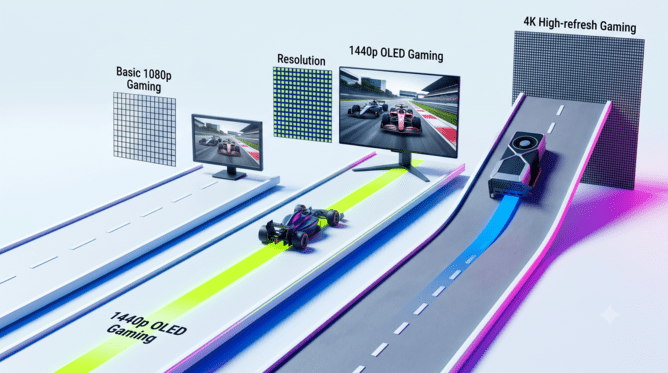
Alienware’s 1440p choice is one of the reasons the AW2726DM makes sense. A cheaper 4K OLED sounds attractive, but 4K gaming is still expensive once the GPU is included. Midrange cards can push 1440p more comfortably, and 240Hz gives competitive players a meaningful ceiling without demanding the extreme GPU power needed for high-refresh 4K.
Wired made the same point in practical terms: increasing render resolution from 1440p to 4K creates a large performance penalty, and midrange GPUs struggle with demanding games at 4K. That turns 1440p from a compromise into a smart budget-build target. A player can buy a cheaper OLED monitor, avoid the GPU burden of 4K, and still get a major visual upgrade over many older IPS or VA displays.
This is especially relevant in 2026 because GPU prices remain uneven. If Radeon and GeForce cards are under memory-cost pressure, every extra pixel matters. A 1440p OLED lets players spend less on the graphics card while still getting premium contrast and motion clarity. That is the kind of balanced budget builders need.
It also suits the current mainstream PC gaming center. Many gamers are still playing at 1080p or 1440p rather than 4K. The AW2726DM gives those players a path to better image quality without forcing a complete platform shift.
Why OLED Motion Still Matters More Than The Refresh Race
The AW2726DM is not a 360Hz or 500Hz display. That could look like a weakness in a market where monitor makers keep pushing higher refresh rates. Yet OLED response behavior changes the comparison. A 240Hz OLED can feel cleaner than many faster LCD panels because pixel response is so quick.
Tom’s Hardware reported that the AW2726DM delivered very low input lag and “perfect motion resolution” over 200fps, with gaming performance that felt on par with more expensive OLED displays. The review argued that players will not necessarily see a major practical improvement from 360Hz or 500Hz monitors compared with this 240Hz model, especially if the rest of the system cannot drive those frame rates consistently.
That is a key point for budget setups. A monitor spec only matters if the PC can feed it. A 500Hz panel paired with a midrange GPU may sit underused in many games. A 240Hz 1440p OLED is still demanding, but it is a more realistic target for esports titles, older games, optimized competitive shooters, and lighter multiplayer games.
For many players, the better upgrade is not a headline refresh number. It is clearer motion, stronger contrast, and a resolution that their GPU can actually sustain.
Where The AW2726DM Still Feels Budget
The AW2726DM should not be treated as a perfect OLED monitor that somehow costs half as much as its rivals. RTINGS describes it as an entry-level 1440p, 240Hz QD-OLED gaming monitor that offers the basics for gaming, including VRR support and sharp motion, but lacks some higher-end features. RTINGS also notes that competing low-cost OLEDs such as the LG 27GX704A-B and HyperX OMEN OLED 27q offer advantages in areas such as brightness, HDMI bandwidth, or color accuracy depending on the model. RTINGS’ AW2726DM review makes the buying position clear: this is a budget-friendly OLED, not a fully loaded flagship.
That distinction matters. A player who works in bright rooms, edits color-sensitive content, wants a USB hub, relies heavily on HDMI 2.1 bandwidth, or spends long hours reading small text may be happier spending more. A player who wants deep blacks, fast motion, strong gaming contrast, and a low entry price may find the AW2726DM much harder to dismiss.
The brightness limitation is the most obvious daily-use issue. Tom’s Hardware found the monitor was bright enough in a moderately bright office after setup, but it still measured lower than pricier competitors. Wired also pointed to the panel choice as part of the price story. Those are fair trade-offs at $350, but buyers should match the monitor to the room.
The safe reading is this: Alienware did not make every OLED monitor cheaper. It made one gaming-focused OLED cheap enough to force everyone else to respond.
How A $350 OLED Changes Upgrade Timing
The AW2726DM arrives at a time when PC gamers are already being asked to rethink upgrade order. RAM prices, SSD costs, GDDR7 pricing, and GPU increases have made the graphics-card-first approach less reliable. A $350 QD-OLED gives buyers a different path: improve the visible gaming experience now, then wait for GPU pricing to settle.
That can be a strong strategy for players with GPUs that already handle 1440p reasonably well. Someone with an RTX 3060 Ti, RTX 4060 Ti, RTX 4070, RX 6700 XT, RX 7700 XT, RX 7800 XT, or similar class of hardware may not need a new graphics card before seeing a huge desk upgrade. The monitor could make the system feel newer without changing the tower.
The strategy is weaker for players still limited by older 1080p-class GPUs. A 1440p 240Hz OLED needs enough graphics power to make sense. A buyer moving from a very old card may need to prioritize the GPU first or accept lower settings while saving for the next upgrade.
That is why the AW2726DM is not a universal answer. It is a timing tool. It gives midrange PC gamers a way to upgrade the experience during a messy component market.
Why Monitor Pricing Could Pressure The Rest Of The Gaming Desk
A $350 QD-OLED also puts pressure on other desk upgrades. If OLED is now reachable, gamers may be less willing to spend $250 or $300 on ordinary 1440p LCD monitors unless those displays bring size, brightness, mini-LED backlighting, productivity features, or strong console support. Budget monitor brands now have to explain why their panels are still worth buying at nearly the same price.
This could reshape gaming desk planning. A player may spend $350 on the AW2726DM, keep the current GPU, and put the remaining budget into a better chair, keyboard, headset, cooling upgrade, or storage expansion. That is a different path from the old monitor market, where premium displays were so expensive that budget players barely considered them.
It also makes the PC case and cooling conversation more practical. Once the display target becomes 1440p OLED, the system has to run quietly enough to match the premium desk feel. A loud, hot PC under a beautiful OLED display creates a mismatch. Better airflow, fan tuning, and cable management still matter, even when the monitor is the headline upgrade.
What Buyers Should Check Before Buying The AW2726DM
The AW2726DM’s value is strong, but buyers should ask a few clear questions before treating it as the obvious choice.
Room brightness comes first. OLED contrast looks best when the room is controlled. A very bright room can weaken the experience, especially with a monitor that is not among the brightest OLEDs. Desktop use comes next. If the monitor will serve as an all-day work display with spreadsheets, small text, coding, and static windows, text clarity and OLED care routines become more important.
GPU target also matters. A 1440p 240Hz monitor is a great match for competitive games and midrange-to-upper-midrange PCs, but the full refresh rate is not realistic in every demanding AAA game. That is fine if the buyer understands the target. OLED motion and contrast remain useful below 240fps, but the purchase makes the most sense when the PC can regularly push strong frame rates.
The warranty should also be part of the decision. Tom’s Hardware praised the AW2726DM’s three-year burn-in warranty, which helps reduce one of the biggest concerns first-time OLED buyers have. Buyers should still follow normal OLED care: use sleep settings, avoid unnecessary static elements, keep firmware updated, and let panel-refresh features work as intended.
Why Budget OLED Is Now A Real Gaming Setup Category
The AW2726DM’s biggest impact may be psychological. It tells PC gamers that OLED is no longer only for flagship builds, $1,000 monitors, and enthusiast desk photos. A $350 Alienware QD-OLED monitor makes the technology part of practical build planning.
That does not mean cheap OLED has no compromises. The AW2726DM gives up brightness, some connectivity, small-text sharpness, and premium extras. It is still strongest as a gaming-first display. Yet that is exactly why it fits budget setups. It spends the money where players feel it most: contrast, motion, refresh rate, and 1440p gaming balance.
For PC gamers, the lesson is simple. A better setup is not always built by chasing the next GPU. Sometimes the smartest upgrade is the screen that shows what the current PC can already do. Alienware’s AW2726DM makes that argument more convincing than most monitor launches this year, and it may force the rest of the budget monitor market to move faster.