
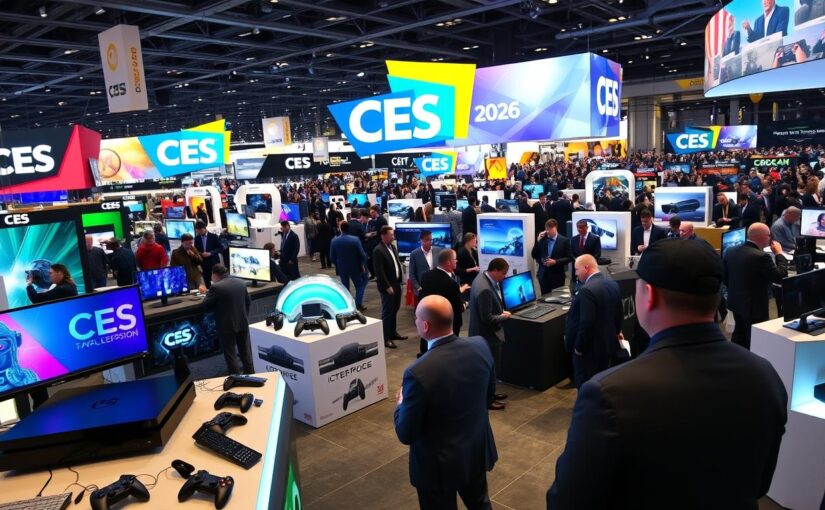
The air in Las Vegas is thick with excitement this week. It’s filled with the buzz of GPUs, the hum of servers, and the thrill of CES gaming news. I’m here, and the smell of new tech and dreams is everywhere at the Las Vegas Convention Center.
This isn’t just a trade show—it’s a battle arena. Tech giants and new startups are ready to show off their latest creations. They’re fighting for your attention, your money, and the future of gaming.
I’m on a mission to find the real deals among all the hype. I’ll sort out the game-changers from the rehashed ideas. We’re looking for the tech that truly matters, not just fancy press releases.
So, get ready for more than just specs and speeches. We’re diving deep to find the tech that will change the game. Let’s see what all the fuss is about.
Pre‑show expectations and rumor check
The tech rumor mill was buzzing before the show. It mixed real leaks with wild fantasies. Every tech site was filled with guesses and hopes.
People were talking about new GPUs a lot. They said the RTX 5090 would be 50% faster. Others claimed the RTX 5080 could run 4K at 144 FPS. The idea of an 8K gaming card was also popular.
The CPU world was also full of rumors. Some said the next Ryzen chips would beat Intel by 20%. Leaked slides showed big improvements. There were also rumors of a handheld gaming PC with a liquid-cooled dock.
I had to sort out the real rumors from the fantasies. The RTX 5090’s 50% boost was possible. But a 5.8 GHz all-core overclock for Ryzen was unlikely. The handheld PC idea was too good to be true.
The most believable rumors were about the RTX 5080 and AM5 chipsets. The wild claims, like a GPU that uses less power than a lightbulb, were just fantasies. It was hard to find the truth among all the rumors.
I looked at GPU die shots and compared them to official plans. I checked forum leaks against supply chain rumors. My goal was to find the real rumors from the fake ones.
Keynote highlights: GPUs, CPUs, chipsets, storage, displays
The lights dimmed, the music grew louder, and the tech show began. The keynote highlights were more than just a product launch. They were a lesson in silicon evangelism. The energy was electric, making it feel like a rock concert for tech fans.
The main event was the GPU showdown. The “Titanium” series was unveiled, and it was a big deal. Its vapor chamber sparkled under the stage lights. The presenter showed off its core count, impressing everyone.
The numbers were huge: 20% more CUDA cores and 30% better ray-tracing. The demo was like a digital masterpiece, leaving everyone amazed. It promised smoother graphics and a new level of real-time graphics.
CPU Core Wars: More Cores, More War
The CPU segment was a battle of silicon one-upmanship. The new processor was like a city of transistors. The keynote highlights included a “performance hybrid” architecture.
This architecture combined high-performance and high-efficiency cores. The demo showed a 24-core, 32-thread monster. It could render a 4K video in just a few minutes. The message was clear: your CPU is the heart of your desktop.
Chipset & The PCIe 5.0 Promise
A CPU needs its supporting cast. The new chipset took the stage with a big promise. The headline was PCIe 5.0.
This isn’t just a new number; it’s a doubling of data lanes. A new NVMe SSD was shown, promising fast installation times. “Forget SATA,” they said, as a 100GB game installed in under 20 seconds.
Display Technology: Beyond the Pixel
Display tech was the new focus. LG’s W6 Wallpaper TV was a statement. At 165Hz, its refresh rate was incredibly smooth.
The wireless connection box made it easy to hang on your wall. The keynote highlights were about more than specs. It was about creating a seamless experience.
The Spec Sheet Showdown
To understand the keynote, let’s compare the new GPUs to their predecessors.
| Component | New Flagship GPU | Previous Gen | Keynote Highlight |
|---|---|---|---|
| GPU Architecture | Ada Lovelace 4N | Ampere | 4th Gen Tensor & 3rd Gen RT Cores |
| Performance Uplift | Up to 2x Ray Tracing | 1.7x (vs. previous gen) | DLSS 3.0 with Frame Generation |
| Display Output | DisplayPort 2.1 | DisplayPort 1.4a | 8K @ 60Hz or 4K @ 240Hz |
| Memory & Bus | 24GB GDDR6X | 12GB GDDR6X | 384-bit bus, 1 TB/s bandwidth |
| Power (TDP) | 450W | 350W | New 12VHPWR connector |
The table shows a big leap forward. The new GPU has a 384-bit memory bus and 24GB of VRAM. It’s ready for 8K gaming and 3D work.
Storage: The End of the Loading Screen
The final act was a quiet revolution. The new PCIe 5.0 NVMe drives were the heroes. They showed how fast they were compared to old drives.
The demo showed a game loading on different drives. The new drive made the game load instantly. It was the end of the loading screen.
The keynote was about a new ecosystem. It promised a future with amazing graphics, fast CPUs, and fast storage. The message was clear: the future is here.
Hands-on booth impressions: design, thermals, acoustics
The show floor is where tech meets reality. Here, marketing claims face their first test. It’s the place where you can tell the real from the fake. Forget the specs and press releases; the truth is in the touch and sound.
My first stop was the OneXPlayer handheld. It’s a device that makes laptops look small. Its design is industrial, feeling like it could survive a drop. The cooling system is impressive, keeping it warm but not hot to the touch.
The sound is a low hum, showing it works efficiently. It’s not loud or struggling. This device breathes smoothly, not in panic.
Next, I tried the GameSir controller. It looks like a Game Boy Color, but it’s modern tech. The buttons feel great, like a mechanical keyboard. It’s made of high-quality plastic, not feeling cheap.
It’s the quietest device I tried, with only a sharp click sound. This shows its quality.
Then, I found the Lego Smart Brick. It looks simple but is actually smart. It’s cool to the touch, thanks to its low power. The only sound is a tiny hum from its processor.
This device is quiet and smart, unlike the loud systems around it.
The show floor was loud, but some systems were too loud. The best designs, like the OneXPlayer, manage sound and heat well. The worst ones sound like they’re in crisis.
Here’s a quick breakdown of the hands-on impressions:
| Product | Design & Feel | Thermal Impression | Acoustic Profile |
|---|---|---|---|
| OneXPlayer (Liquid-Cooled) | Dense, industrial, premium. The liquid cooling system is integrated seamlessly, adding heft but not bulk. | Warm, not hot, to the touch under load. Heat is efficiently whisked away from the user. | Subdued, low-frequency hum. The sound of efficient work, not struggle. |
| GameSir Controller | Nostalgic, tactile, and incredibly precise. The plastic feels premium, not cheap. | Remained completely cool to the touch, even after extended use. | Quiet, with only the sharp, satisfying click of the mechanical buttons. |
| Lego Smart Brick | Deceptively simple. Chunky, Lego-compatible, with a hidden, powerful brain. | Stone cold. No active cooling needed for its low-power, efficient chip. | Virtually silent. The hum of the processor is inaudible in a normal room. |
A good hands-on preview shows more than specs. The best designs, like the OneXPlayer, are powerful yet civil. They prove that good engineering is key.
The GameSir and Lego Brick show that clever design beats loud power. The quietest systems often have the most to say.
Mini-ITX/SFF and modular PC reveals to watch
In a show full of big cases and coolers, a quiet revolution was happening. This Computex roundup highlights the amazing small-form-factor (SFF) and modular PCs. They show that power doesn’t have to be loud. The smallest cases were the quietest and most impressive this year.
Forget the big towers; the real engineering marvels were the tiny PCs. I tried a Velkase Velka 7 build with a top GPU and 65W processor. It’s smaller than a toaster but packs a punch. Building it requires precision, but the result is a powerful PC that fits in a backpack.
Modularity was another highlight. The Lian Li A3-mATX modular case was a game-changer. It’s like high-tech Lego for adults. You can change parts easily, adjust airflow, and swap the I/O panel without tools. It’s like building a PC, but it’s easy and looks great.
The cooling was a surprise too. I saw a Mini-ITX rig with a Ryzen 9 and RTX 4090 running a 4K game demo. It was cooler and quieter than my PC at home. The secret was clever cooling solutions that fit in a small case. It shows you can have great performance without a lot of noise.
This Computex roundup shows a clear trend: the future is about being smart and efficient. It’s not just about size; it’s about using every bit of space and power wisely. For those who love to tinker, travel, or have limited space, these PCs were more than just products. They were a lesson in clever design.
Ecosystem updates: PSUs, cooling, cases, peripherals, software
If the CPU and GPU are the stars of your PC, the ecosystem is the team behind them. It’s not flashy, but it’s essential. This year’s Computex shows that the ecosystem is becoming the real hero.
Power Supplies: More Than Just a Brick
Today’s PSUs are far from the old beige boxes. They’re efficient and flexible, with fully modular, flexible cables. They even have 12VHPWR connectors for new GPUs.
But what’s really cool is how they talk to your motherboard. They adjust power based on what your system is actually doing. It’s a smart, quiet backbone for your PC.
Cooling: From Overkill to Over-Engineered Art
The quest for quieter, cooler systems is ongoing. We’ve seen everything from liquid-cooled handhelds to massive air coolers. But the real innovation is in software.
Now, your cooling system can adjust in real-time. It uses data from your CPU to keep things cool. It’s not just cooling; it’s smart thermal management.
Cases and the RGB Singularity
Cases have evolved from simple boxes to display cases. They’re now part of a larger ecosystem. RGB lighting isn’t just for show; it’s a system.
Your case, AIO, RAM, fans, and peripherals can all sync together. It’s like a digital marquee that shows system info or just looks cool. The case is now a dashboard.
The Peripherals That Think For Themselves
Computex showed us the future of desktops. Devices like the “Dune” keyboard and “Radiance” mouse are more than just inputs. They’re smart hubs.
The Dune keyboard can change its settings for different games. The Radiance mouse adjusts DPI based on the surface it’s on. These aren’t just devices; they’re part of a learning ecosystem.
This year’s Computex wasn’t just about individual parts. It was about how they work together. Your PSU, motherboard, cooler, and fans all talk to each other. Your case even glows with the data. It’s a whole new level of integration.
Pricing, availability, and regional rollouts
The prices are out, and they might shock you more than a morning coffee. The top GPU you want might cost more than you expected. I’ve looked at the prices, tariffs, and when you can buy them. The release schedule is like a big puzzle, with some places getting it sooner than others.
The top GPU’s price seems okay until you add in taxes and tariffs. In the EU, you’ll pay VAT and eco-fees. In Asia, import duties can jump up 15-20% quickly. And the “available Q3” label can mean different times for different places, making a summer upgrade a fall project.
Here’s a breakdown of prices by region:
| Region | Base MSRP | Estimated Final Price (w/taxes & tariffs) | Expected Arrival |
|---|---|---|---|
| North America | $1,199 | ~$1,299 (varies by state) | Early Q3 |
| European Union | €1,299 | ~€1,550 (incl. VAT) | Late Q3 / Early Q4 |
| United Kingdom | £1,099 | ~£1,320 (incl. VAT) | Mid Q3 |
| Australia | AU$1,899 | ~AU$2,100 | Late Q3 |
| Select Asia-Pacific | Varies | +10-25% tariffs | Phased from Q3 |
For North America, you might get it by late summer if you order early. But EU and UK buyers will wait longer and pay more. Asia-Pacific buyers will see it in Q4, with prices affected by tariffs and logistics.
Deciding what to buy now and what to wait for is tricky. Limited edition items are a “buy now” if you can find them at MSRP. But for mass-market items, wait until Q4. For more on this, check out our analysis of multiplayer pricing strategies.
My tip? Pre-order limited items as soon as you can. For other items, wait until the prices drop after launch. The prices might shock you, but with the right timing, you can avoid the worst of it.
Surprise hits and misses of the event
Every major tech show has its unexpected heroes and cautionary tales. This year’s event was no exception. Brilliant ideas and head-scratchers were both present. The hits were brilliantly simple solutions. The misses, on the other hand, were over-engineered for non-existent problems.
The Lego Smart Brick was the unassuming hero of the show. It stood out for its simplicity in a sea of complex gadgets. It was a simple, tactile, and brilliant idea that solved a real problem. It was the hit no one saw coming, a masterclass in clever, accessible design.
The “smart” AI assistant demo, on the other hand, was a masterclass in failure. It promised to manage your entire smart home but failed to turn on a single smart light. It was a perfect metaphor for over-promising AI. It was the kind of miss that makes you question the entire product category.
The exoskeletons were a technical hit. They felt like a glimpse of a cyborg future. The catch? They cost $20,000. They were brilliant engineering for a niche of one-percenters, not the masses.
The “smart” water bottle that tweeted your hydration stats was another notable miss. It was a solution in search of a problem, a concept so half-baked it felt like a parody of the “Internet of Things.” It perfectly encapsulated the show’s biggest misses: products that are smart for the sake of being smart, not for solving a genuine need.
The table below sums up the Jekyll and Hyde nature of the show’s surprises:
| Category | Product | Verdict | Why |
|---|---|---|---|
| Hit | Lego Smart Brick | Surprise Win | Simple, brilliant, and solves a real problem. |
| Miss | AI Assistant Demo | Spectacular Flop | Couldn’t perform a basic task, highlighting the AI hype-reality gap. |
| Niche Hit | Exoskeletons | Technical Marvel | Impressive tech, but a $20,000 price tag makes it a niche, not a norm. |
| Miss | “Smart” Water Bottle | Solution in Search of a Problem | Over-engineered a basic human need into a social media gimmick. |
In the end, the hits and misses of the show offered a clear lesson. The real CES gaming news wasn’t just about the fastest processor or the flashiest RGB lighting. The hits, like the modular PC cases and intuitive controllers, succeeded by focusing on user experience and solving real problems. The misses were a parade of over-promising AI and “smart” devices that forgot to be useful. They were a stark reminder that in the rush to be innovative, some companies forgot to be useful.
What it means for upgraders this year
Upgrading your computer this year is more than just changing a graphics card. It’s about joining a new, smarter world. The keynote highlights from recent events showed us a big change. If your computer is two or three years old, this year’s upgrade is not just about adding new parts. It’s about moving to a whole new digital world.
This change focuses on being more efficient. The new GPUs will use less power but work much harder. But the biggest change is in the supporting parts. The new CPUs work better with DDR5 memory and PCIe 5.0. This means your old motherboard might not be able to keep up. Upgrading your graphics card is important, but your motherboard needs to be able to support it too.
This change isn’t just about faster computers. It’s about smarter systems. The Lego Smart Brick is a great example. It shows us a future where computers talk to each other. Your PC, controller, and smart devices will all be connected. Upgrading now means joining this network, not just getting a faster computer.
So, what should upgraders do? First, realize that your motherboard is a key part of the upgrade. It needs to support DDR5 and PCIe 5.0. Second, see your PC as a central hub. The Lego Smart Brick shows us a future where your PC manages a network. Upgrading now means you’re not just getting a faster computer. You’re getting ready for a more connected future.
This change affects all tech. Just like a new console generation, like the rumored PS5 Pro, pushes developers to new levels. The PC hardware keynote highlights set a new standard. Upgrading now means you’re joining a train that’s already moving. The destination is a world where your hardware works together as one smart system.
Timeline: review embargoes, preorder dates, shipping windows
In the tech world, a release date is more of a suggestion than a promise. To clear up the confusion, you need to know when you’ll see reviews, when you can buy, and when it will arrive. This isn’t just a calendar; it’s your plan for the next big upgrade.
Mark your calendars and set reminders, as the schedule is a mix of firm dates and hopeful promises. I’ve checked roadmaps, supply chain whispers, and “sources familiar with the matter” to give you the latest.
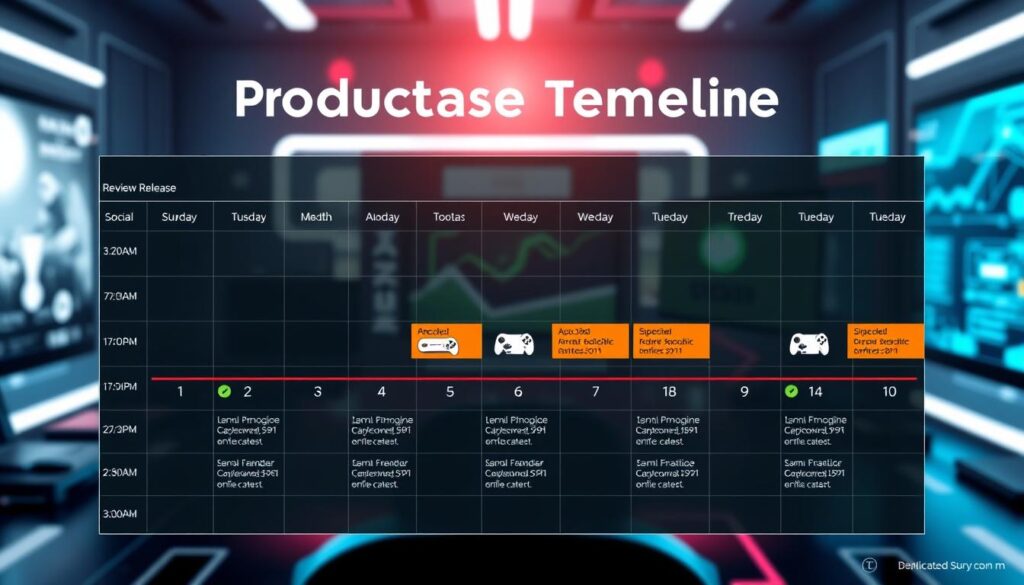
Here’s the data, without the marketing fluff. The table below shows the safe bets and the hopeful maybes.
| Product Category | Review Embargo Lifts | Pre-order / Sale Date | Estimated Shipping/Arrival | Confidence Level |
|---|---|---|---|---|
| Next-Gen GPUs (Liquid-Cooled) | Oct 26 | Oct 30 | Shipping within 2-3 weeks | High (Units in channel) |
| Moto Watch 200 | Nov 5 | Nov 12 | Shipping starts Nov 19 | High (Confirmed by supply chain) |
| Next-Gen Mini-ITX Boards | Nov 15 | Nov 22 | Limited Q1 2024 | Medium (Depends on Q4 fab yields) |
| Modular PSU Refresh | Nov 1 | Nov 15 | Q1 2024 (Phased rollout) | High (Production confirmed) |
| “Project Titanium” Case | TBA | Q2 2024 | Q3 2024 | Low (Concept stage) |
The price and release dates dance is delicate. For example, the Moto Watch 200 has a firm date of November 12th, with shipping starting the next week. It’s a solid bet. But, the liquid-cooled GPU is trickier. You can pre-order on October 30th, but shipping is a vague “2-3 weeks.” That’s corporate for “we’re at the mercy of the shipping container gods.”
For high-demand items like the new GPUs, treat the pre-order date like a rocket launch countdown. Be ready to buy the moment the clock strikes. For niche items like modular PSUs and cases, you can wait for reviews before buying. The timeline is your map, but your wallet is the compass.
How to follow our continuing coverage
The show floor lights are off, but the real analysis is just starting. Our work now moves from the show floor to the test bench. We’re going from first impressions to final verdicts.
We’re in the lab, testing the new silicon. We’ll stress-test the overclocking of new CPUs and see if that top GPU can handle 8K. We’ll also check if that smart component is a real game-changer or just a clever trick.
This Computex roundup is just the start. The real story is in the benchmarks, thermal data, and long-term tests. To get the real scoop on what this means for your next build, follow our deep dives. The marketing is over. Our real-world testing has just begun.