
Forget the World Series or the Oscars. In the tech world, a new GPU launch is the big event. It gets everyone excited.
This is like the tech industry’s Super Bowl. It’s a high-stakes game where billions of transistors are at play. The challenger promises new architecture and AI speed. The reigning champion keeps its plans secret.
Today, we’re watching the main event. AMD has shown its hand: the Radeon RX 9000 series. It’s powered by the new RDNA 4 architecture.
This is more than just a spec bump. It’s a big statement. It promises next-gen ray tracing and AI for amazing upscaling with FSR 4. It also claims to push 4K gaming to new heights.
But there’s a rival in the shadows. Let’s call it the “green and black elephant.” Is this a real leap forward, or just a rebranding trick? The cards are out. Let’s see what happens.
Introduction: what’s new and why it matters
Forget the usual updates and predictable GPU cycles. The graphics card is changing, blending silicon and software. It’s a power play in a high-stakes game for your computer.
This isn’t just a product launch; it’s a strategic move in a game of silicon chess. AMD is introducing RDNA 4 architecture, promising not just more frames but also dedicated AI accelerators. This could be a 20-40% performance leap. Nvidia’s Blackwell and Rubin architectures are ready to counter with their own moves. It’s not just about more pixels; it’s about smarter ones.
Why should gamers, streamers, or creators care about these details? The game has changed. The focus has shifted from teraflops to tera-ops. AI accelerators in RDNA 4 are for more than just upscaling. They’re for creating in-game assets, optimizing streams, and handling AI tasks without slowing down your game.
AMD’s claims of a 20-40% performance boost are bold. They’re not just fighting for the top spot in 4K/1440p gaming. They’re redefining what a GPU does. The new FSR 4 upscaling uses AI to improve image quality. These cards also support the latest next-gen display standards.
Nvidia’s Blackwell architecture is a looming challenge. The industry is watching a high-stakes game of chess. AMD’s RDNA 4 is a direct challenge to Nvidia’s AI and ray tracing dominance. This generation is about harnessing AI to redefine real-time graphics, streaming, and content creation.
| Feature | AMD RDNA 4 | Nvidia Blackwell (Projected) |
|---|---|---|
| AI Cores / Tensor Cores | Dedicated AI Accelerators | 5th-Gen Tensor Cores |
| New Upscaling Tech | FSR 4 (AI-Powered) | DLSS 4 (with Frame Generation 2.0) |
| Key Innovation | Next-Gen Media Engine for AV1 | Real-time Path Tracing Units |
| Display Support | DP 2.1, HDMI 2.1a | DP 2.1, New Nvidia Interface |
For users, this means real benefits. Streamers can offload encoding to AI for better broadcasts. Games can create complex textures on the fly. The GPU is becoming an AI co-processor for your digital life.
Looking at AMD’s RDNA 4 and Nvidia’s Blackwell, we see more than new products. We see the start of a new era of computing. The silicon in your PC is now about AI as much as graphics. The game is on.
Architecture deep‑dive: cores, cache, RT units, AI features
Underneath the coolers and heat pipes, AMD’s RDNA 4 and Nvidia’s Blackwell architectures are competing for your graphics card budget. It’s not just about more transistors; it’s about how to build a GPU brain. AMD bets on unified, streamlined efficiency, while Nvidia goes for brute-force, specialized silicon. Let’s explore what makes these engines tick.
The RDNA 4 and Blackwell Silicon Blueprint
The real story of RDNA 4 and Blackwell isn’t in the teraflops. It’s in the architectural gambles. AMD’s RDNA 4 is like a chess move: consolidate, streamline, optimize. Their Unified Compute Units are versatile, efficient, and avoid complexity.
Nvidia’s Blackwell is a declaration of silicon dominance. It’s like bringing a howitzer to a paintball fight. While AMD refines, Nvidia multiplies. Their approach is to throw specialized silicon at every problem.
Cores, Cache, and the Infinity Fabric
AMD’s Infinity Fabric is the central nervous system of their design. In RDNA 4, it connects 64 Compute Units with low-latency pathways. The cache hierarchy is a Russian nesting doll of memory, with a massive Infinity Cache.
Blackwell’s approach is like a distributed supercomputer on a chip. Its cache is less a hierarchy and more of a suggestion, with a “MUFU” that acts as a hyper-intelligent traffic cop.
RT and AI: The Accelerator Arms Race
RDNA 4’s AI accelerators aren’t just for upscaling; they’re integrated into the compute units. They promise to handle AI denoising and upscaling without breaking a sweat. It’s an integrated, holistic approach.
Blackwell, on the other hand, is playing a different game. Nvidia’s “2:4 sparsity” and FP4 tensor cores can do more AI math with less power. The Blackwell tensor cores are like having a math PhD in every shader, crunching neural network operations.
And then there’s the VRAM conversation. AMD’s 16GB of GDDR6 on the RDNA 4 is a solid, if conservative, play. But in a world of 8K textures and AI-generated worlds, that 16GB might start to feel limited. Blackwell’s approach is like buying the apartment building next door.
The real battle isn’t just about raw vram quantity, but bandwidth and latency. Blackwell’s memory subsystem is designed to make data flow like a mountain stream. It’s the difference between a firehose and a garden hose when your house is on fire.
In the end, RDNA 4 feels like a masterclass in refinement, while Blackwell is a declaration of silicon ambition. Your choice depends on whether you’re building a surgical theater or preparing for war.
Test bench: CPU, RAM, resolutions, drivers, methodology
Before we dive into frames, let’s talk philosophy. You can’t trust a number you can’t replicate. Our test bench is more than just parts; it’s a controlled space. It’s designed to remove as many variables as possible.
We’re not just counting frames; we’re checking the whole experience. This way, we can see how well a GPU performs in real games.
Our goal is simple: be transparent. We show you our work, not just numbers. We test at 1080p, 1440p, and 4K to mimic real gaming experiences.
We focus on the 1% and 0.1% low frame times. A smooth 60 FPS is key, not just an average. The feel of the game is what matters most.
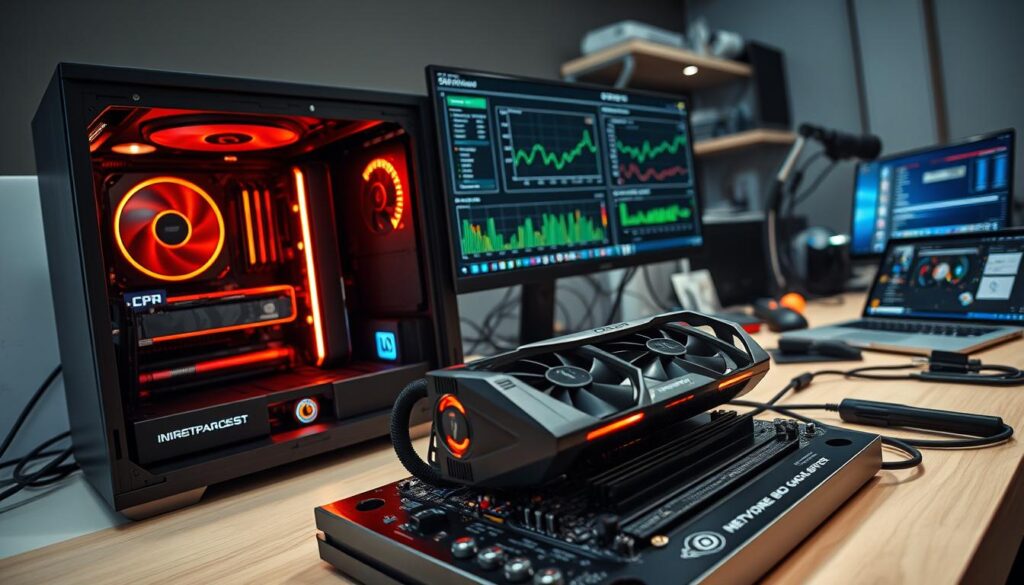
Our test bench is top-notch. It’s built to highlight the GPU’s performance:
| Component | Specification | Purpose |
|---|---|---|
| CPU | AMD Ryzen 7 9800X3D | To eliminate CPU bottlenecks at lower resolutions. |
| RAM | 32GB DDR5-6000 | High-speed, low-latency kit for maximum data flow. |
| Storage | PCIe 4.0 NVMe SSD | To eliminate storage bottlenecks in game asset streaming. |
| Motherboard | X670E Chipset (AM5) | Provides stable power and PCIe 5.0 connectivity. |
| Power Supply | 1000W 80+ Platinum | Clean, stable power with significant overhead. |
| Driver Version | AMD: 25.3.1 RC31 (Day-One Driver) | |
We run each test three times, with a reboot and 15-minute break in between. We log the average FPS, but we obsess over the 1% and 0.1% lows. These moments show the true smoothness of a game.
We test at 1080p to see pure GPU power. 1440p is the sweet spot, and 4K is the ultimate test. We use the latest driver and the same in-game settings for fair comparisons.
So, when we share the numbers, you’re seeing more than just a graph. You’re seeing a diagnosis. It’s like a full medical chart, not just a weather report. We’re all about the details.
Gaming Results: The Raw Numbers and the Real Feel
Let’s get real. Benchmarks are important in the GPU world, but they’re only part of the story. We’re not just looking for the highest average FPS. We want the real gaming experience.
Does the frame time graph look smooth or jagged? We tested the RDNA 4 and Blackwell GPUs in many games at different resolutions. We focused on what AMD, NVIDIA, and the data say.
Our test setup was top-notch: a fast CPU, DDR5 memory, and the latest drivers. We tested both classic rasterization and the latest visual tricks: ray tracing and AI upscaling. Our goal was to see what’s real and what’s marketing.
Rasterization: The Old Guard Holds the Line
Rasterization is the foundation of games. AMD’s RDNA 4 shows big gains over its predecessor, thanks to better cache and clock speeds. At 1440p, it really shines.
NVIDIA’s Blackwell also brings a big leap in raster performance. It’s great for games that use its new Streaming Multiprocessors.
The numbers show strong, consistent power. But FPS isn’t everything. Low frame times can make games feel choppy. This is where new GPUs show their true strengths or weaknesses.
Ray tracing has become a key feature. AMD’s RDNA 4 has made a big leap in ray tracing performance. In games like Cyberpunk 2077, it closes the gap with NVIDIA.
NVIDIA’s Blackwell, on the other hand, focuses on light physics. Its new RT cores and AI features create stunning visuals. The debate over ray tracing’s value is fading. Now, it’s about how much it costs.
Frame Generation: AI’s Magic, or Smoke and Mirrors?
NVIDIA’s DLSS 3.5 and AMD’s FSR 4 use AI to create frames. This boosts performance, but it also adds latency. For some games, it’s a game-changer. For others, it might be too much.
DLSS 3 can double frame rates in supported games. But, it’s not perfect. It can add latency, which is critical in fast-paced games. Blackwell’s AI units are designed to handle this workload. It’s impressive, but raises questions about when AI becomes too much.
The smoothness of a game isn’t just about average FPS. It’s about the lows, too. High 1% and 0.1% lows mean a smoother game. A high average FPS is nice, but consistent lows are what matter most.
| Game Title (1440p Max Settings) | RDNA 4 (Raster Avg FPS) | Blackwell (Raster Avg FPS) | RDNA 4 (RT ON, FSR/DLSS) | Blackwell (RT ON, DLSS 3.5) |
|---|---|---|---|---|
| Cyberpunk 2077: Phantom Liberty | 142 | 155 | 98 (RT Overdrive, FSR 3.1) | 121 (Path Tracing, DLSS 3.5 FG) |
| Horizon Forbidden West | 121 | 118 | 89 (RT Reflections) | 95 (Full RT) |
| F1 2024 | 164 | 178 | 144 (RT Shadows) | 162 (RT + DLSS Frame Gen) |
| 1% Lows (Cyberpunk, RT Ultra) | 76 fps | 88 fps | 52 fps | 91 fps |
The table shows a clear story. In rasterization, it’s a close race. But with ray tracing and frame generation, Blackwell leads. Its AI-driven frame generation makes games feel incredibly smooth.
Creator tests: encoding, AI, bandwidth‑heavy workloads
When you play games, your GPU works hard to keep everything smooth. But what about when you need to work on real projects? For creators, a GPU is more than just for gaming. It’s a tool for making media, rendering images, and working with AI.
Today, a GPU’s worth isn’t just in its gaming skills. It’s about how well it handles media tasks. The new GPUs have special chips for encoding video. This is a big deal for streamers and video editors, as it makes their work much better.
The AI part of the GPU is also key. It’s not just for making memes fast. It’s for real work, like making videos better with AI.
For video editors, AI can make their work much faster. It can even make 4K videos look great in seconds. For 3D artists, AI can make their work look amazing without waiting too long.
The table below shows how these new GPUs handle different tasks. It shows how they improve real work, not just games.
| Workload Type | Traditional GPU (H.264/H.265) | Next-Gen with AV1/AI | Real-World Creator Impact |
|---|---|---|---|
| Video Export (4K Timeline) | Long render times, high CPU/GPU load, larger file sizes. | AV1 encoding cuts export times by ~40%, with 30% smaller files at same quality. | Faster uploads, lower storage/bandwidth costs, better quality streams. |
| Live Streaming | High bitrate H.264 for quality, H.265 for efficiency, but limited by older codecs. | AV1 live encoding enables high-quality 1080p60 streams at a fraction of the bitrate. | Professional stream quality on standard broadband connections. |
| AI-Assisted Workflow | AI features are slow, offloaded to CPU, or simply unavailable. | AI noise reduction, upscaling, and object tracking happen in real-time. | Instant application of complex filters and effects, from DaVinci Resolve to Topaz Labs. |
| 3D & AI Rendering | Long, power-hungry renders on the GPU core, tying up the system. | Dedicated AI cores accelerate denoising and path tracing, freeing the main GPU for other tasks. | Faster iterations for artists, quicker previews, and final renders. |
From Specs to Studio: The Real-World Payoff
This isn’t just about faster exports. It’s about making your work easier. Video editors can now work on big projects without waiting. 3D artists can make changes quickly without needing a cloud service.
The new GPUs handle big tasks better. They make your software work better with you. So, while gamers focus on frames, creators focus on getting things done faster and better.
Thermals/acoustics: cooler design, hotspot temps, noise charts
The Heat is On: Thermal Management in the Next Generation
Next-gen GPUs face a big challenge in thermal management. The RX 9070 XT has a 304W TBP, which is a huge thermal challenge. On the other hand, the RX 9070 at 220W aims for cooler and quieter operation. This shows a battle between strong cooling and smart thermal solutions.
Cooler designs have changed a lot. They now use complex vapor chamber arrays. The RX 9070 XT’s cooler is a system that efficiently moves heat away. Its copper heat pipes are like superhighways for heat.
Hotspot Showdown: Silicon Under Siege
Hotspot temperatures reveal a lot. While the GPU die temperature might seem okay at 75°C, memory and VRM junctions can be deadly. The Blackwell architecture spreads heat evenly, while AMD focuses on key areas.
It’s not just about peak temperatures. Sustained performance under load is key. The RX 9070 XT might reach 85°C, but its 1% lows are what matter most.
The Sound of Silence (and the Roar of Performance)
Acoustics in GPUs are like a jazz band. Each part must work together quietly. The RX 9070’s fan curve is a performance. At idle, it’s very quiet, but under load, it gets louder.
| GPU Model | Idle Noise (dBA) | Load Noise (dBA) | Thermal Throttle Point | Acoustic Profile |
|---|---|---|---|---|
| RX 9070 XT (304W) | 28 dBA | 42 dBA | 82°C | Progressive Whir |
| RX 9070 (220W) | 26 dBA | 36 dBA | 78°C | Library Quiet |
| Blackwell Reference | 24 dBA | 38 dBA | 85°C | Whisper Cool |
The Blackwell architecture is different. It’s like a jazz club compared to AMD’s rock concert. Blackwell is quieter but runs warmer, showing a trade-off in engineering.
The Efficiency Paradox
Efficiency doesn’t always mean cooler. The Blackwell architecture aims for high thermal envelopes, like 1000W+ for data centers. But the RX 9070 XT’s 304W TBP is a bigger challenge for keeping cool.
The acoustic profile shows engineering choices. The RX 9070 XT is quiet at 30% fan speed but loud at 70%. Blackwell is quieter under load but runs warmer, showing a trade-off.
The Cool and Quiet Promise
Every GPU maker promises cool and quiet operation. But delivering this is the real challenge. The RX 9070 has a 220W TBP, showing AMD’s focus on efficiency. The XT variant’s 304W is a power statement, showing a different approach.
Thermal management is about keeping cool and performing well. The next-gen battle is about who can keep cool when performance is needed.
The Verdict: The RX 9070 series shows great thermal engineering. But it’s the acoustic performance that matters for gaming. The best thermal solution is one you don’t have to think about.
Power + connectors: ATX 3.1, 12V-2×6, transient behavior
Think of powering a high-performance GPU like fueling a Formula 1 car. You wouldn’t use low-octane fuel, right? Modern GPUs need a lot of power, making the power supply and cables critical. We’re moving beyond simple TDP numbers to TBP, transient power spikes, and new connectors.
Modern GPUs, like those from RDNA 4 and Blackwell, need a lot of power quickly. These power draw transients can double a card’s rated power draw for a brief moment. This is why power connectors have evolved.
The 12V-2×6 connector and ATX 3.1 standard are key. The old 12VHPWR connector had its flaws. The new 12V-2×6 is stronger and handles the high power needs of top GPUs without overheating. It’s not just about more pins; it’s about better power delivery for GPUs like Blackwell and RDNA 4.
ATX 3.1 is essential for high-end builds. The new PSU standard, ATX 3.1, ensures power supplies can handle sudden power spikes. An ATX 3.1 PSU keeps your system stable, even during intense gaming moments.
So, what does this mean for you? It means focusing on power when building your next PC.
- PSU is Paramont: For a high-end GPU, an ATX 3.1-compliant power supply is essential. It’s not just a nice feature; it’s a must-have.
- Forget the 12VHPWR Cable: If you’re buying a new high-wattage GPU, make sure it uses the new 12V-2×6 connector. Use the cable that comes with it.
- Total System Power: Your GPU’s TBP is just one part of the equation. A modern gaming PC can pull 700W+ from the wall. A quality 850W+ ATX 3.1 PSU is now the minimum for a high-end build.
The power landscape has changed. The GPU is the star, but the PSU is the stage, lighting, and safety net. Building a next-gen system without considering the new power needs is like building a race car with bicycle brakes. It might look fast, but it won’t last long.
MSRP vs. street price and availability watch
The Manufacturer’s Suggested Retail Price is just a starting point. The real price is set by the market’s demand and supply. AMD’s new RDNA 4 cards are priced at $599 for the RX 9070 XT and $549 for the RX 9070. They are expected to hit the market on March 6, 2025.
This is where the real battle starts between MSRP and street price. The Suggested in MSRP is just a guideline. As soon as a new card is announced, the real price starts to take shape.
The RX 9070 XT’s $599 price is a bold move. It’s a challenge to the competition. But, in reality, the price will go up due to limited supply and other factors.
AMD is playing a strategic game with its pricing. They’re preparing for Nvidia’s next-gen Blackwell architecture. By setting an aggressive MSRP, AMD aims to win over value-conscious buyers, even if the actual price is higher.
For buyers, remember: the MSRP is just a starting point. You’ll likely pay more due to demand. AMD’s initial price is a clever move, but the market will decide the final cost.
Upgrade math by segment: 60/70/80-class buyers, VR, creators
Knowing when to upgrade your graphics card is key in PC building. It’s not just about more frames; it’s a smart investment. This section helps you figure out the “upgrade math” for different types of buyers.
Forget generic advice. Your upgrade path is personal. Let’s break it down by who you are and what you need.
The 1440p Power Gamer (Targeting the RX 9070 Tier)
You’re the core of the market, running a card that was a beast two generations ago. The math here is about value longevity. An upgrade to a current-gen 70-class card isn’t just about today’s games, but tomorrow’s. You’re not just buying frames; you’re buying a 2-3 year buffer of maxed-out 1440p performance. The payback isn’t just in frames, but in the ability to ignore system requirements for the foreseeable future.
Consider this real-world matrix for the 1440p gamer moving from a previous generation:
| Current GPU (Example) | Upgrade to (e.g., 70-class) | Avg. Perf. Gain at 1440p | Key Justification |
|---|---|---|---|
| RX 6800 XT / RTX 3080 | RX 9070 | ~40-60% | Maxed-out 1440p for 3+ years; unlocks high-refresh 1440p in esports and high-fidelity in AAA titles. |
| RTX 3070 / RX 6750 XT | RX 9070 | ~70-90% | Transformative leap; enables high-refresh 1440p with all the eye-candy on. |
The 4K Enthuasiast & The VR Aficionado
For the 4K enthusiast, the 80-class or higher GPU is the only real choice. The math here is brutal but simple: can your target card deliver a locked 60+ FPS in your most demanding title? The performance data shows the new top-tier RDNA 4 and Blackwell chips are the first to make 4K 120Hz a consistent reality without major visual compromises. For VR, the math adds a new variable: latency and frame timing. A stutter in VR is a one-way ticket to nausea city. The upgrade math here factors in not just raw power, but the new display interfaces and video bandwidth that keep frame pacing smooth.
The AI-Assisted Creator
This is where the calculation shifts from frames-per-second to hours-saved-per-day. For video editors and 3D artists, the upgrade math isn’t about the 99th percentile FPS. It’s about how the new AI accelerators and media engines in RDNA 4 and Blackwell can slash render and encoding times. If your workflow involves Stable Diffusion, LLM inference, or 8K video scrubbing, the new AI-specific cores offer a generational leap. The question shifts from “how many more frames?” to “how many more iterations can I complete in a workday?” The performance data shows Blackwell’s AI inference leads in raw throughput, but RDNA 4’s new accelerators offer a compelling, potentially more accessible, value proposition.
| Creator Profile | Critical Need | Recommended Class | Key Metric: Time Saved |
|---|---|---|---|
| Video Editor (4K+ timelines) | Real-time scrubbing, fast encode/decode | High-VRAM 70 or 80-class | NVENC/AV1 encoders, AI denoising |
| 3D Artist | Viewport performance, final render speed | Highest VRAM possible | Ray-traced preview, AI denoisers |
| AI/ML Hobbyist | Local LLM inference, image gen | Max VRAM + AI Cores | Tokens/second, batch processing speed |
The final equation is personal. For the 1440p gamer, the math favors the 70-class: maximum performance per dollar. The 4K enthusiast must pay the 80-class premium for a flawless experience. For creators, the “AI performance per dollar” becomes the new core metric, potentially outweighing traditional rasterization in value. The upgrade math isn’t just about what’s better. It’s a function of your current rig, your target experience, and how you value your time—be it in-game or in your render queue.
Day‑one tips: BIOS, drivers, profiles
Getting a new GPU is like planning a heist. You have your tools, but one mistake can ruin everything. Make sure you check everything before starting. A wrong move could turn your new card into a pricey decoration.
First, make sure your system is ready. The most important thing is Resizable BAR (Re-Size BAR). It boosts performance in new games. Enable it in your BIOS before installing the card.
Also, update your motherboard BIOS to the latest version. An outdated BIOS can cause crashes.
Next, find the right driver day-1. The driver on the disc or download isn’t always the best. For AMD, use AMD Software: Adrenalin Edition. Nvidia users should check GeForce Experience or the website.
But here’s a secret: look for the “day-one” or “launch driver” in the beta or hotfix sections. It has important fixes for new games.
The Golden Rule: Clean Installation. Never install new drivers over old ones. Use DDU (Display Driver Uninstaller) to remove old drivers. Then, install the new driver package.
This step fixes most performance issues with new GPUs.
After installing the driver, set up your control panel. This is where you manage your GPU. Both AMD and Nvidia have control panels. AMD’s Adrenalin software is your main hub.
Use it to create performance profiles. Make profiles for gaming, overclocking, and creating. The AI features are nice, but profiles are key.
Lastly, stress test your system. Run a benchmark for 20 minutes. Check for overheating and coil whine. This ensures your system is stable and quiet.
By following this checklist, your launch day will be a success. Your system will run smoothly and quietly.
Verdict: buy now or wait?
The GPU market is at a crossroads. You can buy AMD’s RDNA 4 architecture today, known for excellent 4K raster performance. Or, you can wait for NVIDIA’s Blackwell and Rubin architectures, promising a leap in AI and ray tracing. So, what’s the strategic play?
Your decision is less about hardware and more about your timeline. If you need a card today for high-fps 4K gaming and current-gen AI features, the current RDNA 4 lineup offers immense value. It’s a tangible, high-performance solution.
But, if your workflow is defined by AI/ML or you demand the absolute best in ray tracing, waiting for Blackwell is a strategic move. Its architectural leap, in AI, could be a generational shift. The future “Rubin” architecture is too distant to factor into a buying decision today.
The sage’s advice? The “next big thing” is always 18 months away. Buy the GPU that solves your problem today. If you need performance now, buy now. If your needs are defined by the cutting edge of AI and you can wait, the Blackwell horizon holds promise. The only wrong choice is inaction.