

For decades, the PC gaming industry has operated on a foundational, unquestioned premise: if you want high-performance gaming, you need an x86 processor from Intel or AMD. ARM architecture was reserved for smartphones, tablets, and light-duty laptops where battery life trumped raw computational power. That paradigm is officially shattered. At Computex 2026, NVIDIA, in an unprecedented collaboration with Microsoft and MediaTek, unveiled the RTX Spark superchip. This Arm-based SoC is not just a lightweight productivity processor; it is a dedicated, high-performance powerhouse designed explicitly to challenge the heavyweights of the gaming and AI desktop markets.
By integrating a 20-core Arm CPU with a Blackwell-generation RTX GPU, NVIDIA is bypassing the traditional motherboard layout entirely. The goal is simple but aggressive: deliver desktop-class AI and gaming performance in slim, thermally efficient laptop chassis. If the RTX Spark can deliver on its promises without falling victim to the software compatibility issues that have historically plagued Windows on Arm devices, we may be witnessing the final years of unchallenged x86 supremacy in the PC enthusiast space.
RTX Spark Architecture: Blackwell GPUs, Arm Cores, and Unified Memory
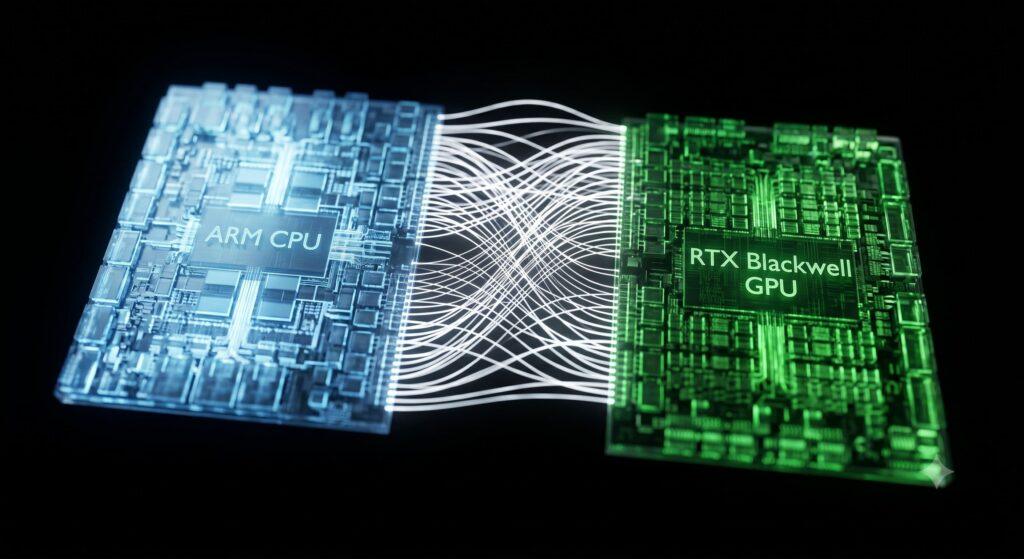
The hardware engineering behind the RTX Spark is nothing short of a massive flex from Santa Clara. Built on TSMC’s 3nm manufacturing node, this SoC merges two distinct chiplets via NVIDIA’s ultra-fast NVLink-C2C interconnect. The compute side is handled by a custom 20-core Arm CPU (featuring 10 Cortex-X925 performance cores and 10 Cortex-A725 efficiency cores) developed in direct partnership with MediaTek. This eliminates the traditional CPU bottleneck by keeping data travel distances incredibly short and highly efficient.
On the graphics front, the Spark is armed with a Blackwell-class RTX GPU packing 6,144 CUDA cores. This effectively gives the SoC the graphical muscle equivalent to a discrete RTX 5070, completely integrated into the primary silicon. But the true game-changer for hardware enthusiasts is the memory architecture. Apple proved the immense value of a shared memory pool with its M-series chips, and NVIDIA is bringing that philosophy to Windows.
The RTX Spark supports up to 128GB of LPDDR5X unified memory, boasting a staggering 273 GB/s of bandwidth. Because the CPU, GPU, and NPU all pull from the exact same massive pool of high-speed memory, data duplication is eliminated. For gamers, this means massive open-world assets load instantly, and texture streaming stutters are essentially eradicated.
| Specification | NVIDIA RTX Spark | AMD Ryzen AI Max+ 395 (Strix Halo) |
| CPU Architecture | 20-Core Custom Arm (MediaTek) | 16-Core Zen 5 (x86) |
| Integrated Graphics | Blackwell RTX (6,144 CUDA Cores) | RDNA 3.5 (40 Compute Units) |
| Max Memory Capacity | 128GB LPDDR5X (Unified) | 128GB (Unified) |
| Target Thermal Design | 45W – 80W | 55W – 120W |
Gaming Capabilities: 1440p Targets, DLSS Support, and Raw Petaflops
When you boil down the spec sheet to actual frames per second, the RTX Spark is designed to handle demanding AAA titles natively at 1440p resolution and over 100 FPS. This isn’t just an upscaling trick; the silicon is rated to deliver up to 1 Petaflop of FP4 compute, giving it more than enough raw overhead to power through unoptimized code. Because it carries the RTX moniker, the Spark platform retains full access to NVIDIA’s elite software suite, including deep-learning super sampling.
The inclusion of DLSS 3.5 and Frame Generation on an Arm-based SoC means these thin-and-light laptops will easily punch above their thermal weight class. You get the battery life benefits of Arm efficiency alongside the AI-driven frame multiplication that has become mandatory for modern 1440p and 4K gaming. For users wondering if they should upgrade their PC components or wait for this new wave of silicon, the sheer graphical density of the Spark makes a compelling argument for holding off until late 2026.
The Software Ecosystem: Emulation Hurdles, Anti-Cheat, and Windows on Arm

Hardware dominance is irrelevant if your Steam library refuses to launch. The graveyard of tech history is littered with Windows on Arm devices that promised the world and delivered driver crashes. NVIDIA understands that its mature software stack—CUDA, TensorRT, OptiX, and Reflex—is its biggest advantage over Qualcomm’s Snapdragon X Elite laptops. By ensuring their proprietary rendering tools are native to the new architecture, they bypass a massive layer of developer friction.
However, gaming on Windows is a notoriously messy ecosystem of legacy spaghetti code. Microsoft has heavily upgraded its Prism emulator for Windows 11, designed to translate x86 instructions to Arm on the fly. While productivity apps handle this translation well, gaming introduces latency and translation overhead that can tank frame rates. Furthermore, competitive gamers face a massive hurdle: kernel-level anti-cheat software.
Games like Valorant, Apex Legends, and Call of Duty rely on aggressive anti-cheat systems that historically panic when encountering an emulation layer. NVIDIA is actively working with major studios to ensure native Arm recompiles for high-profile live service games, but early adopters should expect a transition period. If a game’s anti-cheat doesn’t have a native Arm signature, it simply will not boot, regardless of how many CUDA cores the RTX Spark possesses.
| Software Category | Compatibility Expectation | Performance Impact |
| NVIDIA CUDA/Reflex Tools | 100% Native Support | Zero Impact (Hardware Level) |
| Older x86 AAA Games | Handled via Microsoft Prism | 10% – 15% Translation Overhead |
| Kernel-Level Anti-Cheat | Patch Dependent | Critical Failure if Unpatched |
Market Realities: Fall 2026 Release, System Pricing, and Thermal Constraints

Consumers expecting this massive leap in architecture to be affordable are in for a harsh reality check. As reported by major tech outlets like PCMag in their Computex coverage, the first wave of these ultra-premium laptops will be spearheaded by brands like Dell, ASUS, and Microsoft’s own Surface division. Hitting the shelves this fall, these machines are targeting the extreme high-end of the market.
NVIDIA has hinted that base models featuring the slightly cut-down N1 chip (analogous to an RTX 5050) and 16GB of unified memory will start around $1,800. If you want the fully unlocked N1X chip with 128GB of RAM, you are looking at enterprise-level pricing easily exceeding $3,500. This is compounded by the ongoing 2026 global memory shortage, which is driving up the cost of high-density LPDDR5X modules across the entire industry.
Despite the sticker shock, the thermal efficiency cannot be ignored. The RTX Spark is rated for a 45W to 80W power envelope, meaning we will see desktop-tier gaming performance in laptops measuring just 0.55 inches thick and weighing under three pounds. It might not kill x86 overnight, but for gamers tired of 10-pound laptops with jet-engine fans, NVIDIA’s Arm revolution offers a desperately needed alternative.