
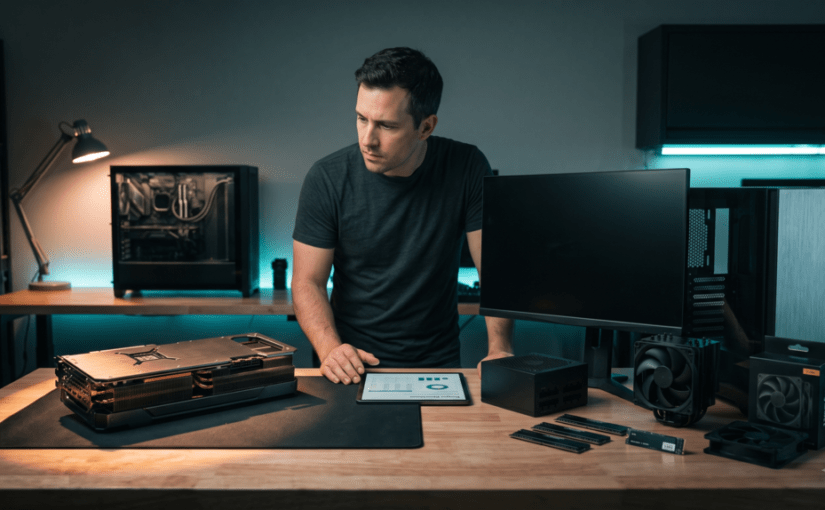
Nvidia’s RTX 50-series price spike is turning 2026 GPU shopping into a full-system budget problem. Tom’s Hardware reported on August 10, 2026, that GeForce RTX 50-series median prices at Newegg had jumped sharply in the United States, with the RTX 5070 up 36% to a $899.99 median price, the RTX 5060 up 27% to $469.99, and the RTX 5060 Ti 16GB up 39% to $804.99. The same report placed the RTX 5090 at an extreme median of $4,699.99, a reminder that the top end has become a reference point more than a realistic gaming upgrade for most buyers. Tom’s Hardware’s RTX 50 price report makes the August 2026 GPU market look less like a normal generation shift and more like a pressure test for every PC gamer trying to build around a fixed budget.
That matters for Cooler Master Gaming readers because GPU prices do not rise in isolation. A graphics-card jump changes the case, power supply, CPU cooler, storage, monitor, and RAM decisions around it. The same setup-first logic shaped Cooler Master Gaming’s recent Alienware AW3426DW ultrawide OLED analysis, where the upgrade question was not whether one component looked impressive, but whether the full desk experience made sense for the money.
Why RTX 50 Pricing Makes 4K Chasing Harder
The RTX 50-series was supposed to define the next high-end gaming PC cycle. Nvidia’s Blackwell consumer generation brought new GPUs, GDDR7 memory, DLSS 4 positioning, and higher expectations for ray tracing, frame generation, creator workloads, and premium displays. The problem is that price movement has shifted the conversation away from raw performance and toward timing.
A gamer looking at an RTX 5070 near a $900 median price is no longer making the same decision as a buyer comparing clean MSRP tiers. That buyer is weighing a GPU against a full 1440p monitor upgrade, a better airflow case, a higher-quality PSU, a 2TB SSD, or 32GB of DDR5 RAM. When the GPU takes too much of the budget, the rest of the build gets weaker.
PC Gamer’s GPU price watch reached a similar practical point in its August 2026 tracking. The outlet said RTX 50-series cards such as the RTX 5060 Ti 16GB, RTX 5070, RTX 5070 Ti, and RTX 5080 had moved up significantly, with the RTX 5090 priced so high that it was mainly useful as a reference point. PC Gamer’s graphics-card price watch reinforces the same lesson: GPU pricing is forcing buyers to compare current retail reality instead of launch-day expectations.
That makes 4K chasing harder. A true 4K gaming build already needs a strong GPU, enough VRAM, a capable CPU, strong cooling, and a display that can show the difference. If the GPU alone consumes too much money, the rest of the setup may fall out of balance. For many players, 1440p becomes the smarter target because it can still look sharp, run at high refresh rates, and leave enough budget for the parts that keep a PC quiet, stable, and useful.
Why 1440p Is Becoming The Safer Performance Target

A balanced 1440p build gives gamers a way out of the price trap. It does not require giving up visual quality. It means choosing a resolution that matches real budgets, current GPU pricing, and the games people actually play. Standard 2560×1440 is easier to drive than 4K, and even ultrawide 3440×1440 can be more practical than full 3840×2160 when the buyer has a capable midrange or upper-midrange GPU.
Steam’s hardware data has repeatedly shown why this matters. Valve’s Steam Hardware & Software Survey still points to a PC gaming audience built around practical hardware rather than flagship setups, with 1080p and 1440p remaining the core display targets for many users. Valve’s Steam Hardware & Software Survey is optional and not a perfect picture of every player, but it remains one of the clearest public snapshots of what Steam users actually run.
The jump from 1080p to 1440p can be substantial. Textures look cleaner, HUDs feel less cramped, and larger monitors become more useful without demanding the same GPU power as 4K. A 1440p high-refresh display can make competitive games feel fast, single-player games look rich, and everyday desktop use feel sharper.
The important part is that 1440p leaves room for balance. A gamer can buy a stronger case, better fans, a more reliable PSU, a bigger SSD, and a quieter CPU cooler instead of spending every spare dollar chasing a card that may still struggle to justify its price.
How The Price Spike Changes The GPU Tier Conversation
The most painful part of the RTX 50 price spike is where it lands. If only the RTX 5090 were overpriced, most buyers could ignore it. The harder problem is that midrange and upper-midrange cards are moving too. The RTX 5060, RTX 5060 Ti 16GB, RTX 5070, and RTX 5070 Ti are exactly the products many gamers would normally compare for a practical 1080p or 1440p build.
Tom’s Hardware’s Newegg median-price data shows why the middle of the market feels strained. The RTX 5060’s reported median at $469.99 makes an entry-level current-gen Nvidia card feel less entry-level. The RTX 5060 Ti 16GB at a reported $804.99 median becomes difficult to justify for many buyers, especially when that money can buy a strong monitor or several core platform parts. The RTX 5070 approaching $900 at the median pushes a card that should interest 1440p gamers into a price zone that starts inviting 4K expectations.
| RTX 50-Series Price Signal | What It Means For Builders | Why 1440p Becomes More Attractive |
|---|---|---|
| RTX 5060 median reportedly near $470 | Entry-level current-gen cards feel less budget-friendly | Buyers may target 1080p high refresh or modest 1440p instead of overbuilding |
| RTX 5060 Ti 16GB reportedly near $805 | VRAM costs and card pricing collide | A full platform upgrade may beat one overpriced GPU |
| RTX 5070 reportedly near $900 | Upper-midrange begins to feel premium | 1440p becomes the realistic target for value |
| RTX 5080 and RTX 5090 remain expensive | 4K builds demand major budget discipline | Many players may delay the flagship chase |
| GPU prices vary by retailer and model | Median price is a warning, not a universal shelf price | Buyers need fallback cards and firm price ceilings |
A buyer should not treat every model as equally bad. Some cards may appear below median pricing through promos, bundles, used listings, open-box deals, or temporary sales. The key point is that the buyer now needs a ceiling. Without a strict price target, it becomes too easy to justify a bad deal because every other option also looks inflated.
Why Memory Pressure Is Still Behind The Build Problem
The RTX 50 price spike fits a larger 2026 component story: memory is expensive, supply is tight, and gaming hardware is competing with AI and data-center demand for parts. Graphics cards depend on VRAM. PCs depend on DDR5 or DDR4 system memory. Game libraries depend on SSDs. Premium monitors and laptops all compete for the same buyer’s budget.
Tom’s Hardware’s report tied the August price movement to Blackwell price hikes hitting the U.S. retail market, and recent GPU coverage has kept pointing back to memory costs as one of the major stress points. That explains why the problem can hit several tiers at once. A better GPU die is only one part of the board. Memory chips, board design, cooler assembly, retail margins, and supply timing all matter.
The memory pressure also makes “wait for the next card” less reliable as advice. Waiting works when supply improves and pricing falls. Waiting becomes risky when new stock arrives at higher board-partner pricing and old inventory disappears. That does not mean gamers should panic-buy. It means they need to plan the whole PC around flexible upgrade paths.
A 1440p build can help because it lowers the pressure on extreme GPU tiers. The buyer can choose a card that fits today’s games, keep enough case and PSU headroom for a future upgrade, and avoid building the entire system around one overpriced moment.
How Monitor Choices Can Save Or Break The Budget
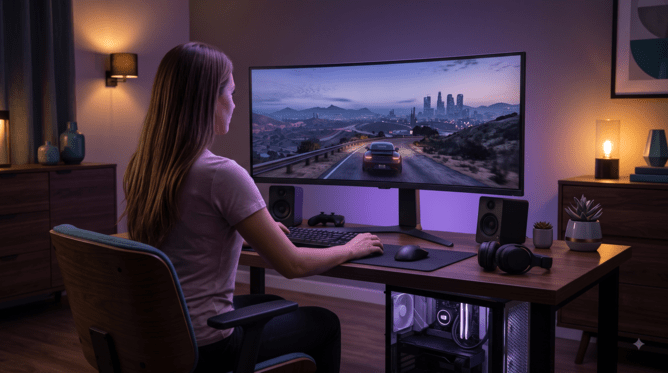
The display is where a balanced 1440p build becomes most visible. A 27-inch 1440p OLED, a fast IPS panel, or a 34-inch 3440×1440 ultrawide can make a system feel premium without requiring flagship GPU spending. This is why monitor pricing has become part of the GPU conversation.
A 4K OLED panel can look stunning, but it pushes the GPU harder. A 1440p OLED panel offers a more forgiving target with deep blacks, fast response, and strong motion clarity. A 3440×1440 ultrawide adds immersion and desktop space, but it still stays below 4K pixel load. That gives buyers multiple ways to improve the experience without automatically moving to the highest GeForce tier.
The Alienware AW3426DW is a good example of how the monitor market is shifting. A 34-inch QD-OLED ultrawide with a 280Hz refresh rate and a more aggressive price than earlier OLED ultrawides changes the upgrade order for some gamers. A player may get more daily satisfaction from the display than from stretching from one overpriced GPU tier to another.
The warning is that the monitor must match the card. A gamer with a lower-tier GPU may be better served by standard 1440p than ultrawide. A player who mostly plays competitive shooters may prefer a 27-inch 1440p high-refresh monitor. A player who enjoys RPGs, racing games, open-world titles, and cinematic single-player games may get more from ultrawide.
Why Cooling And Case Planning Matter More When GPUs Cost More
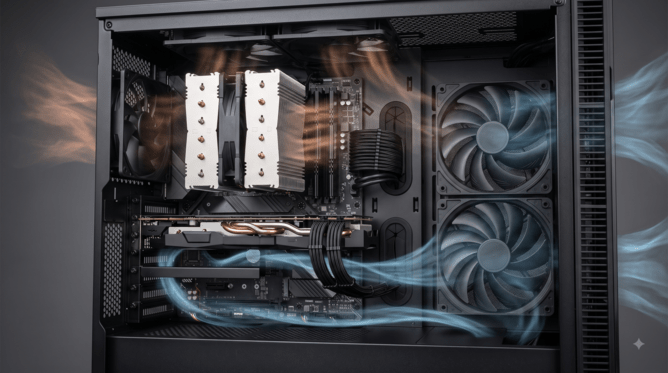
When a GPU costs more, buyers often try to save money elsewhere. That can create the wrong kind of budget build. A weak case, cheap PSU, cramped airflow path, or loud cooler can make an expensive card feel worse than it should. A premium GPU inside a hot, noisy, restrictive system is not a premium setup.
This is where Cooler Master Gaming’s hardware angle matters. GPU pricing may be the headline, but cooling decides whether the card performs comfortably. Higher-end RTX 50-series models can generate heat, and a card pushed at 1440p high refresh or ultrawide resolution may stay under load for long sessions. Case airflow, intake clearance, cable routing, fan quality, and GPU support brackets all affect the final experience.
A balanced 1440p build should protect the support parts. That means a case with clean airflow, enough GPU clearance, a PSU with headroom, a CPU cooler that does not add noise pressure, and storage that can handle modern game sizes. These parts may not create the same excitement as a graphics-card box, but they make the PC feel better every day.
A buyer who delays the GPU upgrade can still improve the platform. A better case, PSU, SSD, and monitor will support a future graphics card when pricing settles. That can be smarter than forcing an inflated GPU into an old case with poor airflow.
What Gamers Should Do Before Buying An RTX 50 Card
The first step is setting a display target. Do not start with the GPU name. Start with the monitor. A 1080p esports setup, a 1440p high-refresh setup, a 3440×1440 ultrawide setup, and a 4K OLED setup all demand different GPU budgets.
The second step is setting a maximum price. A buyer should decide what an RTX 5060, RTX 5060 Ti, RTX 5070, RTX 5070 Ti, or RTX 5080 is worth for their target before opening retailer pages. Without that ceiling, an inflated market can make every bad price seem normal.
The third step is comparing alternatives. AMD Radeon RX 9000-series cards, older Nvidia RTX 40-series cards, Intel Arc options in lower tiers, used GPUs, and prebuilts can all matter depending on pricing. PC Gamer’s price watch tracks Nvidia, AMD, and Intel current-generation cards, which gives buyers a wider view than one brand’s launch stack.
The fourth step is protecting balance. Do not cut the PSU, case airflow, SSD capacity, or cooling quality just to move up one GPU tier. That kind of compromise can shorten the useful life of the build.
Why A Balanced 1440p Build May Age Better
A balanced 1440p build is not just a cheaper 4K build. It is a different strategy. It aims for strong frame rates, good image quality, lower heat pressure, more consistent acoustics, and better total-system value. In a price-spike market, that strategy may age better than an overextended 4K build.
A 1440p system can use a more reasonable GPU, especially with modern upscaling and tuned settings. It can pair with a quality OLED or IPS monitor. It can keep fan noise lower than a system constantly fighting 4K workloads. It can leave room for 32GB RAM, a larger SSD, and a better case. It can also be upgraded later when GPU pricing becomes less painful.
This matters because PC gaming hardware is now a timing game. A buyer who overspends on a GPU during a price spike may delay every other upgrade. A buyer who builds a balanced platform can upgrade the card later without replacing the whole system.
That is the strongest argument for 1440p in August 2026. It gives gamers a way to stay current without letting Nvidia’s RTX 50 pricing decide every other part of the PC.
Why The Smartest 2026 Gaming PC May Be The Most Balanced One
Nvidia’s RTX 50-series price spikes do not mean gamers should stop building PCs. They mean buyers need to stop treating the GPU as the only part that matters. A gaming PC is a platform: graphics card, monitor, CPU, case, cooling, PSU, RAM, SSD, peripherals, and room setup all shape the result.
The current U.S. price data makes that lesson harder to ignore. When an RTX 5070 can appear near a $900 median at Newegg, and an RTX 5060 Ti 16GB can reportedly sit above $800 at the median, the old midrange script breaks. A player has to ask whether that money creates the best experience, or whether a balanced 1440p build offers more value across the whole desk.
For many gamers, the answer will be balance. Choose a realistic display target. Buy the GPU that fits it at a sane price. Keep airflow strong. Avoid weak power delivery. Protect storage and memory capacity. Leave room for the next GPU cycle.
A great 2026 gaming PC does not need to chase every flagship number. It needs to run the games people play, stay quiet under load, look sharp on a good monitor, and avoid wasting money during a price spike. Right now, that makes balanced 1440p builds look less like a compromise and more like the smartest response to a messy RTX 50 market.