
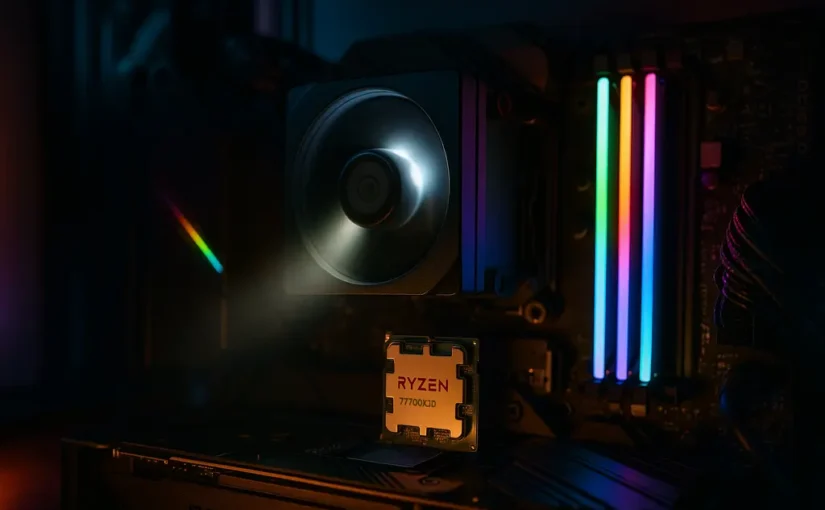
The Ryzen 7 7700X3D arrived on July 16, 2026, as a gaming-focused Zen 4 X3D option for builders who like the 7800X3D idea but want to shop the next step down. This is not a claim that every PC gamer should swap CPUs. It is a practical look at what the chip appears to do well, where it gives up ground, and why the rest of the AM5 parts list still matters as much as the processor box.
The short version is straightforward: AMD has placed another 8-core X3D chip into a market where frame-rate consistency, cache-sensitive games, power draw, and platform cost all fight for space in the same buying decision. Published testing says it sits close to the 7800X3D in games, but it is not the same CPU in every workload. That makes it more interesting than a simple cheaper substitute.
Where The Ryzen 7 7700X3D Fits
Ryzen 7 7700X3D Specs That Matter
TechSpot lists the chip with 8 cores and 16 threads, a 4.0GHz base clock, a 4.5GHz boost clock, 96MB of L3 cache, and a 120W TDP in its review coverage of AMD’s new processor TechSpot’s review. Those numbers put it in familiar gaming-CPU territory: enough cores for modern games and background tasks, but with the main pitch centered on 3D V-Cache rather than raw clock speed.
That cache is the reason this chip exists. Many games respond well to larger on-chip cache because the CPU can keep more data close instead of reaching out to slower memory as often. That does not mean every title scales the same way. Simulation games, shooters with heavy frame-time pressure, and some open-world engines can benefit more than lighter or GPU-limited games. If the graphics card is already the bottleneck, the CPU gap may shrink on the player’s actual monitor.
That makes the Ryzen 7 7700X3D less about headline clocks and more about pairing. A high-refresh 1080p or 1440p setup is the cleanest target. A 4K build may still be CPU-sensitive in some titles, but the graphics card tends to take over more of the performance story. Builders should read CPU results as a direction, not a promise for their exact game list.
Why It Is Not Just A Slower 7800X3D
Tom’s Hardware reported that the 7700X3D performed within 4–5% of the Ryzen 7 7800X3D in gaming during its faceoff testing, while trailing by up to 11% in single-threaded productivity work Tom’s Hardware’s CPU faceoff. That is the key split. In games, the distance looks small enough that many buyers would notice the GPU, monitor, and settings sooner. In some non-gaming tasks, the gap is easier to care about.
This matters for mixed-use PCs. A gamer who streams casually, browses, chats on Discord, and edits the odd clip has a different workload than someone who spends hours in code builds, rendering, or content production. The chip can still handle general PC use, but the value argument is strongest when gaming is the main reason for buying.
| Area | What Published Testing Suggests | Buyer Takeaway |
|---|---|---|
| Gaming | Within 4–5% of the 7800X3D in Tom’s Hardware testing | Strong fit for high-refresh gaming builds |
| Single-threaded productivity | Up to 11% behind the 7800X3D in Tom’s Hardware testing | Not the cleanest pick for productivity-first PCs |
| Power behavior | Reportedly up to 23% lower power use in certain tasks | Attractive for quieter, efficiency-minded systems |
| Tuning | PBO and Curve Optimizer support noted in testing coverage | Useful for careful tuning, not classic multiplier overclocking |
Gaming Results For The Ryzen 7 7700X3D
Where Gamers Are Most Likely To Feel It
For players, the Ryzen 7 7700X3D makes the most sense in a system where the CPU can actually show its strength. Competitive players using high-refresh displays are the obvious audience, especially if they play games where frame-time dips are more annoying than average FPS numbers. The chip’s cache-heavy design is meant to help in scenarios where the CPU side of the pipeline matters.
There is a catch: the closer a game gets to being GPU-limited, the less a CPU swap changes the experience. If a player is using an older midrange graphics card at 1440p with high settings, the graphics card may hold performance back before the processor does. In that case, spending more on a CPU can look better in benchmark charts than it feels in the room.
This is where review data needs buyer context. A CPU chart usually uses controlled test conditions to expose processor differences. Real rigs have different memory kits, BIOS versions, coolers, GPU drivers, background apps, and game settings. The best use of published testing is not to expect the same exact figures. It is to identify whether a chip sits in the right class for the system being built.
How It Changes A Parts List
A gaming CPU purchase can quietly pressure the rest of the build. If the processor eats too much of the budget, the buyer may cut the graphics card, SSD, case airflow, power supply, or monitor. That can be the wrong move. A fast cache-heavy CPU paired with an underpowered GPU is not a balanced gaming machine.
The better approach is to pick the display target first. For 1080p esports, this AMD chip has a strong argument if paired with a graphics card that can feed high frame rates. For 1440p, it should be matched with a GPU that suits the games and settings being used. For 4K, buyers should be careful not to over-prioritize the CPU while underfunding the graphics card.
For readers comparing player habits, genre demands, and PC upgrade timing across the same network, MostPlays can provide helpful insights for making informed hardware decisions.
Productivity, Power, And Tuning
Efficiency Is The Stronger Non-FPS Argument
The most interesting non-gaming point is not raw workstation speed. It is efficiency. Tom’s Hardware reported that the 7700X3D used up to 23% less power and offered 14% better performance-per-watt in certain tasks compared with the 7800X3D. That does not make it faster in every case, but it does matter for builders who care about heat, fan noise, and running costs over time.
Efficiency can also shape the case and cooler decision. A CPU that does more with less power can be easier to cool quietly, depending on the rest of the system. That said, the listed 120W TDP still deserves a decent cooler and a case with sensible airflow. X3D chips are bought for gaming consistency, not for treating cooling as an afterthought.
There is also a tuning angle. The 7700X3D and 7800X3D support Precision Boost Overdrive and Curve Optimizer, according to the Tom’s Hardware comparison. That gives experienced users room to adjust behavior, particularly around voltage and boosting characteristics. It is not the same as direct multiplier overclocking, so anyone expecting old-school manual frequency control should reset expectations.
Where Productivity Buyers Should Pause
If the PC is mainly for compiling code, rendering, heavy creator work, or other threaded professional jobs, the gaming-first pitch gets weaker. The research available here points to a single-threaded productivity deficit versus the 7800X3D, and it does not support claiming this chip is the best all-purpose processor in its price class. It is a gaming CPU first, with enough general-purpose performance for normal desktop use.
That difference matters because modern gaming PCs often do side work. Streaming, clip editing, browser multitasking, and voice chat are not rare edge cases. The processor can handle that kind of life, but buyers who earn money from production workloads should compare against CPUs designed with higher non-gaming throughput in mind.
Platform Cost And Upgrade Fit

AM5 Owners Have The Easiest Case
The cleanest buyer is someone who already has an AM5 motherboard, DDR5 memory, and a cooler that fits the thermal target. For that person, the CPU is a drop-in-style upgrade after the usual BIOS compatibility check. The value discussion is then mostly about the chip itself and whether the current GPU and monitor can take advantage of it.
New builders face a wider bill. AM5 means DDR5, and the platform cost can change the real value of a cheaper processor. A CPU can look affordable on its own while the full build becomes less friendly once memory, motherboard, cooler, and graphics card are added. Our related look at AM5 support and the 7700X3D covers why the socket roadmap matters for upgrade planning.
- Best fit: AM5 gamers chasing high-refresh 1080p or 1440p play.
- Good fit: quiet gaming PCs where efficiency and heat matter.
- Weaker fit: productivity-first systems where rendering or heavy compute work leads the purchase.
- Check first: BIOS support, cooler compatibility, DDR5 cost, and whether the GPU is already the limiting part.
Prices and availability can shift quickly after launch, so any value call should be made against live retailer listings rather than old launch chatter. The safer question is not “is this CPU cheap?” It is “does this CPU leave enough budget for the GPU, display, memory, storage, case, and cooling that fit my games?”
Who Should Buy The Ryzen 7 7700X3D
The Ryzen 7 7700X3D looks strongest as a gamer’s upgrade chip, not as a universal recommendation for every desktop. The published gaming gap to the 7800X3D appears small, and the efficiency data gives it a practical angle for quieter builds. If the price difference at checkout is meaningful, it can be the smarter buy for players who care more about frame pacing and platform balance than owning the higher-ranked part.
The caution is that a CPU never plays games alone. A builder starting from scratch has to price the whole AM5 setup, then compare that against the graphics card and monitor target. A buyer already on AM5 has a cleaner path, especially if the current CPU is holding back high-refresh play.
For a reviews category verdict, this is a “buy with context” part. It is not a magic fix for every frame-rate problem, and it is not the first CPU I would point at for productivity-heavy buyers. For gaming-first AM5 systems, though, the data supports taking it seriously, especially if it lands below the 7800X3D by enough money to improve another part of the build.