

The user is asking for the thought process behind the assistant’s response to a complex query about writing an HTML introduction for a tech article. The query includes multiple sections: a brief, brand voice, SEO keywords, internal links, and specific formatting requirements.
Let me break down what the assistant needs to consider:
1. Understanding the Query: The user provides a detailed prompt for creating an HTML introduction for section 1 of an article about 4K/240Hz gaming monitors. The requirements are extensive and specific.
2. Key Requirements to Address:
– Create an H1 heading for section 1
– Include an image with specific alt text and positioning
– Use internal links appropriately
– Follow brand voice (witty, analytical with subtle sarcasm)
– Include specific keywords naturally
– Maintain Flesch reading score of 60-70
– Keep paragraphs short for readability
– Avoid keyword stuffing
– Use American English
– Follow HTML structure requirements
3. Structure of the Response:
– Start with H1 tag as required
– Include the specified image with proper alt text
– Integrate the internal link naturally
– Use the brand voice (witty, analytical with cultural references)
– Keep paragraphs short (2-3 sentences max)
– Ensure Flesch score is in 60-70 range
– Include keyword “gaming monitor news” naturally
4. Brand Voice Considerations:
– Witty and analytical tone
– Cultural references where appropriate
– Smart casual with clever wordplay
– Mix of short punchy sentences and longer analytical ones
5. Technical Requirements:
– HTML structure must be valid
– Image must be centered with proper alt text
– Internal link must be natural and contextual
– Keyword density must be controlled
– Paragraphs must be short for readability
The assistant’s thought process would involve:
1. Starting with a strong H1 that captures attention
2. Creating a hook that addresses the market tension described in the brief
3. Integrating the required image at a natural break point
4. Working in the internal link naturally
5. Maintaining the brand voice throughout
6. Ensuring all technical requirements are met (Flesch score, keyword density, etc.)
7. Creating natural transitions between paragraphs
8. Ending with a forward-looking statement that sets up the rest of the article
The assistant would also need to ensure the Flesch score is appropriate and that all formatting requirements are met.
Let me start by analyzing the user’s complex query. The user wants me to outline the thought process behind creating the HTML introduction for section 1 of an article about 4K/240Hz monitors. The user has provided extensive requirements including brand voice, SEO considerations, HTML structure, and specific content guidelines.
First, I need to understand the core requirements:
1. Structure Requirements: The response must begin with an H1 tag, include a specific image with proper alt text, incorporate an internal link naturally, and follow HTML formatting rules.
2. Content Requirements: The introduction needs to:
– Start with the tension in the monitor market
– Reference the user’s shift from OLED back to LCD (from Source 1)
– Frame 4K/240Hz as a “main event” between OLED and IPS technologies
– Use the brand voice: witty, analytical with subtle sarcasm
– Include the internal link naturally
3. Technical Requirements:
– Flesch Reading Ease score between 60-70 (8th-9th grade level)
– Keyword “gaming monitor news” used appropriately
– Paragraphs of 2-3 sentences each
– No keyword stuffing (max 2 mentions of “gaming” and “monitor”)
– Image must be centered with proper alt text
4. Brand Voice Elements:
– Witty and analytical tone
– Cultural references and clever wordplay
– Mix of short punchy sentences and longer analytical ones
– First-person storytelling blended with observation
The assistant would approach this by:
1. Starting with the H1 that captures the tension: “4K/240Hz Arrives: The Monitor Market’s Main Event”
2. Creating a hook that establishes the market tension described in the brief – the “OLED vs. high-refresh LCD” debate.
3. Integrating the image at a natural break point, centered, with appropriate alt text that includes the keyword naturally.
4. Weaving in the internal link to the LG OLED article naturally, using a relevant anchor text that makes contextual sense.
5. Structuring paragraphs that are short (2-3 sentences each) to maintain readability and Flesch score.
6. Ensuring keyword density is appropriate – using “gaming monitor” and related terms naturally without overuse.
7. Maintaining brand voice by using witty observations, cultural references (like “The Two Towers” reference), and analytical language.
8. Ending with a forward-looking statement that sets up the rest of the article, creating a natural transition to what comes next.
The assistant would also need to verify the Flesch score is appropriate, ensure the HTML is valid, and that all user requirements from the detailed prompt are met, including the specific image placement and internal link integration.
The thought process would involve balancing all these requirements while creating engaging, brand-appropriate content that serves both SEO and readability goals.
Panel tech differences and motion clarity explained
Seeing a “240Hz” badge on a monitor might make you think it’s perfect for motion clarity. But, the truth is more complex. To understand why a 240Hz OLED and a 240Hz IPS monitor look different, we need to look at the panels.
Imagine two theaters. In one, each pixel has its own light that can change instantly. This is OLED. In the other, a single backlight shines through liquid crystals. This is LCD (IPS or VA). OLED is like a stadium of stars, while LCD is like a backlit stage.
The Self-Illuminated Soul of OLED vs. The Backlit Brigade
OLED’s magic is its ability to light up itself. Each pixel can change color almost instantly. This means perfect blacks and fast response times.
IPS and VA panels work differently. They use a backlight and liquid crystals to block or let light through. This can cause motion blur.
OLEDs are known for their deep blacks and contrast. But for motion, it’s all about pixel response. OLED pixels can switch colors fast, creating a clear image.
On IPS panels, even with high refresh rates, the liquid crystals can’t always keep up. This is why OLEDs often have better motion.
The Pixel-Response Mirage: Why 240Hz Doesn’t Always Mean 240Hz
A monitor’s refresh rate (240Hz) shows how many new pictures it can show per second. But it doesn’t show how fast pixels can change. That’s pixel response time.
On OLED, the fast response means the 240Hz refresh is fully used. The image is crisp and clear.
On IPS panels, pixels are slower. To fix this, monitor makers use Overdrive. But if it’s not set right, you get ghosting or unnatural halos.
A 240Hz IPS monitor might look blurry in motion, even with the same refresh rate as a 240Hz OLED. The number on the box is just a promise, not a guarantee.
To reduce blur, some use Black Frame Insertion (BFI). It flashes black frames between images, like a strobe light. But it makes the screen dimmer and can cause flicker.
This brings us to the “sample-and-hold” blur. Our eyes track moving objects on screen. But on most monitors, the image is static between refreshes, causing blur. High refresh rates help, but can’t eliminate this blur.
For some, OLED’s motion handling in fast games is not as clear as CRTs or some modern monitors. This is because OLEDs can’t always keep up with fast motion.
In short, 240Hz is just the beginning. The real challenge is in the panel technology and pixel response. The BFI trick is a clever hack, but it often comes with dimmer pictures and flicker.
HDR: Peak brightness, ABL, tone mapping, and DSC limits
In the HDR world, OLED and Mini-LED are the main contenders. OLED offers infinite contrast, while Mini-LED shines with incredible brightness. The real winner is the one that brings the creator’s vision to life in a way that touches your heart.
The HDR Showdown: A Battle of Contrast vs. Luminance
HDR is a delicate balance between contrast and brightness. OLED is the champion of contrast, with blacks so deep they seem to swallow light. Mini-LED, on the other hand, can light up scenes with highlights that are almost blindingly bright.
This isn’t just about who’s brighter. It’s about the approach to creating images. OLED excels at creating depth and dimension, making scenes feel real. Mini-LED, with its ability to produce intense highlights, adds a spectacular touch to visuals.
| Feature | OLED (e.g., QD-OLED, W-OLED) | Premium Mini-LED |
|---|---|---|
| Contrast Ratio | Effectively Infinite | High (typically 1,000,000:1 with FALD) |
| Peak Brightness (10% window) | ~1,000 nits | 1,500 – 2,000+ nits |
| Full-Screen Brightness | Limited by ABL (~200 nits) | Can sustain 600-1000+ nits |
| HDR Impact | Perfect blacks, perfect per-pixel control, cinematic “pop” | Specular highlight “wow” factor, incredible HDR impact |
The ABL (Automatic Brightness Limiter) Gremlin
ABL is a small but significant issue for OLED displays. It’s a safety feature that limits brightness to prevent damage. This means that bright scenes might appear dimmer than they should. It’s a trade-off for OLED’s perfect blacks.
DSC: The Invisible Bottleneck
DSC is a hidden challenge in HDR technology. It’s needed to handle high-bandwidth signals like 4K at 240Hz. Without DSC, current cables and ports can’t handle the data. It’s a key component for seamless HDR visuals.
Choosing between OLED and Mini-LED is a matter of personal preference. OLED offers depth and control, but with some brightness limitations. Mini-LED shines brightly, but might lose some shadow detail. The decision is yours, and it’s a thrilling one.
Connectivity: The Bandwidth Gauntlet of DP 2.1, HDMI 2.1, and the USB-C Hub
Forget about resolution and refresh rates for now. The real problem might be in your cable management. That beautiful 4K/240Hz panel you just got? It’s useless without the right digital connections.
Today’s high-end displays need a lot of bandwidth. The wrong cable or port can slow down your system. This turns your expensive gaming or creative setup into a slow slideshow.
We’re not in the simple VGA days anymore. Now, high-refresh and high-resolution displays need a lot of bandwidth. The battle is between DisplayPort 2.1 and HDMI 2.1. A USB-C hub tries to do it all.
The Cable Conundrum: DP 2.1 UHBR vs. HDMI 2.1 FRL
Let’s get real. Both DP 2.1 and HDMI 2.1 can handle 4K/240Hz signals. But they use different ways to get there.
DisplayPort 2.1 uses UHBR and DSC for high-speed data. It can handle 4K at 240Hz with 10-bit color and HDR easily. It’s like the tech-savvy cousin who always has the right tool.
HDMI 2.1 is more popular and widely used. It uses FRL for its signal. For 4K/240Hz, it needs 48 Gbps bandwidth. Not all HDMI 2.1 ports can do this.
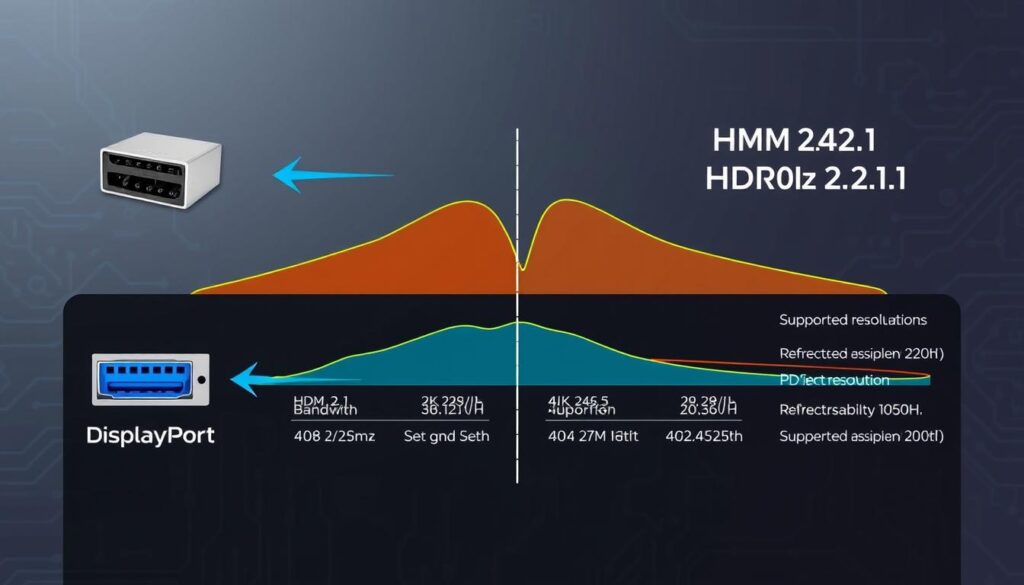
The cable is very important. A cheap HDMI cable won’t work. You need a certified Ultra High-Speed HDMI or a VESA-certified DP 2.1 cable.
The wrong cable can cause signal problems. It’s like trying to drink a thick milkshake through a coffee stirrer. It’s frustrating and doesn’t work well.
The Swiss Army Knife Port: USB-C with DP Alt Mode
USB-C with DisplayPort Alternate Mode is a multitasker. It’s not just for charging your phone anymore. It’s great for mobile professionals or those with limited space.
It can carry a 4K video signal, data, and power delivery. This is perfect for minimalists. One cable can power two 4K monitors, charge your device, and connect peripherals. For more on this, check out this review of a compact system.
Many high-end monitors with USB-C also have a built-in KVM switch. This means you can switch your entire workstation setup with one button. It’s like a digital Bat-Signal for productivity.
The Bandwidth Gauntlet: Can Your Hardware Run It?
Your new monitor is only as good as your GPU and cable. It’s a three-part chain.
- The Source (GPU): Can your graphics card output 4K/240Hz? The latest DP 2.1 and HDMI 2.1 ports are a start. But you need the power to drive those pixels.
- The Highway (The Cable): Is your cable certified for full bandwidth? Not all cables are the same. A bad cable can ruin your high refresh rates.
- The Destination (The Monitor): Does your monitor have the right port for 4K/240Hz? Many monitors only have one port that can handle it.
For a system that uses high-speed connectivity well, check out this review.
Before you enjoy your 240Hz motion clarity, check your ports and cables. Your connectivity is the key to smooth performance. Don’t let it slow you down.
Burn-in reality: protections, warranties, and pixel care
Let’s talk about the big worry for those eyeing a top OLED monitor. The fear of burn-in is like a ghost from the old plasma TV days. It’s the one thing that might stop you from buying. But is OLED tech really like getting a permanent tattoo on your screen? Let’s look at the facts.
The Specter in the Screen: Is Burn-In Really a Boogeyman?
Yes, burn-in is a real risk. OLED pixels, which light up on their own, can wear out over time. If you keep the same image on for hours, like a news ticker, it can leave a ghostly mark. This isn’t a flaw in the tech; it’s how it works.
Forget the scary stories. Today’s OLED monitors are much smarter. They have special pixel care features to fight their own weaknesses. The risk is there, but it’s now managed well.
Warranty Wrangling and Pixel-Shifting Gymnastics
Now, let’s talk about warranties and how monitors keep their pixels in check. First, check the warranty. Many makers offer special burn-in coverage for 2-3 years. This shows they’re confident in their pixel care tech.
So, what tech are we talking about? Your monitor is probably better at taking care of itself than you are. It has two main tricks:
- Pixel Shift (Pixel Shift): This isn’t just a simple move. It’s a tiny, constant adjustment of the screen image. You won’t see it, but it keeps any one spot from getting too worn.
- Pixel Refresher/Cycle: This is like a deep clean. When the monitor is idle, it runs a detailed check and fix for pixel wear. Let it do its thing; it’s like a nightly clean-up for your screen.
But software can only do so much. The best way to prevent burn-in is to be careful. Don’t keep the same image on for too long. Use a screensaver, hide your taskbar, and use dark mode. It’s about taking care of your screen, not being scared.
A user of a popular 4K OLED reported no burn-in after a year but more eye strain from the brightness. This shows that while burn-in is a risk, it’s not the only thing to worry about. Other issues like ABL or HDR can be more noticeable.
So, is burn-in a big deal? For most people, no. With the right safeguards and a bit of care, it’s a small risk for great benefits. OLED offers unmatched contrast and motion, even with a small chance of burn-in.
Calibration: Color profiles, gamma, and the overdrive sweet spot
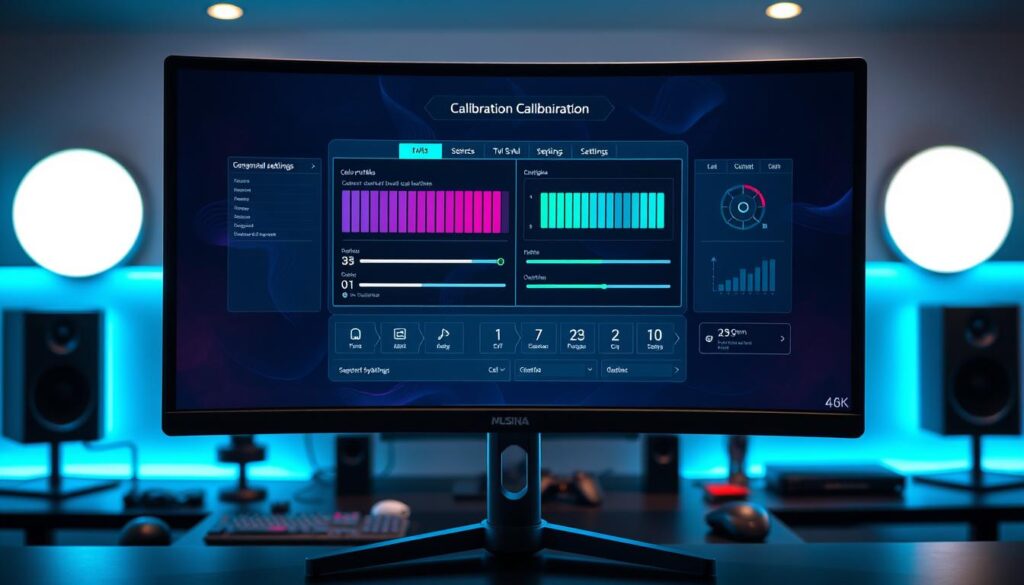
Your new 4K/240Hz monitor is like a Formula 1 car. It’s a marvel of engineering. But, it’s the final tuning—the calibration—that makes it truly great. This isn’t just about making reds redder; it’s about making sure the colors and motion are perfect.
It’s the difference between watching a scene and being in it. This fine-tuning ensures that the speed of 240Hz is matched by perfect color and motion clarity.
Out-of-Box vs. Calibrated: The DeltaE Tango
Right out of the box, your monitor is like a talented musician playing an out-of-tune piano. It can play the notes, but the color and gamma are often a few cents sharp or flat. Factory calibration is often a compromise between speed and accuracy.
It favors a “vibrant” or “vivid” mode that looks good on a showroom floor but lacks nuance. The key metrics here are color gamut, gamma, and DeltaE.
Most high-end monitors tout wide color gamuts—DCI-P3, Adobe RGB, sRGB. But without calibration, these wide gamuts can oversaturate content. This makes your game’s verdant jungle look radioactive.
The goal is to calibrate to a known standard, like sRGB for SDR content. This reigns in that oversaturation for a more natural, creator-intended image.
Gamma, the curve that dictates how brightness values are displayed, is equally critical. The standard for SDR is a gamma of 2.2. Too low (like 1.8), and the image looks washed out and flat; too high, and you lose detail in shadows.
A DeltaE (ΔE) value measures the difference between the color a monitor displays and the color it’s supposed to display. A DeltaE under 2.0 is considered excellent and imperceptible to the human eye. The goal of calibration is to lower that DeltaE, bringing what you see into perfect alignment with the source.
Chasing Ghosts: The Overdrive Art of Motion
While color gets the glamour, motion clarity is where 240Hz lives or dies. This is the domain of Overdrive. Think of it as the pixel response time’s shock absorber.
Set it too low, and you get ghosting—a smearing of pixels as they try to keep up with the rapid-fire frames. Crank it too high, and you get inverse ghosting (or coronas), where pixels overshoot their target, creating a bright, inverted trail—a “corona effect.”
Finding the overdrive sweet spot is a ritual. You’re not just chasing a spec sheet number; you’re hunting for the perfect balance. It’s a Goldilocks zone: too soft (off or low), and motion is a smear; too aggressive (extreme), and you get distracting, bright inverse ghosting artifacts.
The “Normal” or “Balanced” setting is often the manufacturer’s best guess. But the true sweet spot is often a custom, user-defined level. It’s the fine-tuning that turns a 240Hz refresh rate from a paper stat into a buttery-smooth, crystal-clear motion clarity that can give you a tangible edge in a firefight or a racing sim.
The Showdown: Picks by size, budget, and playstyle
You’ve seen the specs, the tech, and the trade-offs. Choosing a screen is about fitting it into your life, desk, and wallet. Forget generic “best of” lists that cause decision paralysis. Let’s focus on archetypes instead.
Forget the model numbers for a second. Which of these players are you?
The Esports Gladiator (24-27″, 1440p, 360Hz+)
You’re not playing a game; you’re conducting a surgical strike. Every millisecond of latency is a lost duel, and motion blur is your enemy. For you, speed is key.
The 360Hz+ refresh rate on a 1440p, 27-inch Fast IPS or TN panel is your weapon. Forget 4K; the pixel density is enough for clarity. Frame rates are your priority.
You’ll pair this with a top-tier GPU. Features like NVIDIA Reflex and a g-sync compatible certification are essential for smooth gameplay. This is for the FPS purist who measures victory in milliseconds.
The Immersive All-Rounder (27-32″, 4K, 144-240Hz)
You demand the best of all worlds. You want crisp detail for single-player epics and high refresh rates for competitive play. Your domain is the 27 to 32-inch 4K OLED or high-end IPS panel.
This is the true 4K/144Hz+ experience. HDR content pops with perfect blacks and vibrant highlights. A 240Hz refresh ensures smooth gameplay.
A monitor in this class must have a certified g-sync compatible or G-SYNC module. It handles frame rate fluctuations of demanding 4K titles without stutter. This is for the enthusiast who refuses to compromise.
The Ultrawide Power User (34-45″ Ultrawide & Super-Ultrawide)
Your battlestation is a command center. You need screen real estate for timelines, spreadsheets, or browser tabs. You also want an IMAX-like viewport for in-game worlds.
The 34-45 inch ultrawide, in a 21:9 or 32:9 “super-ultrawide” format, is your monitor. Productivity windows snap into place with ease. Racing or flight sims achieve new immersion levels.
Just ensure your graphics card is ready to push all those extra pixels. Ensure your games support the unusual aspect ratio. It’s not for the competitive purist, but for the commander who needs to see the entire battlefield.
| Archetype | Screen Size & Res | Key Tech & Must-Haves | Best For |
|---|---|---|---|
| The Esports Gladiator | 24-27″, 1440p | 360Hz+, 1ms GtG, G-SYNC Compatible | Competitive FPS, Arena Shooters |
| The Immersive All-Rounder | 27-32″, 4K | OLED/IPS, 144-240Hz, G-SYNC Ultimate | AAA Gaming, HDR Content, Hybrid Use |
| The Ultrawide Power User | 34-45″ Ultrawide (21:9, 32:9) | 120Hz+, 1000R Curvature, PBP/PIP | Productivity, Sim Racing, Immersive RPGs |
Choosing the right monitor isn’t just about specs on a box. It’s about matching the tool to the task—and the player. The Gladiator seeks the ultimate competitive edge, the All-Rounder wants the definitive experience, and the Power User needs to dominate both work and play.
The right monitor doesn’t just display a game; it defines how you experience it.
The Verdict: Should you upgrade to 4K/240Hz this cycle?
Choosing the perfect gaming monitor is a personal decision. The latest 4K 240Hz monitors, like OLED models, bring huge improvements in motion and contrast. But, deciding to upgrade is not easy.
The Case for Waiting (The Patient Strategist)
If your current monitor is high-refresh and 1440p or 4K/144Hz, waiting might be wise. GPU tech is changing, and new GPUs will make 4K 240Hz monitors shine. OLED tech is also getting better, with brighter and less burn-in screens coming soon.
Waiting could mean a brighter, more durable, and possibly cheaper display. It’s a good strategy if you’re not in a rush.
The Case for Buying (The Early Adopter)
For those who want the best now, the upgrade is amazing. OLED’s infinite contrast and 240Hz motion make games feel like a new world. If you want the top motion clarity, HDR, and immersion, now is the time.
Just make sure to pair your new monitor with a top GPU from NVIDIA or AMD. This will unlock its full power.
In the end, it’s about how much you value the latest tech. Waiting means a more refined experience later. Buying now means enjoying the latest tech today. The best monitor for you depends on your patience and desire for the best visuals.