

Valve’s 2026 Steam Machine is one of the clearest tests yet of whether PC gaming can feel natural in the living room without becoming too expensive, too noisy, or too compromised. The pitch is strong: a compact SteamOS-powered box built for the TV, a unified Valve-made hardware target, access to a large Steam library, and a console-style experience without giving up PC flexibility. Valve’s official Steam Machine page frames it as “your games on the big screen” and “powerful PC gaming made easy” in a small package, which is exactly the living-room PC promise players have wanted since the first Steam Machine era. Valve’s Steam Machine page
The problem is that the 2026 version now has to compete in a harsher hardware market. Reviews and teardown-style analysis have already put pressure on the system’s value story. GamersNexus listed the Steam Machine’s original MSRP at $1,050 for the 512GB model and $1,350 for the 2TB model, with a June 29, 2026 release date. Its testing found that the Steam Machine performed closest to cards such as the RX 6600, Intel B570, and RTX 3060 in GPU tests, and argued that a stronger-performing box could be assembled for the same money or less. GamersNexus Steam Machine review
That is why this topic fits Cooler Master Gaming’s hardware lane. The recent AMD AM5 support analysis focused on platform longevity and upgrade decisions. The Steam Machine pushes the same question into the living room: if a gaming PC is sold like a console, players will judge it like a console, a mini PC, and a full desktop all at once.
Why Valve’s Living-Room Pitch Still Makes Sense
The Steam Machine remains appealing because Valve is solving a real player problem. Many PC gamers already own hundreds of Steam games, yet playing them on a couch can feel clumsy. A traditional tower may be too large for a media console. Windows can feel awkward from ten feet away. A keyboard-and-mouse setup does not fit every living-room arrangement. A console is easier, but it locks the player into a platform, subscription ecosystem, and store model.
SteamOS is Valve’s biggest advantage. A living-room PC that boots into a controller-friendly Steam interface can feel more coherent than a Windows mini PC connected to a TV. It gives players access to PC sales, cloud saves, mod-friendly titles, indie games, controller support, and desktop mode when needed. That flexibility is hard for a closed console to match.
Wired’s review described the 2026 Steam Machine as a compact, console-like device running SteamOS/Linux, with a footprint similar to a GameCube, clean setup, internal power supply, and access to a wide Steam library. The same review still found the experience less convincing for demanding AAA games, citing inconsistent 4K performance, the need for tweaking, and a price higher than a PS5 Pro. Wired’s Steam Machine review
That tension is the whole story. The living-room idea is not wrong. The execution has to fight physics, pricing, and expectations. A compact PC needs enough GPU power, enough memory, enough cooling, quiet fan behavior, strong software compatibility, and a price that does not make a traditional desktop or console look obvious by comparison.
How Compact Cooling Shapes The Living-Room PC Problem
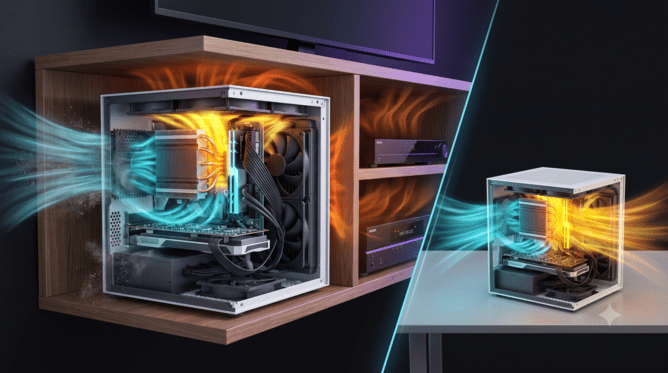
The living room is a harder place for a gaming PC than a desk. A desktop tower can sit with open air around it, multiple intake fans, a larger GPU cooler, a full-size power supply, and a case layout designed around airflow. A small TV box sits in an entertainment center, near walls, cables, receivers, streaming devices, and dust-prone shelves. It may have less room to breathe, and the fan noise is easier to notice in a quiet room.
That makes cooling central to the Steam Machine’s value. A small chassis can be elegant, but heat density rises quickly. A semi-custom AMD Zen 4 CPU and RDNA 3 GPU may be efficient compared with a full desktop build, yet they still need to sustain gaming loads at living-room distances and noise levels. If fan curves become too aggressive, the box loses its console-like feel. If power limits are too conservative, the box loses the PC-performance argument.
GamersNexus tested thermals, acoustics, CPU performance, GPU performance, frame rates, compression, and decompression in its Steam Machine review. The outlet’s summary matters because it treats the Steam Machine as a prebuilt PC, not as a magical console replacement. That is the fair comparison for Cooler Master Gaming readers. A living-room PC is still a PC, and its cooling design decides how much performance survives outside a marketing demo. GamersNexus Steam Machine review
This is where the Steam Machine creates a lesson for builders. Compact gaming systems are not automatically better just because they look cleaner under a TV. The best small-form-factor builds succeed by matching power draw, airflow path, fan size, heat sink area, noise targets, and component access. If one of those areas is weak, the system can feel expensive and limited at the same time.
Why The Specs Create A Value Gap

The Steam Machine’s reported hardware makes sense for a compact SteamOS box, but it creates a value problem at the confirmed price bands. Coverage of Valve’s specs has described a semi-custom AMD Zen 4 six-core CPU, RDNA 3 graphics with 28 compute units, 16GB of DDR5 RAM, 8GB of GDDR6 VRAM, and 512GB or 2TB storage options. That is a serious step above the Steam Deck, but it is not automatically a high-end living-room desktop. Steam Machine specs report
The value issue appears when the price is compared with real alternatives. A console buyer sees a PS5 Pro at a lower entry price. A PC builder sees a DIY or prebuilt desktop that may offer stronger graphics performance, better upgrade paths, and better airflow. A Steam Deck owner sees a more powerful couch device, but not a portable device. A mini PC buyer sees an elegant SteamOS target, yet may compare it against Windows mini PCs with newer or more flexible hardware.
Polygon reported that Steam Machine pricing and pre-orders started at $1,049, confirming that Valve’s box had entered premium mini-PC territory rather than mass-market console pricing. Polygon’s Steam Machine pricing report
| Buyer Question | Steam Machine Strength | Steam Machine Concern |
|---|---|---|
| Living-room ease | SteamOS is built for couch-first play | Some PC games still need settings work |
| Compact design | Small, console-like footprint | Less thermal headroom than a larger desktop |
| Steam library access | Existing PC library becomes TV-friendly | Compatibility depends on SteamOS and Proton behavior |
| Price | Cleaner than building a custom couch PC for some users | Starts above many console and desktop alternatives |
| Performance | Stronger than Steam Deck | Reviews question 4K consistency and AAA value |
The Steam Machine is not weak in isolation. Its challenge is that every category around it has become stronger. Consoles are polished. Gaming laptops are more common. Handheld PCs are improving. Mini PCs are more capable. Desktop PC builders can still choose their own cooling, GPU, memory, and case. Valve has to make the living-room experience feel worth paying extra for.
How Memory Prices Make The Value Problem Harder
The Steam Machine is launching into a memory market that is punishing almost every hardware category. PC Gamer reported in July 2026 that Valve engineer Yazan Aldehayyat said the memory crisis was “still getting worse,” with bulk supply trends lagging retail pricing by several months. The same report said Pierre-Loup Griffais confirmed that Valve was producing Steam Machines at full capacity but remained constrained by memory availability. PC Gamer’s memory crisis report
That detail changes how players should read the Steam Machine’s price. It is not simply a case of Valve overpricing a box. RAM, SSDs, and graphics memory are all affected by broader supply pressure tied to AI demand, server hardware, and component allocation. If memory pricing is rising faster than retail markets have fully absorbed, compact gaming systems have less room to hide the cost.
A larger desktop builder can adjust more easily. They can choose a cheaper SSD, wait for RAM discounts, reuse a case, reuse a PSU, buy a different GPU tier, or delay one upgrade. Valve cannot do that for a fixed product without creating more SKUs, fragmenting the experience, or lowering the spec target. A console-style PC has to absorb the component market inside one price.
That makes the Steam Machine a warning sign for living-room PC gaming. If a compact SteamOS box with a fixed spec still lands above $1,000, the idea of affordable couch PC gaming becomes harder to sell. SteamOS may reduce software friction, but it cannot remove the hardware cost beneath it.
Why SteamOS Is The Best Part Of The Product
The Steam Machine’s strongest contribution may not be the box itself. It may be the continued push to make SteamOS a serious living-room PC platform. A smooth SteamOS experience can make a custom couch PC more attractive, especially for players who prefer not to use Windows on a TV.
That is a major shift. For years, living-room PC gaming struggled because the software felt wrong. Windows expected a mouse. Updates interrupted sessions. Launchers fought for attention. Controller support varied. Desktop pop-ups could break the illusion. Steam Big Picture helped, but it did not fully erase the feeling that a PC was being forced into a console role.
SteamOS changes that by making the gaming interface the center of the product. It gives Valve a path where Steam Machine, Steam Deck, Steam Controller, and future SteamOS-compatible PCs can share a clearer design language. Even if the Steam Machine has a value problem, SteamOS may still help the category grow.
The caveat is compatibility. Proton has improved PC gaming on Linux, but not every game works perfectly. Anti-cheat, launchers, online services, peripheral support, and edge-case settings can still create friction. A console buyer expects the game to run. A PC buyer may tolerate tweaking. A Steam Machine buyer is stuck between those expectations.
That is why Valve’s product is so interesting. It is not trying to be a closed console, but its living-room shape invites console comparisons. SteamOS makes the experience cleaner, yet the PC library remains messy by nature.
What This Means For Gaming PC Builders
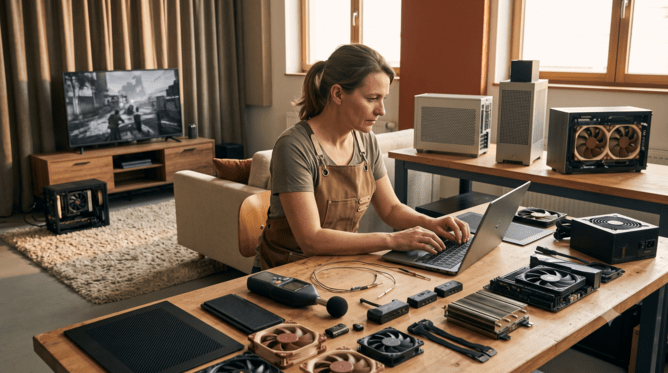
For Cooler Master Gaming readers, the Steam Machine should not be read only as a product review. It is a build-planning lesson. Living-room PC gaming is possible, but the setup has to be designed around space, acoustics, display target, controller use, and upgrade expectations from the start.
A player who wants 1080p or 1440p couch gaming through a Steam library may find the Steam Machine appealing if SteamOS simplicity matters more than raw value. A player who wants consistent 4K performance in demanding games should be more cautious. A player who already has a large TV, a quiet living room, and sensitivity to fan noise should wait for noise-normalized testing and real living-room placement impressions.
A custom living-room PC can still make sense. The advantage is flexibility: stronger GPU, larger case, quieter cooler, larger SSD, full-size PSU, and future upgrades. The disadvantage is effort. The builder has to choose the chassis, tune fan curves, configure SteamOS or Windows, manage controller behavior, and make the system look acceptable near a TV.
The Steam Machine exists for the buyer who wants Valve to do that work. The price shows how hard that job has become.
Why Living-Room PC Gaming Still Needs A Better Middle Ground
The Steam Machine shows that living-room PC gaming is closer than it was in the old Steam Machine era, but it still lacks the perfect middle ground. The category needs a device that feels more open than a console, simpler than a Windows mini PC, quieter than a cramped desktop, and cheaper than a boutique prebuilt. That is a hard target.
Valve has made real progress by controlling the hardware and software this time. The 2026 Steam Machine is not a scattered ecosystem of partner boxes with confusing specs. It is a single Valve-made product tied to SteamOS. That alone makes it easier to understand than the original Steam Machine concept.
The remaining problem is value per frame and value per watt. If a compact living-room PC cannot outperform a console at a similar price, it has to win through library access, openness, Steam sales, desktop flexibility, and user control. If it cannot outperform a similarly priced desktop, it has to win through convenience, size, noise, and setup quality.
That is where cooling returns to the center. A living-room PC does not need to be the fastest machine in the house. It needs to stay quiet, stable, and comfortable during real play. It needs to fit the furniture without choking. It needs enough thermal headroom to avoid sounding strained. It needs pricing that does not make every compromise feel expensive.
Valve’s 2026 Steam Machine may still find an audience among Steam loyalists who want couch-first PC gaming without building a box themselves. Its larger impact may be to prove that the living-room PC idea is alive, but still waiting for the right balance of cooling design, component cost, and performance value.