
So, you’ve seen the shimmering trailers. You’ve heard the promises of pixel-perfect immersion. Let’s be real for a second: the marketing for ultra-high resolution is a masterclass in selling dreams.
Here’s the unfiltered truth. Achieving that buttery-smooth, detail-rich experience isn’t about buying a fancy monitor. It’s a full-system commitment that will ruthlessly expose every weak link in your hardware chain.
I’ve watched more than one “gaming beast” whimper under the load. The graphics card is the undisputed king here. For a truly seamless ride in 2025, you’re looking at modern RTX 40-series or AMD equivalents as the bare-minimum entry ticket.
This isn’t about selling you a fantasy. Consider this a diagnostic. We’re here to dissect what “4K ready” actually means, separating attainable glory from silicon-fueled hype. And if your budget is feeling the strain, understanding this balance is key before you explore options for the best budget gaming hardware.
4K Gaming Demands Explained
Imagine your GPU as a master forger, tasked with creating four perfect Mona Lisas in the time it used to paint one. That’s the brutal, elegant math of jumping from 1080p to 4K. You’re not asking for a slightly better sketch. You’re demanding a masterpiece, quadrupled.
Let’s break down the numbers, because they don’t lie. A standard 1080p frame contains just over 2 million pixels. A 4K frame? That’s a staggering 8.3 million. It’s not a 4x increase in workload, though. It’s often exponential. Rendering detailed textures, complex lighting, and shadows at that resolution makes your graphics card sweat.
The demand isn’t linear; it’s a cliff. Your hardware must paint this sprawling mural of pixels within the same 16.7 milliseconds to hit 60 frames per second. This is where raw pixel-pushing power becomes non-negotiable. We’ve moved past the era of mere graphics cards.
Building a capable 4k gaming pc today means investing in a computational powerhouse. Think of it as trading in a set of fine brushes for an industrial spray-painting robot. The historical baseline, like the GTX 1080, was a legend in its time. For “most games” at 4K a few years ago, it was the recommended starting pistol.
Today, that same card might suddenly feel like it’s painting with a broom. Why? Modern titles use higher-resolution textures, more complex geometry, and advanced effects that simply didn’t exist when that hardware was king. The goalposts have moved, and they’ve gotten much heavier.
This is the core reality. Chasing 4K isn’t about turning settings from “Ultra” to “High.” It’s about an architectural shift in your entire system’s philosophy. You’re no longer just playing a game. You’re asking your machine to solve a vastly more complex visual equation, sixty times every second.
So, before you get lost in specs for your new 4k gaming pc, understand the fundamental ask. It’s a demand for brute force, clever rendering tricks, and a wallet that’s ready for the big leagues. Let’s see what that means for your GPU, your CPU, and every other component in the chain.
GPU Requirements by Game Genre
The right GPU for 4K gaming depends on the games you play. It’s not just about raw power. You need a GPU that fits the game’s needs perfectly. Just like you wouldn’t use a sledgehammer to hang a picture, you shouldn’t buy a card meant for heavy games if you play lighter ones.
Let’s look at the different types of games you might play. We can group them into three main categories:
- The Lightweight League: Esports, indie games, and older classics.
- The Mainstream Arena: AAA games from a few years ago or modern games with average demands.
- The Heavyweight Division: New games with huge worlds and advanced graphics.

In the Lightweight League, your GPU gets a break. Games like Valorant and League of Legends don’t need much. Even an older mid-range card can handle 4K smoothly. Your GPU is like a gentle guide here.
Move to the Mainstream Arena, and things get more serious. Think of games like Red Dead Redemption 2 or modern titles without extreme graphics. Cards like the RTX 4070 Ti or AMD’s RX 7800 XT are great here. They offer good performance without breaking the bank.
In the Heavyweight Division, the games are the real challenge. We’re talking about games like Cyberpunk 2077 and Avatar. For top-notch 4K gaming, you need the best. That’s why the NVIDIA RTX 40 series is recommended.
The RTX 4080 is a top choice for this division. It handles demanding games at 4K without any issues. Choosing a less powerful card for these games is like using a knife in a war.
The key takeaway is to choose a GPU that matches your gaming style. The right GPU makes all the difference. The wrong one can lead to poor performance or wasted money.
CPU Bottlenecks at 4K Resolution
Buying a top GPU for 4K without a matching CPU is like trying to conduct a symphony with a kazoo. It might sound, but it won’t be good. The common myth is that ultra high resolution gaming makes your CPU useless. This is very wrong.
Think of it this way. Your GPU is like a special effects studio, making every pixel look amazing. The CPU is like the director. At 4K, the director’s job gets harder, not easier. They have to manage more complex tasks, like AI and physics, and give the GPU instructions.
When the director is slow, everything stops. Your powerful RTX 4090 or RX 7900 XTX waits for its next task. This is the silent killer of framerates. You’ve built a sports car but forgot to take it off the parking brake.
So, what CPUs avoid this problem? You need a high-end CPU. Intel’s Core i7/i9 series and AMD’s Ryzen 7/9 chips are recommended. They have the power to keep up with today’s games.
For example, the Intel Core i9-13900KF is found in many top systems. It’s a top processor for a reason. Its design handles game logic and background tasks at the same time, keeping the GPU busy. This balance is key for smooth ultra high resolution gaming.
To see how bottlenecks change at different resolutions, check out this analysis on how bottlenecks shift at different resolutions. The higher you go, the more the script flips.
Here’s a quick guide to CPU tiers for a 4K build:
| CPU Tier | Example Models | Suitability for 4K Gaming |
|---|---|---|
| Entry-Level | Core i5, Ryzen 5 | Risk of bottleneck with high-end GPUs; okay for medium settings. |
| Mid-Range | Core i7, Ryzen 7 | The sweet spot for most; excellent balance for high framerates. |
| High-End / Enthuasiast | Core i9, Ryzen 9 | Ideal for maximum performance, future-proofing, and streaming. |
The lesson is clear. Don’t spend all your money on the GPU. A balanced build is the best. For a great ultra high resolution gaming experience, your CPU must be as ready as your GPU.
VRAM Requirements Analysis
VRAM isn’t just a number; it’s key for your 4k gaming gpu to handle textures. It’s like the GPU’s green room. Here, all the high-resolution assets wait to be shown on screen.
At 1080p, this room is small. At 4K, it needs to be huge. Modern games use lots of VRAM, like prime Manhattan real estate. A single character model’s detailed leather jacket can use more memory than an old game’s entire level.
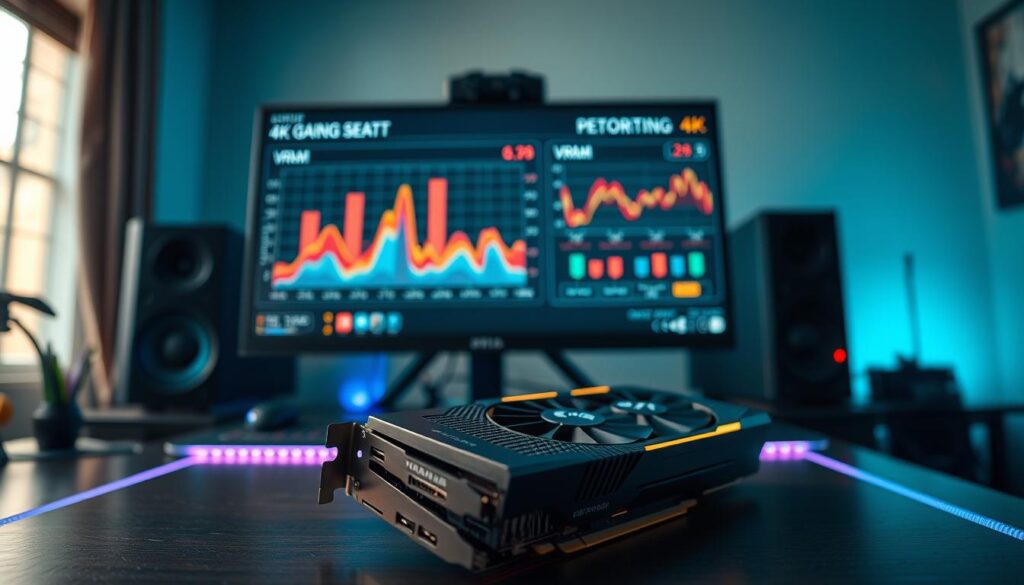
When the room is too small, the system panics. It moves less-critical textures to slower system RAM. This is like a librarian rushing to a dusty basement every time you ask for a book. It causes stutters and frame-time spikes.
The push for 32GB of system RAM is a sign. Games are loading big asset libraries. Your GPU’s VRAM is the first and most important cache. If it’s full, your system stumbles.
So, how much VRAM do you truly need for 4K in 2025? It depends on the game genre you play.
- Competitive Esports & Older Titles: 8GB might work, but you’re on the edge. Any extra task or higher texture setting will cause swapping.
- Mainstream AAA Games (2023-2024): 12GB is now the minimum. It gives you room for high-texture settings without constant swapping.
- Future-Proof / Maxed-Out Settings: 16GB or more is best. For those who want every texture setting on “Ultra” or “Nightmare,” this avoids compromises.
Choosing a GPU with enough VRAM is a long-term choice. It ensures a smooth experience now and in the future. A powerful GPU with enough VRAM is key for any serious 4K gaming bench setup.
A fast processor can’t help if the data is stuck. Your VRAM is the fast lane for your pixels. Don’t get stuck in the slow lanes.
Monitor Selection for 4K Gaming
Your GPU is a marvel, but the right monitor is key. It’s like a Stradivarius needing a top-notch speaker. You’ve built a PC for stunning visuals, but the screen is the last hurdle.
Choosing a monitor is more than just picking pixels. It’s about understanding a complex spec sheet. This isn’t just about buying a screen; it’s about finding the perfect match for your high-end PC.
First, you need a fast connection. A 4K 120Hz signal needs a high-speed path. Older HDMI 2.0 ports are too slow. Look for HDMI 2.1 or DisplayPort 1.4 for smooth data transfer.
Also, consider DSC (Display Stream Compression). It’s a game-changer for ultra high resolution gaming. Without it, you might have to lower the quality of your visuals.
Next, think about how frames move. A high refresh rate is pointless if your monitor can’t keep up. VRR (Variable Refresh Rate) is essential for smooth gaming. Choose G-Sync or FreeSync to avoid screen tearing.
Response time is also critical. Slow pixels cause blurring in fast scenes. Aim for 1ms (GTG) ratings. But, don’t trust the marketing; check reviews for real performance.
The panel type is your canvas. Each technology offers a unique visual experience.
| Panel Type | Strengths | Weaknesses | Best For |
|---|---|---|---|
| IPS | Superior color accuracy, wide viewing angles | Lower contrast, possible backlight glow | Color-critical work, competitive gaming |
| VA | Deep blacks, high contrast ratio | Slower response times, color smearing | Immersion, dark room gaming |
| OLED | Perfect blacks, infinite contrast, instant response | Risk of burn-in, higher cost | The ultimate visual experience, no budget constraints |
Lastly, HDR is important. HDR400 is not enough. Aim for HDR600 or HDR1000 for a real difference. These levels ensure vivid highlights and deep shadows.
In summary, your monitor is the lens of your gaming world. A good lens makes all the difference. Look for HDMI 2.1/DP 1.4, high refresh rates, fast panels, and true HDR. Only then will your ultra high resolution gaming setup shine.
DLSS/FSR Performance Impact
Imagine telling a PC gamer from 2015 that the key to smooth 4K gameplay wouldn’t be a monstrous GPU, but a clever software algorithm. Welcome to the present. Technologies like NVIDIA’s DLSS and AMD’s FSR are the closest thing we have to a philosopher’s stone in modern gaming. They don’t create performance from nothing, but they perform an alchemy that feels just as miraculous.
Here’s the simple magic trick. Instead of forcing your 4k gaming gpu to render all 8.3 million pixels natively, these technologies render the game at a lower resolution—say, 1440p. Then, using either dedicated AI hardware (DLSS) or advanced spatial algorithms (FSR), they reconstruct and upscale the image to fill your 4K screen. The result? You get a frame rate that often doubles, while the image quality remains startlingly close to the native alternative.
Let’s be honest, this is the cheat code. For a pragmatic gamer in 2025, it’s the difference between your high-end card struggling at 45 fps and soaring at a buttery 90 fps in the latest AAA title. This is precisely why Source 2’s recommendation of NVIDIA’s RTX 40 series is so pointed. Those GPUs are built around DLSS 3 and 3.5, with features like Frame Generation that can effectively double your perceived performance. It’s no longer an optional feature; it’s a core part of the performance equation.
But is it perfect? Purists will scoff, and they have a point. The “digital vaseline” effect is real, if often subtle. In motion, fine details like distant chain-link fences or hair strands can sometimes exhibit a faint shimmer or softness that isn’t present in native 4K. DLSS, with its AI training on super-high-resolution game data, generally has an edge in preserving detail and stability. FSR, being driver-based and open, is more universally compatible but can sometimes show more artifacts.
So, what’s the verdict for your wallet and your experience? Think of it this way:
- DLSS (NVIDIA): The AI-powered concierge service. It’s incredibly effective, with its latest 3.5 “Ray Reconstruction” guise for path tracing. It requires specific RTX hardware.
- FSR (AMD): The open-source algorithmic toolkit. It works on almost any modern GPU, giving older or competitor cards a new lease on life. Its quality is rapidly catching up.
The performance impact isn’t just a boost; it’s a paradigm shift. It allows a high-tier GPU to perform like an ultra-tier one. For anyone building or buying a 4k gaming gpu today, support for these upscaling technologies isn’t a nice-to-have—it’s a critical spec. It future-proofs your investment and makes the demanding 4K landscape navigable. You can have your visual cake and eat a high frame rate, too. The recipe might be slightly different, but honestly, in the heat of an immersive game, only the most discerning eye will spot the difference.
Frame Rate vs Visual Quality
At 4K, the debate between frame rate and visual quality gets intense. Your graphics card is deciding your gaming style. Do you prefer smooth motion or detailed visuals?
High frame rates make games feel real. They offer quick responses and clear views. This is key for competitive players, where every second counts.
On the other hand, ultra settings focus on visual details. They show off textures, lighting, and more. This is for those who love to take in the game’s beauty.
The challenge of ultra high resolution gaming is choosing between these. Your GPU can only handle so much. Setting everything to “Ultra” is like trying too many expensive dishes at once.
There’s a point where adding more graphics doesn’t improve the game much. Some features, like “Contact Hardening Shadows,” might not be worth the cost. The difference between “High” and “Ultra” can be small, but the performance hit is big.
It’s better to know which graphics settings are most important. Start by reducing the load on your GPU with less demanding settings.
Shadows are often a big performance drain. Lowering them to “High” can save a lot of performance without losing much quality. Ambient Occlusion adds depth but can slow down your game.
At 4K, anti-aliasing is less important. The high pixel density makes jagged edges less noticeable. Turning AA down can free up a lot of performance.
This is why there’s a big difference between prebuilt PCs. Some offer smooth 1440p gaming, while others focus on 4K visuals. It’s about what you value more in your gaming experience.
Getting the right balance is the goal of ultra high resolution gaming. It’s about knowing when to prioritize smoothness and when to enjoy the visuals. Your perfect settings are unique and depend on your preferences.
Power Consumption Considerations
Building a 4K gaming rig is like getting a pet dragon. It’s amazing to look at, but you need to manage the heat and power. That top 4k gaming gpu you want doesn’t just show pictures; it eats power like a big machine. Add a CPU with lots of cores, and your system might use over 700 watts.
Your electricity bill will go up. Your room will get warmer. In winter, it’s a free heater. In summer, it’s a fight for your air conditioner.
You need to spend on two key things. First, the Power Supply Unit (PSU). Don’t skimp here. For a top 4K system, get a 850W to 1000W PSU from a trusted brand. Aim for an 80 Plus Gold or Platinum rating. It’s not just about enough power; it’s about good, steady power when you need it.
Second, think about cooling. A strong 4k gaming gpu needs to cool down. A good case with airflow is essential. Look for a case with mesh panels and extra fans. CPU coolers and smart fan placement help avoid overheating and slow performance.
The real cost of 4K gaming isn’t just the parts. It’s also higher energy bills and possibly a stressed HVAC system. Watching your power usage isn’t about cutting back; it’s about smart, lasting performance. Plan your power and cooling as carefully as you choose your 4k gaming gpu. Your gaming and your bills will appreciate it.
Best 4K Gaming Builds
Theory is just a guide, but 4K gaming is about real hardware and money. Let’s move to the garage workshop. What does a good 4k gaming pc look like in 2025?
I’ll show you three build ideas. Think of them as the supercar, sports sedan, and hot hatch of PCs.
This build laughs at settings menus. You max out ray tracing. It aims to top the benchmark charts and get that “4K 120Hz Ultra” feel in tough games.
The heart is an NVIDIA GeForce RTX 4090. Pair it with an Intel Core i9-14900K or AMD Ryzen 9 7950X3D for speed. You’ll need 32GB DDR5 RAM and a 2TB PCIe 4.0 NVMe SSD.
Power? A 1000W 80+ Platinum PSU is key. Cooling needs a top AIO or custom loop. This 4k gaming pc is a statement. Your electricity bill will be a topic of conversation.
The Sweet Spot Performer
This build offers great value and performance. It aims for 60-90 FPS at 4K with high settings, using smart upscaling when needed. It’s for those who want great gaming without spending too much.
The GPU is the RTX 4080 Super or AMD Radeon RX 7900 XTX. They offer huge power for a good price. A CPU like the Intel Core i7-14700K or Ryzen 7 7800X3D is perfect.
32GB DDR5 RAM is standard. A quality 850W PSU and a 2TB SSD make it balanced and fast. This is the actual dream build for most gamers.
The Strategic Compromiser
This build is all about smart gaming. It uses upscaling like DLSS and FSR, not as a crutch. It aims for great 4K images, even if rendering starts lower.
A GPU like the RTX 4070 Ti Super or Radeon RX 7800 XT is key. Paired with a Ryzen 5 7600X or Core i5-14600K, it’s cost-effective and powerful.
You can choose 32GB DDR5 or 16GB DDR4. A 750W PSU and a 1TB NVMe SSD keep costs down. This 4k gaming pc shows smart tech can make you powerful.
| Build Philosophy | GPU Recommendation | CPU Partner | Target Experience |
|---|---|---|---|
| No-Compromise Flagship | NVIDIA RTX 4090 | Intel i9-14900K / AMD Ryzen 9 7950X3D | 4K 120Hz, Max Settings, No Upscaling |
| Sweet Spot Performer | NVIDIA RTX 4080 Super / AMD RX 7900 XTX | Intel i7-14700K / AMD Ryzen 7 7800X3D | 4K 60-90Hz, High-Ultra, Smart Upscaling |
| Strategic Compromiser | NVIDIA RTX 4070 Ti Super / AMD RX 7800 XT | Intel i5-14600K / AMD Ryzen 5 7600X | 4K 60Hz, High Settings, Quality Upscaling Essential |
Choosing your path depends on your budget and tweaking comfort. The flagship is for the absolute. The sweet spot is for the practical enthusiast. The strategic build is for the clever.
A balanced 4k gaming pc avoids pairing a supercar engine with scooter brakes. Every part must support 4K ambitions. Now, go build.
Future of 4K Gaming Technology
The push for more pixels is like a never-ending movie series. It’s always about bigger numbers, but sometimes it’s not the best idea. 4K is just the beginning, not the end.
The real leap forward in gaming is using artificial intelligence. Tomorrow’s gaming PCs won’t just show more pixels. They will create them using AI.
AI will become the norm for making frames, not just NVIDIA’s DLSS 3 or AMD’s FSR 3. Microsoft’s DirectStorage in Windows 11 will make loading games fast. This makes loading times seem like a thing of the past.
Today’s top features will soon be common. This means the fancy stuff will become everyday. Soon, 4K at 144Hz will be as common as 1080p at 60Hz today.
Building a gaming PC now is about preparing for the future. It’s not just about today’s top scores. It’s about being ready for a smarter gaming experience, supported by technologies like multiplayer game hosting solutions that enable smoother online worlds and scalable performance.
The goal is not just about high resolution. It’s about making every pixel count with intelligence, not just power. Your next gaming PC should be ready for this change.