
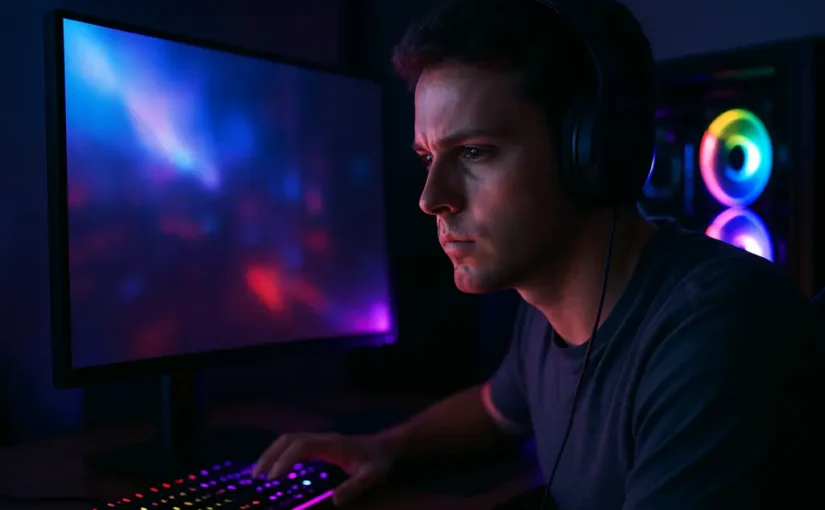
27-inch gaming monitors were once the easy recommendation for PC players who wanted a sensible mix of desk fit, sharpness, refresh rate, and price. As of September 6, 2026, that advice still holds, but the buying decision has become more split. Budget QD-OLED has moved into the range once held by good IPS panels, 4K OLED has made the 27-inch format much sharper, and mini-LED LCD still fights back with brightness that OLED panels often cannot match in full-screen HDR scenes.
This review is not based on private lab testing. It is a category review built from current hardware review findings and the monitor market data provided in the research notes. That matters because monitor quality is now highly dependent on use case. A competitive FPS player, a single-player HDR fan, and a buyer working in a bright room may all look at the same 27-inch screen and come away with different priorities.
Why 27-inch gaming monitors Got Harder To Buy
How 27-inch gaming monitors Split By Budget
The old 27-inch gaming monitor ladder was fairly simple: buy a 1440p IPS screen for value, step up to faster refresh if you played competitive games, and avoid premium OLED unless you had a large monitor budget. In 2026, that ladder has shifted. The Alienware AW2726DM is now discussed as a major budget OLED option because it brings a 27-inch 1440p QD-OLED panel, 240Hz refresh, strong motion clarity, deep contrast, and a roughly $350 price tier. For more detail on that specific value angle, our related coverage of the Alienware AW2726DM budget OLED explains why that model changed expectations for lower-cost OLED setups.
That does not make every cheaper monitor obsolete. The research notes also point to 27-inch mini-LED and IPS options under the same rough price band, with some mini-LED models sitting near $290. Those panels can still make sense if you care more about high sustained brightness than pixel-level black depth. Prices and availability can move quickly, so the useful question is not only “Is OLED cheaper now?” It is whether the panel type fits your room, your games, and the brightness level you actually use.
The 1440p Sweet Spot Is Still Real
For many PC gamers, 1440p remains the practical match for a 27-inch screen. It looks sharper than 1080p without demanding the same GPU power as 4K, and it pairs well with refresh rates from 180Hz through 360Hz. That makes 1440p the safest resolution for players who want one monitor for esports titles, RPGs, shooters, and everyday desktop use. The market has simply become less forgiving because OLED, mini-LED, and high-refresh IPS each make a different trade.
OLED, QD-OLED, WOLED, And Mini-LED
OLED Strengths And Brightness Trade-Offs
OLED’s main gaming appeal remains motion clarity and contrast. With per-pixel lighting, OLED panels can show black areas without needing a backlight zone to dim behind them. PC Gamer’s review coverage of the Gigabyte MO27Q28GR highlighted the contrast advantage from OLED’s pixel-level lighting while also noting the recurring HDR brightness trade-off: OLED can struggle with large bright full-screen scenes compared with strong LCD and mini-LED monitors PC Gamer’s Gigabyte review.
QD-OLED, WOLED, and Tandem OLED are no longer just spec-sheet labels. Research notes say QD-OLED panels generally deliver more vivid color, though they can show gray or purple tinting in bright rooms. WOLED panels can be more consistent in some color handling, but some models show gamma shifts at lower refresh rates. Tandem OLED has also entered the conversation at the premium end, aimed at improving brightness and longevity characteristics, though buyers should still judge each model from reviews rather than panel branding alone.
Mini-LED Still Makes Sense In Bright Rooms
Mini-LED LCD has not disappeared just because OLED pricing has fallen. It remains a strong alternative for bright rooms, HDR games with full-scene highlights, and buyers nervous about OLED care routines. The trade-off is that mini-LED relies on dimming zones rather than self-lit pixels, so blooming and zone behavior can matter. In a dark room, OLED contrast often feels cleaner. In a sunlit room or for sustained bright HDR scenes, a good mini-LED can still be the more practical choice.
Model Notes From The 2026 Shortlist
MSI MPG 271QRX For Competitive Players
The MSI MPG 271QRX is one of the clearest examples of where premium 1440p OLED has gone. It is a 27-inch QD-OLED monitor with a 360Hz refresh rate and full-bandwidth HDMI 2.1, which puts it squarely in the competitive FPS bracket rather than the casual upgrade bracket. RTINGS reviewed the model with those core specs, making it a useful reference point for players who care about very high refresh and fast motion response RTINGS’ MSI MPG 271QRX review.
For most players, the question is whether 360Hz is worth paying for over a cheaper 240Hz OLED. If you mainly play story games, racing titles, or mixed multiplayer at moderate frame rates, the extra refresh headroom may go unused. If you play shooters at high frame rates and tune settings for latency, the 271QRX sits in a more serious performance class.
ASUS PG27UCDM And The 4K 27-Inch Push
The ASUS ROG Swift OLED PG27UCDM shows the premium direction of the category. Research notes identify it as a 27-inch OLED 4K monitor with a 240Hz refresh rate, strong HDR performance, and very good picture quality, while still carrying the OLED limitation of lower full-screen brightness for large bright objects. Its appeal is straightforward: 3840×2160 resolution at 27 inches is very sharp, and 240Hz keeps it from feeling like an older productivity-first 4K panel.
The catch is system demand. A 4K 240Hz monitor can outpace many gaming PCs in demanding games, especially if ray tracing or high settings are involved. That does not make the screen a bad buy, but it means the monitor should be matched with a GPU plan. If the graphics card is more comfortable at 1440p, a cheaper 1440p OLED may deliver a better gaming experience for the money.
Alienware AW2726DM And The Budget OLED Shift
The Alienware AW2726DM is the monitor that makes the market feel different. A 27-inch 1440p QD-OLED panel at 240Hz was recently a premium-sounding spec list. At roughly $350 in the research notes, it turns OLED into a real option for midrange gaming desks. That pricing also pressures IPS and mini-LED monitors, because buyers now have to ask whether saving a little money is worth giving up OLED contrast and motion clarity.
Still, the AW2726DM is not automatically the right answer for everyone. OLED care, room lighting, text clarity preferences, and HDR brightness expectations all matter. Buyers who use one monitor for work documents all day and games at night should read long-form reviews before assuming a gaming-first OLED will also be the best productivity panel.
Buying Advice By Player Type

The most useful way to review the current 27-inch field is to start with the player, not the panel. A high-refresh esports player should look first at 1440p OLED models around 240Hz to 360Hz, with the MSI MPG 271QRX acting as the higher-speed reference. A mixed-use player who wants strong contrast, fast response, and a sane GPU target should start with 1440p OLED options such as the AW2726DM class. A bright-room HDR player should keep mini-LED on the list, especially if full-screen brightness matters more than perfect black levels.
| Buyer Type | Best-Fit Panel Direction | Main Trade-Off |
|---|---|---|
| Competitive FPS player | 1440p OLED at 240Hz to 360Hz | Higher cost for refresh headroom |
| Single-player HDR fan | OLED or mini-LED depending on room brightness | OLED contrast versus mini-LED brightness |
| Budget upgrader | Value QD-OLED, IPS, or lower-cost mini-LED | Price swings and feature cuts |
| Sharpness-first buyer | 27-inch 4K OLED at 240Hz | GPU demand and premium pricing |
It is also worth checking broader setup coverage before buying a display in isolation. A monitor can expose weak GPU choices, desk-space issues, poor speaker placement, and bad cable planning. For adjacent gaming-tech reading, you can explore related gear and setup topics at Rave Tech, which helps frame a monitor purchase as part of the whole desk setup.
Where 27-inch gaming monitors Stand In 2026
The practical review verdict for 27-inch gaming monitors is that quality has improved faster than the buying process has simplified. OLED is no longer only a luxury tier. Mini-LED is still relevant. 4K at 27 inches is now a serious gaming option rather than a productivity-only play. Very high refresh rates are available for competitive players, but they make the most sense only if the rest of the PC can feed them.
The safest pick for most gamers remains a 27-inch 1440p display, with panel choice driven by room lighting and budget. Choose QD-OLED if you want contrast, fast motion, and a more cinematic look in darker rooms. Choose mini-LED if you want stronger bright-scene HDR and fewer OLED ownership concerns. Choose 4K OLED only if sharpness is a priority and the GPU budget supports it.
The market is pricey at the top, but it is no longer barren in the middle. The best 2026 monitor buy is not the one with the loudest spec sheet. It is the one that fits your games, graphics card, room brightness, and upgrade timing without forcing the rest of the setup out of balance.