
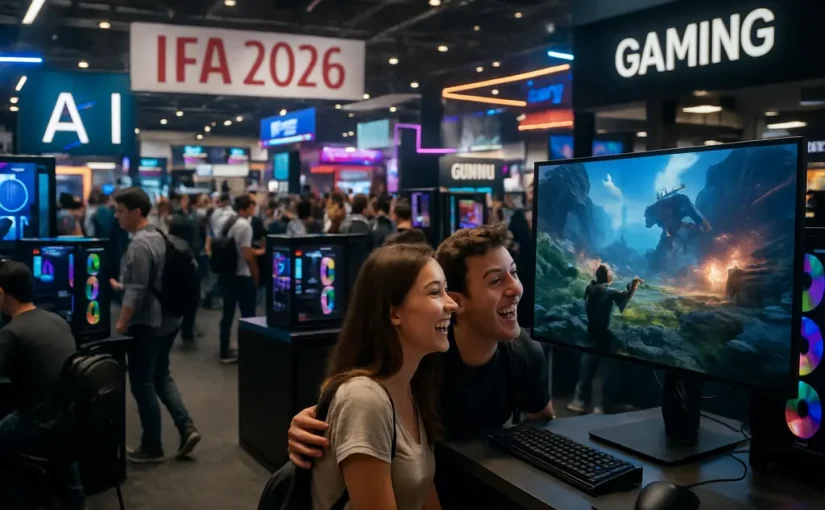
AI-enhanced gaming systems were one of the clearer signals from IFA 2026 in Berlin, which ran from September 4 to September 8, 2026 and had concluded by today, September 8, 2026. The useful read for players is not that AI has replaced the normal gaming PC, monitor, handheld, or console-style box. The better read is that vendors are now building systems that split their personality: one side for familiar GPU-driven gaming, the other for on-device AI features, local model work, display processing, assistant behavior, and smarter system control.
That makes the traditional-versus-AI comparison less dramatic, but more relevant to buyers. A normal gaming setup still wins on simple value: pick a CPU, GPU, display, storage, and controller or mouse setup that suits the games you actually play. The AI layer adds potential convenience and new workloads, but it can also add cost, cooling demand, and uncertainty around which features will matter after the first demo.
For readers interested in wide-ranging technology insights beyond just gaming, our related network site Rave Tech provides coverage of broader consumer technology trends. Meanwhile, Cooler Master Gaming remains focused on what these developments mean specifically for PC players, their setups, and upgrade timing.
What IFA 2026 Said About AI-enhanced gaming systems
AI-enhanced gaming systems Are Hybrid Machines
The strongest IFA 2026 takeaway was that vendors are not asking players to throw away the gaming PC model. Instead, the new pitch is hybrid hardware. A system can still lean on a dedicated graphics pipeline for games, while also carrying local AI hardware or memory capacity for assistant features, creator tasks, upscaling, device control, or model inference.
Tom’s Hardware’s IFA 2026 coverage highlighted hardware aimed at local AI workloads, including AMD Ryzen AI Max+ Pro 495 systems shown in AI Mini Workstation and NAS-style devices, with some designs expected to use up to 192GB of unified memory for larger local AI tasks, according to Tom’s Hardware’s IFA picks. That is not the same thing as a pure gaming benchmark win, and buyers should not treat it that way. It does show why PC-style systems are being pulled toward AI capacity alongside the usual GPU, display, and storage checklist.
Traditional Gaming Still Has A Clear Job
The traditional gaming system is still easier to judge. If the machine is built for competitive shooters, racing sims, action games, or high-refresh multiplayer, players tend to care about frame pacing, input feel, display response, compatibility, thermals, and driver maturity. Those basics have not disappeared because a system can run local models or adjust image processing automatically.
That is why the smarter comparison is not “old hardware versus new hardware.” It is “known gaming behavior versus extra AI behavior.” If the AI feature improves a display setting, reduces setup friction, helps with streaming, or supports content creation outside the game, it may be useful. If it sits unused while pushing up the total price, it is just another premium feature competing with a better GPU, a better monitor, more storage, or a quieter case.
Where Traditional Gaming Hardware Still Wins
Latency, Compatibility, And Player Trust
Traditional systems have one big advantage: players know what they are buying. A discrete-GPU desktop, a gaming laptop, or a dedicated handheld is judged against familiar questions. Does it run the games in your library? Does it support your display target? Is it quiet enough? Can it be serviced or upgraded? Does the software behave?
AI features add another layer of trust. A player may want to know whether image tuning can be disabled, whether a motion feature adds lag, whether an assistant collects personal usage data, and whether local processing really stays local. The research notes from IFA 2026 point toward more on-device AI, which is encouraging for latency and privacy in principle, but each product still needs its own review and software check before buyers can treat that as a strength.
The Setup Is Easier To Budget
A traditional setup also gives buyers more control over the spend. If you are building around 1080p esports, a lighter GPU and high-refresh monitor might be enough. If you want 1440p single-player games, the graphics card and display become the center of the budget. If you are buying a handheld, battery behavior and screen quality may matter more than any AI badge.
With an AI-heavy product, the price may reflect hardware that not every player needs. More memory, a stronger NPU, AI display processing, or a flagship chassis can be useful, but those items should earn their place. A good buying rule after IFA 2026 is simple: do not pay extra for an AI claim unless you can name the feature, the game or app it helps, and whether it runs locally or depends on a cloud service.
The Buying Trade-Off For AI-enhanced gaming systems
Display Tech Is A Real Example
Gaming monitors are one of the more practical places to watch AI-driven features because displays already process images before players see them. IFA 2026 included high-refresh OLED and MiniLED gaming displays, and Tom’s Hardware reported that the Acer Nitro XV275U Z2 uses 1,152 MiniLED backlight zones, reaches up to 1,000 nits of HDR brightness, and was listed at $329 for Q4 2026 in that coverage. Those numbers matter because a display can affect every game, not just titles that support a specific AI feature.
Still, buyers should be careful with AI display language. Motion interpolation can sound attractive for video or casual play, but competitive players often care more about input response and native refresh behavior. Contrast and color tuning can be useful, but only if it can be adjusted, disabled, or profiled sensibly. Local dimming zones and HDR brightness are clearer hardware facts than a vague AI image claim.
| System Type | Why It Still Makes Sense | What To Check Before Buying |
|---|---|---|
| Traditional gaming PC | Clear upgrade path and familiar performance trade-offs | GPU tier, cooling, PSU headroom, and display target |
| Gaming handheld | Portable play with a focused power envelope | Battery behavior, screen quality, controls, and game support |
| AI-focused mini workstation | Local AI workloads alongside PC-style flexibility | Memory capacity, cooling, software support, and gaming mode behavior |
| AI gaming monitor | Image processing can apply across many games | Latency options, local dimming behavior, HDR settings, and disable controls |
AI Features Should Not Hide Core Specs
AI-enhanced gaming systems can be worth considering when the normal hardware is strong first. A gaming laptop with weak cooling is not rescued by AI branding. A monitor with poor response behavior is not fixed by smart color tuning. A desktop with limited upgrade options still needs to justify its case, power, thermals, and parts access.
This is also where price pressure matters. If AI-capable memory configurations and local inference hardware push systems into flagship territory, many players may be better served by traditional parts that hit a known target. That is especially true for mid-range buyers who mainly want a machine for Steam libraries, multiplayer sessions, mods, Discord, capture software, and a few creator apps. For a broader look at how AI is already changing PC gaming expectations, our piece on AI gaming technology connects the hardware trend to software disclosure and player trust.
Physical AI Was Bigger Than Gaming

Robots Showed The Wider Direction
IFA 2026 also pushed AI beyond PCs and monitors. The show placed humanoid robots and intelligent helpers in the spotlight, with demonstrations built around robot movement, smart-home interaction, and embodied AI behavior. IFA’s own release described humanoid robots on the runway and physical AI as part of intelligent helpers for everyday life, according to IFA Berlin.
That matters for gaming only indirectly, but it explains the mood around the show. AI is being framed as something that can sense, move, assist, and act across devices. Gaming systems are part of that direction, but they are not the whole story. A gaming PC does not need robot behavior to be useful. It does, however, live in a home where AI assistants, smart displays, local inference boxes, and connected peripherals may start sharing more of the same hardware ideas.
Players Should Separate Useful AI From Show-Floor Theater
The risk after any large tech show is that players remember the spectacle and forget the buying checklist. A robot demo is fun to watch. A high-memory AI box is interesting. A monitor with smart tuning sounds neat. None of that tells you whether your next system should spend more on AI acceleration than on a better GPU, quieter cooling, or a larger SSD.
For gaming, the best AI features are the ones that stay practical. They should reduce friction, improve image quality without harming response, help creators manage streaming or editing, or let local tools run without sending every request to a cloud service. If the benefit is unclear, wait for reviews from hardware testers who can compare settings, measure behavior, and show trade-offs without relying on vendor demos.
IFA 2026 Gaming Systems Takeaways
IFA 2026 made AI-enhanced gaming systems feel less like a side category and more like the next premium branch of PC-style hardware. The key word is premium. Much of the most interesting AI hardware is likely to sit above entry-level pricing at first, while traditional PCs, monitors, and handhelds remain the safer choice for players with fixed budgets and clear game targets.
- Buy traditional hardware if your main goal is predictable gaming value, easy compatibility, and a clear upgrade path.
- Consider AI hardware if you also run local AI tools, creator workloads, smart assistants, or display features you will actually use.
- Treat AI monitor claims carefully, and check whether motion, contrast, or tuning features can be controlled or disabled.
- Do not trade away cooling, power quality, storage, or display fundamentals just to buy a higher-AI model.
The practical takeaway is that AI-enhanced gaming systems should be judged as gaming systems first. If the GPU, display, cooling, input behavior, storage, and software support make sense, the AI layer can be a useful extra. If the normal gaming hardware is compromised, the AI badge is not enough. After IFA 2026, the best buyer is not the one chasing the most futuristic spec sheet. It is the one who can tell which features will change daily play and which ones belong in a trade-show demo reel.