
Your powerful PC is more like a moody artist than a sleek machine. It gets upset if you try to play demanding games. I’ve seen many PCs get overwhelmed by heat, not just tough enemies.
It’s not just about avoiding crashes. It’s about getting the most out of your PC. Data shows that good cooling can improve CPU performance by 25%. That means more games running smoothly.
Without the right cooling, your PC will get old faster. Heat is a silent enemy that hurts performance and shortens life. It’s a major problem.
So, why let your PC get too hot? Think of cooling as a wise guide for your CPU. In the world of gaming, staying cool is key to success.
Air vs Liquid Cooling Explained
Air cooling is like the infantry, solid and reliable. Liquid cooling is like the special forces, more advanced. Both keep your CPU cool, but in different ways.
Air cooling uses big heatsinks and fans to fight heat. It’s like using strength to solve problems.
Liquid cooling, on the other hand, is like a sophisticated system. It moves heat away quietly and efficiently. It’s a smooth, elegant process.
So, which one is better? The answer is clear. New cooler designs can cut thermal resistance by up to 30%. This is a big deal.
This drop in thermal resistance means your CPU can run faster. For those who love to push their systems, this is great news. You could see a 10-15% boost in performance.
But numbers only tell part of the story. Let’s look at what really matters.
| Aspect | Air Cooling | Liquid Cooling |
|---|---|---|
| Core Philosophy | Brute force dissipation | Elegant heat transfer |
| Noise Profile | Can get loud under load | Generally quieter operation |
| Installation | Straightforward, often simpler | More complex, requires planning |
| Performance Ceiling | Good for most stock operations | Superior for extreme overclocking |
| Maintenance | Dust cleaning occasionally | Potential for pump failure, leaks |
I didn’t pick a winner. The best cooler depends on your needs.
For a quiet PC, air cooling might be best. But for extreme tasks, liquid cooling is the way to go.
Remember, liquid cooling offers more power but at a cost. It’s more expensive and complex. Is it worth it? It depends on your goals.
Don’t get caught up in the hype. Think about what you really need. Both air and liquid cooling have their strengths.
The debate between air and liquid cooling isn’t about good vs bad. It’s about finding the right solution for your cooling needs. Your CPU just wants to stay cool.
CPU Cooler Performance Testing
Marketing claims often disappear quickly when a CPU cooler is tested in real life. I’ve seen many cool-looking heatsinks fail when put to the test. It’s not about the fan speed or the lights; it’s about the actual numbers.
A TechPowerUp report showed that a good aftermarket cooler can drop CPU temperatures by over 30 degrees Celsius under full load. This is a big difference. It means your processor won’t overheat during intense gaming sessions.
Why is this important for gaming? Lower temperatures mean your CPU can run faster and longer. This isn’t just about showing off. It’s about getting those extra frames in games when every second matters. A cooler that can’t handle this makes your expensive chip seem average.
So, what should you look at? Don’t just focus on the highest temperature.
- Delta T (ΔT): This shows how well a cooler keeps your CPU cool compared to the room. A lower delta T means better cooling.
- Noise-Normalized Performance: This measures how cool your chip stays while being quiet. It’s about finding a cooler that’s both cool and quiet.
- Consistency Under Dynamic Load : Games don’t heat up steadily. A good cooler keeps your CPU cool even when it’s under sudden stress.
Idle temperatures aren’t useful for testing a gaming CPU cooler. The real test is during a burn-in test like Prime95 or a long gaming session in Cyberpunk 2077. That’s when you see how well it performs.
Benchmarking shows you what’s real and what’s just marketing. For gamers, this information is key to getting a fast and stable system.
GPU Cooling Modifications
GPU cooling modifications take PC building to a new level. It’s about moving from factory settings to custom, high-performance cooling. For gamers, this is the top of PC gaming cooling.
The stock cooler on your graphics card is good but limited. It’s made to be affordable but often can’t handle intense gaming. This leads to your GPU slowing down when you need it to speed up.
The modding community offers three main ways to improve cooling:
- Aftermarket Air Coolers: These big, new coolers replace the old one. They offer more surface area and better airflow.
- Hybrid Liquid Cooling Kits: This mix uses a liquid cooler for the GPU core and air for the rest. It’s a smart choice.
- Custom Water Blocks: This is the top choice. It wraps your GPU in a custom water loop for the best cooling.
Switching to a big aftermarket air cooler is easy. It’s like upgrading from a small car fan to a big industrial blower. Your GPU can run cooler and faster. Check out these VGA cooling solutions for more options.
Hybrid kits are a smart choice. They cool the GPU core well but use air for the rest. This is a great way to cool your GPU without too much work.
Custom water loops are for the serious enthusiasts. They need planning and a good budget. But they offer amazing cooling and quietness. They show the best way to remove heat.
It’s like having a high-tech phone cooler for your desktop. It’s not just about blowing air; it’s about moving heat away. The goal is to keep your system running at its best.
Is it needed for everyone? No. But for those who love gaming, it’s a must. It’s about getting the most out of your system. You’re not just buying a cooler; you’re buying better performance, silence, and longer life. That’s true gaming cooling mastery.
Case Airflow Optimization
The fight for cool components isn’t just about the CPU heatsink. It’s about the air currents inside your case. Poor airflow can be a silent killer, causing your GPU and CPU to overheat.
Optimizing your gaming cooling setup is more than just using loud fans. It’s about smart design. You need to become an architect of your case’s atmosphere.
The Pressure Principle: Positive vs. Negative
The core concept is about air pressure. Positive air pressure means more intake fans than exhausts. This pushes air out through every mesh and crack.
Negative air pressure is the opposite. It has more exhaust than intake. This creates a vacuum, pulling air in through unfiltered cracks.
So, which is better for your rig? Positive pressure is usually the best. It keeps dust out by ensuring air only enters through filtered intakes. Negative pressure, on the other hand, turns your case into a dust magnet.
Fan Placement: The Strategic Map
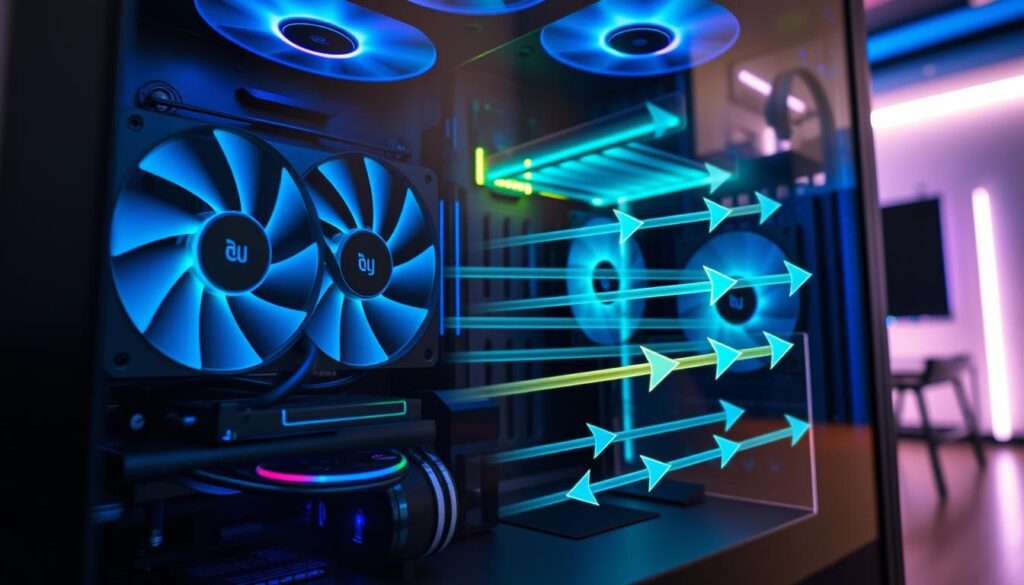
Placement is key. You’re directing a play, not causing a riot. The rule is: front and bottom are for intake (cool, fresh air). Rear and top are for exhaust (hot air rises, let it escape).
Imagine a logical river of air flowing from the front of your case, over your components, and out the back. Your job is to remove obstacles and guide the current. Avoid fans fighting each other. An intake fan pointed directly at an exhaust fan just creates a short-circuit, bypassing your components entirely.
This is where engineering meets art. Not all fans are created equal. The blade design is critical for promoting smooth airflow while reducing noise. Static pressure fans have tighter, more angled blades designed to push air through tight spaces like radiators or dense heatsinks.
Airflow fans have wider, more spaced blades optimized for moving large volumes of air through open spaces. Using the right fan for the right job is a subtle but powerful upgrade. It’s the difference between a turbulent, noisy gale and a quiet, laminar breeze that effectively whisks heat away.
So, how do you put this all together? Let’s compare the primary airflow strategies to see which configuration suits your gaming cooling goals.
| Configuration | Setup | Pros | Cons | Best For |
|---|---|---|---|---|
| Positive Pressure | More/better intake fans than exhaust (e.g., 3 intake, 2 exhaust). | Dramatically reduces dust ingress. Directs airflow predictably. Generally quieter. | Can lead to slightly higher internal temps if not balanced well. Requires good filtered intakes. | Most users, including those in dust-prone environments. The set-it-and-forget-it choice. |
| Negative Pressure | More/better exhaust fans than intake (e.g., 1 intake, 3 exhaust). | Can offer slightly better peak heat expulsion in open-bench scenarios. | Major dust accumulation. Air takes unfiltered paths, depositing debris on components. | Extreme overclocking benches where the case is regularly opened and cleaned. Not recommended for daily systems. |
| Balanced Flow | Equal number and strength of intake and exhaust fans. | Theoretical ideal for laminar, straight-through airflow. Simple concept. | Hard to achieve perfectly. Often defaults to slight negative pressure due to case resistance. | Enthuisiasts with high-quality, matched fan sets who enjoy precise tuning. |
The goal is simple: create an environment where your expensive cooling hardware can actually perform. You wouldn’t put a Formula 1 engine in a go-kart chassis and expect to win. Why pair a top-tier CPU cooler with a case that chokes it? Master your airflow, and you stop fighting your components’ environment. You start collaborating with it. That’s the secret to unlocking stable, quiet, and relentless gaming cooling performance.
Thermal Paste Application Guide
Think of thermal paste as a bridge between your CPU’s heat and your cooler’s cooling power. It’s a small, gray compound that’s key to your cpu cooler gaming setup. Its role is to fill in tiny gaps between the CPU and cooler, helping to remove air pockets.
There’s a lot of talk about how to apply it. Some say use a pea-sized dot, others an X pattern, or smear it like butter. The truth is, you want a thin layer that’s evenly spread. Too little and you get hot spots, too much and it blocks heat transfer.
- Clean First: Use isopropyl alcohol and a lint-free cloth to remove old thermal material. Any leftover residue hinders heat transfer.
- The Dot Delivers: For most CPUs, a small pea-sized dot in the center is enough. The cooler’s weight will spread it evenly.
- Mount with Care: Place the cooler straight down. Use a cross pattern to mount it, ensuring even pressure.
- Less is More: You likely need less paste than you think. Too much will spill out, wasting material.
This is a simple yet effective way to boost your PC’s performance. Applying it wrong is like using a fancy handkerchief to clean a grease trap. Doing it right ensures your CPU’s heat is transferred smoothly to the cooler. This prevents overheating and helps maintain stable performance. For gamers, mastering this step is key to a top-notch gaming experience.
In the world of cpu cooler gaming, spending a few minutes on perfect thermal paste application is worth more than all the RGB lights in the world.
Noise vs Performance Balance
Modern cooling isn’t just about being quiet or cool. It’s about finding a balance between the two. Sometimes, your PC can get so loud during quiet moments in games. This noise can ruin your gaming experience by making it hard to hear important sounds.
But, there’s good news. New advancements in gaming cooling aim to solve this problem. They help you keep your PC cool without making too much noise.
Fans have changed a lot. Now, they have special designs that make them quieter. These designs can cut down noise by 40% compared to old fans. This is because they move air more efficiently, so they don’t have to spin as fast.
PWM (Pulse Width Modulation) control is another key feature. It lets fans run quietly most of the time. Only when your PC gets hot does the fan speed up. This way, the fan only gets loud when it needs to.
So, how do you choose the right setup? It depends on how quiet you want your PC to be and how fast you want it to run. Do you want it to be super quiet, or are you okay with a bit of noise for better performance?
| User Profile | Noise Priority | Performance Priority | Recommended Cooler Type | Fan Strategy |
|---|---|---|---|---|
| The Silent Operator | Extreme | Moderate | Large Air Cooler or Quiet AIO | Low-noise fan models, aggressive low-temperature fan curve. |
| The Balanced Gamer | High | High | Quality AIO or Premium Air Cooler | PWM fans with a balanced curve, focus on case airflow. |
| The Overclocking Enthuasiast | Low | Extreme | High-performance AIO or Custom Loop | Static pressure fans, higher RPM tolerance, prioritize thermal headroom. |
For most, the best choice is the “Balanced Gamer” option. A good liquid cooling review can help a lot. A well-made AIO liquid cooler can cool your CPU better, so its fans can run slower and quieter.
The goal is to find a balance. You want your PC to be cool and quiet at the same time. By choosing smart components and setting up good fan curves, you can create a system that stays cool without being too loud. This is what makes gaming cooling sophisticated.
Custom Loop Basics
Building a custom water cooling loop is like open-heart surgery. It’s scary, detailed, and can be amazing. This upgrade takes a whole weekend, patience, and a small budget. You’ll also need to accept that you’re now a plumber and an artist.
This project is attractive for two main reasons: it cools better and looks stunning. A well-made custom loop doesn’t just cool; it shows off. Your computer turns into a moving art piece, with coolant flowing through clear tubes.
Before you start, know the main parts. A basic loop has:
- Pump: The heart. It moves the coolant.
- Reservoir: Holds extra fluid and helps manage air bubbles.
- Radiator(s): The lungs. They dissipate heat into the air.
- Tubing: The arteries. Rigid acrylic for sharp lines, soft rubber for easier bends.
- Fittings: The connective tissue. They join tubes to every other component.
- Water Blocks: The interfaces. They attach directly to your CPU and GPU.
The benefits are clear. A custom loop offers better cooling and can handle extreme overclocking. It’s the top choice for serious liquid cooling review enthusiasts.
But, there’s a catch. Quality parts can be expensive, like a mid-tier GPU. The project also takes a lot of time and effort. Plus, you’ll need to keep it clean and check the coolant regularly.
Leak risk is another big concern. A single mistake can ruin everything. This is why experts are so careful. For you, it means planning well and testing everything for 24 hours without power.
Is it for you? Let’s look at the facts. The table below gives you a clear view of what to expect.
| Aspect | Custom Loop | High-End Air / AIO Cooler |
|---|---|---|
| Peak Thermal Performance | Unmatched. Best for pushing overclocks to the limit. | Excellent. Handles most overclocking needs with ease. |
| Aesthetic Control | Total. You choose every color, material, and tube run. | Minimal. You get the cooler’s design, maybe some RGB. |
| Initial Cost & Complexity | Very High. A significant investment of money and time. | Moderate. A straightforward purchase and installation. |
| Ongoing Maintenance | Required. Yearly coolant changes and system checks. | Minimal. Mostly just cleaning dust from fans and fins. |
| Inherent Risk Factor | Present. Leaks can damage components if not properly tested. | Negligible. A sealed system with virtually no leak risk. |
So, who wins this liquid cooling review? The custom loop isn’t a competition. It’s for those who love building and need top-notch cooling.
For most people, a good air cooler or AIO is better. The custom loop is for the ultimate challenge. Make sure you really want to do this before you start.
Monitoring & Control Software
The true art of gaming cooling isn’t just in the radiators and heat pipes. It’s in the silent, digital dialogue between sensor and software. Your hardware is brilliant, but without the right guidance, it’s just a very expensive space heater with lights.
This is where monitoring and control utilities become your system’s central nervous system. They translate the raw thermal gossip from your CPU and GPU into something you can understand and command. It’s the difference between watching a silent movie and having a real-time, subtitled thermal tête-à-tête.
The star of this show is PWM, or Pulse Width Modulation. Think of it as the software’s gentle hand on the fan’s throttle. PWM lets the software adjust fan speed with incredible precision based on temperature. Your goal is to craft a fan curve—a set of instructions that says, “At this temperature, spin this fast.” A good curve is responsive, not reactive. It ramps up fans smoothly as things warm up, preventing a temperature spike, not screaming to life after the damage is done.
Mastering this turns your PC from a digital panic room into a calm, measured environment. You get performance when you need it and silence when you don’t. An idle whisper, a gaming roar—all controlled like a zen master.
So, which software suite gets you this granular control? Here are the heavy hitters:
- HWInfo64: The intelligence agent. It provides staggering depth of real-time telemetry for every sensor in your system. It’s for the analyst who wants all the data.
- MSI Afterburner / RivaTuner Statistics Server: The dynamic duo for GPU overclockers. Famous for its in-game overlay, it gives you direct control over your graphics card’s fan profile and clocks.
- Fan Control by Rem0o: The universal translator. This brilliant, often-free tool can unite fans from different manufacturers under one cohesive, highly customizable curve. It’s a game-changer for mixed-fan setups.
- Your Motherboard’s Native Software (Armoury Crate, iCUE, CAM, etc.): The integrated command center. These are designed for seamless control of their own ecosystem’s fans and RGB. Convenience is their main advantage.
Ultimately, this software is about removing the degrees of separation between you and your machine’s thermal behavior. Knowledge here isn’t just power—it’s quieter fans, lower temperatures, and a longer-lasting system. You’re not just cooling; you’re conducting.
Maintenance & Longevity
Keeping your gaming PC running well for years isn’t just about the initial purchase. It’s about how you take care of it over time. Think of it as giving your high-performance machine regular check-ups. Neglect can lead to a slow, overheated demise.
Dust and decay are your main enemies. Dust in your case isn’t cute; it’s a problem. It blocks fan blades and heatsinks, making them less efficient.
Thermal paste also has a limited lifespan. Over time, it dries out and becomes less effective. This can slow down your CPU cooler.
So, what’s the benefit of all this effort? Studies show that a good cooling system can extend your CPU’s life by about five years. That’s a big deal.
This effort is worth it. It keeps your system running smoothly and prevents costly damage. A stable CPU means a stable system.
Let’s talk about a simple maintenance routine. You don’t need to clean your PC every week. But a little regular care can prevent big problems later.
| Component / Task | Recommended Frequency | Key Action |
|---|---|---|
| Case & Fan Dusting | Every 3-6 Months | Use compressed air to blow dust from filters, fan blades, and case vents. Focus on intake areas. |
| CPU Cooler Inspection | Every 12 Months | Visually check for dust matted in heatsink fins. For air coolers, this is a quick blast of air. |
| Thermal Paste Reapplication | Every 2-3 Years | Replace old, dried thermal paste with a fresh, pea-sized amount. This is key for any gaming CPU cooler. |
| Fan Bearing Check | During Cleaning | Listen for grinding or whining noises. A failing fan can’t move air, making your system work harder. |
| Overall Airflow Audit | After Hardware Upgrades | When you add new hardware, check your case’s airflow. Avoid creating hot spots. |
Following a simple maintenance plan does more than keep your PC cool. It keeps your system running smoothly. No sudden drops in performance during games.
Longevity in PC gaming is about consistent performance. It’s a system that works well year after year. Your premium cooler was a smart choice. Keeping it maintained is the next step.
Take good care of your cooling system, and it will protect your expensive components. This peace of mind is a big advantage of regular maintenance.
Best Cooling by Use Case
Looking for the ultimate gaming cooling setup? It all depends on the game you’re playing. Are you chasing frames, seeking silence, or aiming for longevity?
For esports players, every millikelvin counts. Your setup needs to be fast, not peaceful. A big dual-tower air cooler or a 360mm AIO is perfect. Noise isn’t a big deal when you’re competing.
Building a PC for the living room? You want it to be quiet. Look for coolers that are almost silent. Brands like be quiet! or a quiet AIO are great choices. Reviews often praise these for their quiet operation.
Overclocking enthusiasts see cooling as a challenge. They need top-notch cooling from a custom loop or a high-end AIO. This is where serious cooling makes a difference, similar to how zero-latency cloud gaming infrastructure relies on optimized performance conditions to deliver consistent, high-speed experiences.
For those on a budget, focus on value. A good air cooler like the Thermalright Peerless Assassin is affordable and lasts long. It’s a smart choice for budget gaming.
The right cooling solution depends on your goals. Your needs define the perfect setup. Now, it’s time to build something amazing.