
I’ve seen more systems crash from bad energy parts than from CPU failures. It’s the part we often ignore, until the screen goes dark in a critical moment.
This guide isn’t about selling you a box of watts. It’s a deep dive into the unsung hero of your system. Stability under load is a must for serious performance.
We do hands-on stress tests and deep technical analysis. Why? Your hardware needs a solid base, like reliable internet during a big game. We’ll break down the specs, from silent efficiency to the power needed for new graphics.
Every pick here is about long-term value and safety, not just looks. It’s your guide to building without worry.
Why PSU Quality Matters for Gaming
We often focus on GPU core counts and CPU speeds. But the power supply is key to it all. A weak PSU can hold back even the best GPUs, keeping them from reaching their full power.
A good gaming power supply is about precision, not just wattage. It ensures steady power and protects against power spikes. It acts as a shield, keeping your system safe and stable.
It’s all about “clean vs. dirty” power. Dirty power can cause issues like micro-stutters and random shutdowns. Modern GPUs need clean power to run smoothly.
If a PSU can’t handle power spikes, it might shut down. This can be annoying or even damage your system over time. It’s a risk you don’t want to take.
| Scenario | With a Quality PSU | With a Poor PSU |
|---|---|---|
| Power Delivery | Clean, stable voltage on all rails. Handles GPU/CPU transient spikes effortlessly. | “Dirty” power with ripple. May crash under high transient loads. |
| System Stability | Rock-solid performance. No random crashes or reboots during intense gaming sessions. | Micro-stutters, freezes, and unexpected system shutdowns. |
| Component Safety & Longevity | Advanced protections (OPP, OVP, UVP) safeguard your expensive GPU, CPU, and storage. | Increased risk of damage from surges, poor voltage regulation, or overheating. |
| Future-Proofing | Stable platform for overclocking and upgrading to more powerful components later. | Limits upgrade ability. May need replacement with any significant hardware change. |
| Overall Experience | Quiet, confident operation. The system feels like a tuned instrument. | Anxiety. You wonder when the next hiccup or failure will occur. |
The right PSU does more than prevent disaster. It enables performance. It gives you the stable foundation to push an overclock, to know your RGB lighting won’t flicker, and to add that next-gen GPU without a second thought. Choosing a unit with robust protections and headroom is the smartest insurance policy you can buy. For a deeper dive into what those efficiency labels mean, I recommend understanding PSU ratings.
So, while it doesn’t render polygons or calculate physics, your power supply for gaming dictates whether those fancy components can do their job at all. Never cheap out on the foundation.
Efficiency Ratings & Power Draw
Your PSU’s efficiency rating is like its metabolic rate. It shows how well it turns AC power from the wall into DC power for your components. The difference between what you pay for and what your PC uses is waste heat.
The 80 Plus certification is like a report card for your PSU’s performance. It tests how well your unit does under three loads: 20%, 50%, and 100%. This shows how efficient it is.
Decoding the 80 Plus Badge
Bronze, Gold, Platinum, Titanium are not precious metals but efficiency levels. Each level means less energy lost as heat and more money saved. A Bronze unit might convert 85% of power at full load, while a Titanium unit converts over 94%.
| Certification Tier | Typical Efficiency at 20% Load | Typical Efficiency at 50% Load | Typical Efficiency at 100% Load | The Real-World Takeaway |
|---|---|---|---|---|
| 80 Plus Bronze | ~82% | ~85% | ~82% | The budget-conscious entry. You’ll lose more power as heat, specially at peak loads. |
| 80 Plus Gold | ~87% | ~90% | ~87% | The sweet spot for most gamers. Excellent balance of cost, efficiency, and thermal performance. |
| 80 Plus Platinum | ~90% | ~92% | ~89% | For the silent, cool-running enthusiast build. Premium components, minimal energy waste. |
| 80 Plus Titanium | ~90% | ~94% | ~90% | The hyper-efficient apex. Like a hybrid supercar engine—max performance, minimal exhaust (heat). |
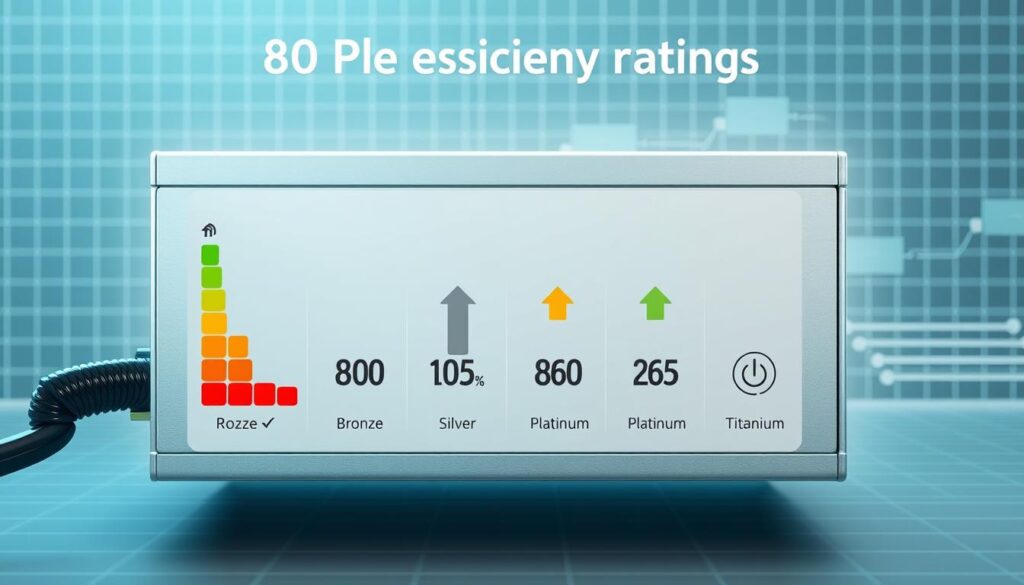
A PSU is often happiest—quietest and most efficient—when operating at about 50% of its rated capacity. This is the performance sweet spot. It leads to a counterintuitive but brilliant strategy.
Imagine running a demanding game on two different systems. One uses a 600W Bronze PSU straining at 95% load. It’s hot, the fan is whirring, and efficiency is plummeting. The other uses a 1000W Gold unit cruising at a 500W (50%) load. It’s cooler, quieter, and sipping power more effectively. The higher-wattage, higher-efficiency unit often provides a better experience, even if you never use its full capacity.
Choosing your efficiency tier is like selecting the fuel grade for a performance car. You can run premium in any engine, but in a high-strung system, it delivers cleaner operation, better stability, and long-term savings. This logic is a cornerstone of any serious modular psu review. It’s not just about cable management, but about intelligent power economics that affect your entire build’s health and your wallet’s bottom line.
Modular vs Non-Modular Cables
Imagine your PC’s interior as a gallery. Do you want it to look like a rat’s nest or a clean, minimalist space? Your power supply is the key to this choice. It affects not just looks, but also airflow, thermals, and your sanity.
Non-modular PSUs are like pre-wired tract homes. They come with every cable, whether you need them or not. This leads to a tangled mess of unused wires that blocks airflow and collects dust.
Modular PSUs, on the other hand, are like custom-built homes. They let you use only the cables you need. This makes your case interior look like it belongs in a tech museum.
The benefits are clear. Better airflow means cooler components. Installation and upgrades become easier. It’s like the difference between wrestling an octopus and conducting a symphony.
The Cable Conundrum: A Trio of Types
Before we decide, let’s look at the three types of cables.
- Non-Modular: All cables are fixed. It’s cheap but messy.
- Semi-Modular: The main cables are fixed, but extras can be removed. It’s a good middle ground.
- Fully Modular: Every cable can be removed. This is the ultimate in customization.
For most builders, semi or fully modular is the best choice. But there’s a critical point to remember.
The Not-So-Universal Truth of Modular Cables
Modular cables are great, but they have a warning. They are not universal. The connections on the PSU side vary by manufacturer and model.
Using modular cables from one PSU on another is risky. Plugging the wrong cables can damage your GPU or motherboard. It’s not just a boot failure; it’s expensive and smoky.
The rule is clear: use only the cables that come with your PSU. Treat them well. If you lose them, you’ll need to get exact replacements from the manufacturer.
| Feature | Non-Modular | Semi-Modular | Fully Modular |
|---|---|---|---|
| Core Concept | All cables permanently attached | Essential cables fixed, extras detachable | Every cable is detachable |
| Price Point | Most Budget-Friendly | Mid-Range Value | Premium Investment |
| Cable Management | Very Difficult, Clutter Inevitable | Good, Reduces Unused Cables | Excellent, Maximum Cleanliness |
| Airflow Impact | Often Poor (Blocks Pathways) | Good (Minimal Obstruction) | Best (No Unnecessary Cables) |
| Best For | Extreme Budget Builds | Most Gamers & Enthuasiasts | High-End, SFF, & Aesthetic Builds |
So, what’s the best choice for a gaming PSU? Unless you’re on a very tight budget, go for modularity. The benefits of a clean build, better thermals, and satisfaction are worth the extra cost. Just remember, with great power comes great responsibility. Treat those cables with care.
Noise Testing Under Load
Ever had a cutscene ruined by a loud power supply fan? It’s like a cell phone ringing in a movie. For serious power supply gaming, sound quality is key. I test power supplies under heavy load to see how they perform.
Noise Testing Under Load
Top-notch power supplies use smart tech to stay quiet. They have a special mode where the fan only kicks in when it gets hot. This is like having a silent butler who only acts when needed.
When the fan does turn on, its design matters. Fluid Dynamic Bearing (FDB) fans, like in the Corsair HX1500i, are quiet and smooth. They don’t make annoying sounds like cheaper fans do. A bigger fan, like the 135mm one in the be quiet! Pure Power 12 M, can be quieter because it moves air at lower speeds.
Here’s what makes a power supply quiet during load tests:
- The Ramp-Up Profile: Does the fan speed up smoothly or suddenly? A smooth increase, like in the Super Flower Leadex III, is important.
- The Tone Quality: Is it a soft whoosh or a high-pitched whine? The latter is annoying and often means the PSU is not well-made.
- The Thermal Feedback Loop: A loud PSU is usually too hot. Too much noise under load can mean poor cooling, which harms your system’s life.
Choosing a quiet power supply gaming setup is more than just about being quiet. It’s about keeping your system cool and your sanity. You bought that expensive graphics card to enjoy the game sounds, not the PSU’s noise.
Safety Certifications & Protection
A PSU’s protection features are not just marketing tricks. They are what keep your system safe from damage. In any serious modular psu review, we look beyond the marketing. We use a multimeter to check if a PSU really works.
These circuits act like your PC’s immune system and emergency team. A PSU’s claims are cheap. But, when it really works under stress, that’s priceless. We respect tier lists that demand real proof, not just promises.
The Guardian Protocols: Decoding the Alphabet Soup
What do all these acronyms really do for you? Let’s make engineer-speak easy to understand.
- OVP & UVP (Over/Under Voltage Protection): These are the bouncers. OVP stops power surges from harming your GPU. UVP prevents low voltage from causing data loss. They keep everything safe.
- OCP (Over Current Protection): This is the circuit breaker. If a rail draws too much current, OCP stops it before damage happens.
- OPP (Over Power Protection): This is the weight limit sign. It checks total wattage output. If you go over, OPP shuts it down to prevent damage.
- OTP (Over Temperature Protection): This is the fire alarm. A good OTP senses high temperatures and stops power before damage occurs. A bad one is useless.
- SCP (Short Circuit Protection): This is the instant emergency stop. It cuts all power if it detects a short circuit. This is essential.
For a unit to be in Tier B or above, it must have these protections tested. This is the standard.
Why is this important for a modular psu review? Modular cables can lead to user errors. Good protections are your safety net against these mistakes.
Two important but often overlooked features are ripple suppression and voltage regulation. Ripple is electrical “noise” that can harm components. Good regulation keeps voltages steady, even with load changes. A unit that does this well is like a heart with a steady rhythm.
Ignoring these protections is a false economy. It’s like buying a car without airbags to save money. When an electrical problem happens, a good PSU protects your expensive components. This is not just a feature; it’s electrical insurance.
From any credible modular psu review, you should know: demand verified protection. A PSU that has been lab-tested and has these protections active is the only one worth considering for a high-stakes build.
Top PSUs by Wattage Category
The best gaming PSU isn’t just one model. It’s the right fit for your build’s power needs. Using a 1500W PSU in a small rig is like using a firehose on a bonsai tree. It’s overkill, expensive, and silly.
My picks are based on wattage. It’s not about who’s the most popular. It’s about matching your components with the right PSU.
The Contenders, Sorted by Power Class
We start with the highest power and go down to the best value. Each PSU is top in its class for performance, reliability, or value.
The Overkill Elite (1300W & Above)
For those with top GPUs and CPUs, and no plans to upgrade. The CORSAIR HX1500i is the top choice. It has digital monitoring and is very reliable.
The Super Flower Leadex III ATX 3.1 is a great rival. It supports the latest GPU power needs. These PSUs are like a power grid for your case.
The Compact Powerhouse (1200W)
Small Form Factor (SFF) builds need special PSUs. The ASUS ROG Loki SFX-L 1200W is a marvel. It’s small but packs a lot of power.
This PSU is like a sports car engine in a go-kart. It’s perfect for niche enthusiasts.
The Silent Sentinel (1000W)
For quiet gaming setups, the be quiet! Pure Power 12 M 1000W is ideal. It’s very quiet and efficient. It’s perfect for builds where silence is key.
The Value Workhorse (850W)
The 850W range is great for most gaming rigs. The Thermaltake Toughpower GF1 850W is a top choice. It’s efficient, modular, and affordable.
It’s the reliable option for powerful builds without breaking the bank.
The Mid-Range Maestro (750W)
The MSI MAG A750GL is great for savvy builders. It’s efficient, quiet, and affordable. It’s the perfect balance of power and value.
| Model | Wattage | Efficiency Rating | Key Feature | Best For |
|---|---|---|---|---|
| CORSAIR HX1500i | 1500W | 80 Plus Platinum | Digital Monitoring & Extreme Reliability | Flagship, Overclocked Systems with Future Expansion |
| Super Flower Leadex III | 1300W | 80 Plus Platinum | Native ATX 3.1 Support | Next-Gen GPU Readiness & Peak Efficiency |
| ASUS ROG Loki SFX-L | 1200W | 80 Plus Platinum | SFX-L Form Factor, Premium Cables | High-Power Small Form Factor (SFF) Builds |
| be quiet! Pure Power 12 M | 1000W | 80 Plus Gold | Exceptional Acoustic Performance | Silent, High-End Gaming & Workstation Rigs |
| Thermaltake Toughpower GF1 | 850W | 80 Plus Gold | Outstanding Value & Full Modularity | The High-End Gaming Sweet Spot |
| MSI MAG A750GL | 750W | 80 Plus Gold | ATX 3.0 Ready, Budget-Friendly | Value-Conscious Mid-Range Builds |
Finding the best gaming PSU is not easy. The real goal is to match your system’s needs with the right PSU. This will make your wallet and components happy. Now, let’s look at what connects all that power: the cables.
Cable Quality & Length Analysis
If your power supply is the heart, then its cables are the circulatory system—and you don’t want clogged arteries. In the high-stakes world of a power supply gaming rig, we obsess over clock speeds and cooling. Yet, we often treat the cables like boring, necessary plumbing. That’s a mistake. These veins carry the lifeblood to your components. Flimsy wires can bottleneck performance, create heat, and turn a build day into a frustrating puzzle.
Let’s start with the basics: wire thickness, or gauge. Think of it like a highway. An 18AWG wire is a multi-lane freeway for electrons. A skinny 20AWG wire is a single-lane country road. When your GPU demands a sudden burst of power, you want that freeway. Industry standards are clear. For the critical 12V leads feeding your CPU and graphics card, 18AWG is the minimum. Using thinner 20AWG wires for these high-current paths increases electrical resistance. More resistance means wasted energy, which turns into heat. That heat weakens the cable insulation over time and stresses your components.
Length is the next practical hurdle. A modern case with a power supply shroud looks clean but demands longer cables. If your 24-pin motherboard cable is five inches too short, you’re in for a bad time. You’ll be forced to route it awkwardly, putting strain on the connector. The same goes for the CPU power cable that must snake around the back of the motherboard tray. Quality units provide generous length, often 650mm or more for the main cables. This gives you the slack needed for clean, hidden routing that improves airflow and aesthetics.
The Tactile Details: From Sleeving to Seating
Sleeving isn’t just for beauty pageants. A good sleeve makes cables flexible and durable. Stiff, unsleeved bundles fight you at every turn. They resist bending, making it hard to tuck them away neatly. A braided sleeve protects the individual wires and allows them to glide into place. It’s the difference between wrestling an anaconda and guiding a garden hose.
Now, for the connectors—the handshake between your PSU and parts. Are the latches on the PCIe connectors firm and click with authority? Or are they flimsy, requiring you to tape them down? A weak latch can lead to a loose connection under desk vibrations, causing crashes. Then there’s the 24-pin motherboard connector. Some require the grip strength of a comic book hero to seat fully. A well-made connector should slide in with firm, even pressure and a satisfying click. You shouldn’t fear for your motherboard’s structural integrity.
| Feature | Premium Spec | Budget Compromise | Impact on Your Build |
|---|---|---|---|
| Wire Gauge (12V Leads) | 18AWG | 20AWG or Mixed | Lower resistance, less heat, stable voltage for gaming. |
| Cable Length (24-pin) | 650mm+ | Under 550mm | Enables clean routing in cases with shrouds; reduces strain. |
| Sleeving | Braided, Flexible | Stiff or Unsleeved | Easier cable management, better aesthetics, improved durability. |
| PCIe Connector Latches | Firm, Audible Click | Weak, Loose | Prevents accidental disconnection; ensures secure power delivery. |
| 24-pin Connector | Smooth, Even Seating | High Insertion Force | Makes installation effortless; eliminates motherboard flex anxiety. |
So, when you’re evaluating a power supply gaming unit, give the cables a good, hard look. Check the specs for wire gauge. Read reviews about lengths and connector quality. These aren’t just accessories; they’re critical infrastructure. Investing in a PSU with robust cables is an investment in a stable, cool, and frustration-free system. It turns a potentially frustrating process into a seamless part of your build.
Warranty & Brand Support
Think of a PSU warranty like a marriage vow. It’s a long-term commitment. You hope you never need to test its limits. In this modular psu review, we see the warranty as the manufacturer’s most confident statement.
It’s their bet that their Japanese capacitors and fluid dynamic bearing fan will last longer than your next three GPU upgrades.
Consider the evidence. Corsair backs its flagship HX1500i with a 10-year warranty. Thermaltake does the same for its GF1 series. That’s a decade. These aren’t gestures; they’re votes of confidence etched in legal terms.
A seven or ten-year promise on a power supply is like a builder’s warranty on your house’s foundation. It says, “We built this to last.”
But a long warranty is only half the story. The other half is what happens when, despite all odds, you need to use it. This is where “brand support” moves from a marketing bullet point to a real-world experience.
Beyond the RMA Portal: The Support Spectrum
For some brands, support is a transactional RMA process—a necessary evil. For others, it’s an ongoing relationship. Take Corsair’s iCUE software. It’s not just for RGB; it gives you deep monitoring and control over your PSU’s performance.
That’s proactive support. It helps you prevent problems before you ever need to file a claim.
Then there’s the reputation game. Which companies are known for honoring warranties without a fight? Which ones make you jump through hoops? In online forums and communities, these stories become legend.
A brand with a sterling support reputation is often worth a slight premium. Your time and sanity have value, too.
Here’s the analytical twist from our modular psu review: sometimes, the better value signal isn’t a flashy RGB logo or a shiny casing. It’s that humble 7-year warranty on a sensibly priced, mid-range unit.
It tells you the manufacturer focused on longevity over glamour. A unit with a 3-year warranty, no matter how pretty, is saying, “We expect you to replace this soon.”
Your power supply is a long-term investment in system stability. The warranty is your peace-of-mind contract. Read it. Understand what it covers. And remember, the most confident companies offer the longest guarantees.
In the end, that piece of paper might be the most reliable component in your entire build.
Power Calculators & Sizing Guide
Online power calculators are like vague fortune cookies for PC building. They give you a number but often get it wrong. This can lead to buying too much power or not enough.
Think about headroom. It’s not just about your current power needs. It’s about future upgrades and keeping your system cool and quiet. Buying a slightly larger PSU is like getting a bigger apartment for future needs.
Buying a PSU with more wattage than you need does not hurt performance. In fact, it helps. The best power conversion happens when the PSU is about 50% full. But, you’re wasting money on unused capacity.
The 50-70% Sweet Spot: Why Your PSU Should Be a Little Lazy
For the best gaming, aim for a 50-70% load. This is a win-win-win. Efficiency is high, noise is low, and your components last longer.
An oversized PSU is like an Olympic sprinter asked to shuffle. An undersized one is like a sprinter in a marathon. We want a PSU that’s just right.
| Component | Typical Gaming Load (Approx.) | Peak/Spike | Calculation Note |
|---|---|---|---|
| High-End GPU (e.g., RTX 4080) | 320W | Up to 450W | Use TDP, then add 30% for spikes |
| Modern CPU (e.g., Ryzen 7 7800X3D) | 90W | Up to 120W | Check PPT limit |
| Motherboard, RAM, SSDs | 50W | 60W | A fixed, conservative buffer |
| Fans, RGB, Peripherals | 30W | 40W | Often overlooked “vampire” draw |
| Total Base Draw | ~490W | ~670W Peak | Recommended PSU: 750W-850W |
Your Personal Wattage Detective Kit
Forget generic tools. Be your own detective. Here’s how to figure out your real needs.
- Anchor with the GPU: Find your graphics card’s TDP. Then, add 30-40% for spikes. Modern GPus can demand double their TDP for a short time.
- Add the CPU’s Appetite: Don’t just look at base clock. Find the CPU’s PPT or Maximum Turbo Power. This is the real load.
- The Supporting Cast: Motherboard, RAM, drives, and fans need power. A safe estimate is 80-100W for a gaming setup.
- The Sensible Buffer: Add 20-25% to your total. This is for efficiency, future upgrades, and keeping your PSU happy.
Let’s use the table above. A system with a 490W typical draw has a scary 670W peak. A 750W PSU puts that peak load at about 90%. An 850W unit brings it down to 79%. This is the precision you need to find the best gaming psu for you.
The goal is to avoid two bad outcomes. Don’t buy too little power or too much. It’s about building with confidence, knowing your system has the power it needs.
Future Expansion Considerations
Your PC build is a long-running series, not a one-off movie. A smart power supply gaming strategy writes the script for future seasons. Are you plotting a GPU upgrade or adding more storage drives next year?
Forward-thinking separates a good build from a great one. Start with your connector roster. You need enough PCIe cables for a multi-GPU storyline. Ensure sufficient SATA ports for every storage subplot you envision.
Next-Gen Hardware Demands New Standards
New standards like ATX 3.1 and the 12V-2×6 connector are essential for next-gen graphics cards. Think of them as required plot devices. Integrating them now avoids a costly continuity error later.
To Reuse or To Retire?
Reusing a gaming PSU in a new build is often a smart, economical move. If the wattage and connectors fit your new narrative, go for it. But a powerful new GPU can change the script. Its higher power draw may force a full power supply upgrade.
When your new build has significantly higher demands, retiring that reliable unit is the sage move. Don’t let your initial choice become a bottleneck.
Select a power supply that enables your future upgrades. Make it an asset, not an obstacle. This ensures your system can handle demanding setups, including gaming rigs optimized for zero-latency cloud gaming infrastructure, delivering smooth, responsive performance. That’s how you craft a build worth binge-watching.