

Compact Gaming PCs make sense for budget players who want a clean desk, lower power draw, and a machine that can sit beside a monitor or TV without becoming the main feature of the room. As of October 28, 2026, the catch is still graphics. The smallest and cheapest mini-PCs usually rely on integrated Radeon graphics, while the stronger gaming boxes add a discrete GPU and cost more. That does not make budget mini-PCs a bad idea. It just means buyers need to match the machine to the games they actually play, not to a desktop fantasy build with a full-size graphics card.
The current review picture is useful because it separates two very different buyer groups. One group wants esports, indie games, older PC titles, emulation-style libraries, cloud gaming, and media playback in a small box. The other wants newer AAA games at 1080p or 1440p with fewer compromises. Those groups can both shop mini-PCs, but they should not buy the same hardware. A budget gaming setup should start with expectations: display resolution, game type, storage needs, noise tolerance, and whether future GPU expansion matters.
Why Compact Gaming PCs Are A Budget Trade-Off
Compact Gaming PCs With Discrete Graphics
The cleanest split is discrete graphics versus integrated graphics. PC Gamer’s gaming mini-PC list, updated on September 30, 2026, listed the Minisforum AtomMan G1 Pro with a low-profile Nvidia GeForce RTX 5060 and described it as capable of strong 1080p gaming and some 1440p play; the same list also kept the Minisforum Venus UM790 Pro in the budget conversation as an integrated-graphics model with playable 1080p ability at a lower price than GPU-equipped systems, according to PC Gamer’s mini-PC picks.
That distinction matters more than the case size. A low-profile RTX 5060 is still a real graphics card, even if it lives inside a compact chassis. It gives the buyer more room for newer games, higher settings, and 1440p experimentation. An iGPU box can still be fun, but it is a different class of machine. It is better judged as a small gaming and media PC, not as a replacement for a tower with a midrange desktop GPU.
Integrated Graphics Means Setting Limits
For Compact Gaming PCs built around integrated Radeon graphics, the right question is not whether the chip can game. The question is which games, at which settings, and for how long under sustained load. Radeon 780M, Radeon 760M, Radeon 680M, and older Vega iGPUs can cover lighter games and modest 1080p targets, but buyers should expect setting cuts in heavier titles. This is where review language matters. Phrases like playable 1080p or decent 1080p do not mean the same thing as high-refresh AAA gaming.
Mini-PC cooling is another budget trade. A tiny chassis can be easy to place, but less forgiving under long sessions. Fan noise and heat are not cosmetic issues if the PC will sit on a desk near an open microphone. A larger small-form-factor desktop may be easier to cool than a palm-size mini-PC, so buyers who are unsure should compare this class with our Mac mini versus Windows mini-PC comparison before committing to a platform.
Review-Backed Mini-PC Models Worth Shortlisting
GMKtec Options From TechRadar
TechRadar’s mini-PC guide, updated on October 21, 2026, listed the GMKtec NucBox M6 Ultra with a Ryzen 5 7640HS, Radeon 760M graphics, up to 32GB RAM with a 128GB maximum, a 1TB SSD expandable to 8TB, and a chassis around 5.07 by 5.00 by 1.88 inches; the same guide listed the GMKtec G10 with a Ryzen 5 3500U, Radeon Vega 8 graphics, 16GB DDR4 expandable to 64GB, a 1TB SSD with up to 16TB across slots, and dual 2.5GbE LAN, based on TechRadar’s mini-PC coverage.
| Model | Graphics | Review-Supported Fit | Main Trade-Off |
|---|---|---|---|
| Minisforum AtomMan G1 Pro | Low-profile GeForce RTX 5060 | Better fit for 1080p and some 1440p gaming | Costs more than iGPU boxes |
| Minisforum Venus UM790 Pro | Integrated graphics | Budget 1080p entry point | Less headroom for demanding games |
| GMKtec NucBox M6 Ultra | Radeon 760M | Small box with modern mobile Ryzen hardware | No discrete GPU for heavier AAA targets |
| GMKtec G10 | Radeon Vega 8 | Light gaming, media, and low-cost mini-PC use | Older iGPU limits gaming ambition |
How To Read The Shortlist
For Compact Gaming PCs, model names are less useful than graphics class and cooling behavior. A mini-PC with strong CPU specs can still struggle in games if it depends on a modest iGPU. A cheaper box with generous storage may be excellent for Game Pass downloads, Steam indies, retro libraries, and media, but it will not behave like a tower with a full desktop GPU. The buyer who accepts that up front is less likely to overspend or return the system later.
The AtomMan G1 Pro sits in the more serious gaming lane because of its discrete RTX 5060. The Venus UM790 Pro, NucBox M6 Ultra, and G10 are better read as small gaming-capable PCs. That wording is not an insult. For a living-room setup, dorm desk, travel monitor, or second-room PC, gaming-capable can be the right target. A living-room mini-PC also changes how people choose and rotate games, so visiting a related network site such as Most Plays can be useful for broader play discovery.
What To Check Before Buying A Mini-PC
Memory, Storage, And Expansion
Budget buyers should treat 16GB of RAM as the practical floor and 32GB as the cleaner target where the price makes sense. That is especially true with integrated graphics, because the iGPU uses system memory. Storage is just as important. A 500GB SSD fills quickly once modern launchers, updates, and a few large games are installed. A 1TB SSD is easier to live with, and expansion slots matter if the mini-PC is meant to last more than a short trial period.
External GPU support is worth checking, but it should not be treated as free upgrade magic. OCuLink, USB4, and Thunderbolt-style options can help certain mini-PCs grow, yet they add enclosure cost, cable clutter, and compatibility questions. If the real goal is a discrete graphics card from day one, a compact desktop or a mini-PC that already includes a GPU may be the cleaner buy.
Ports, Displays, Heat, And Noise
Ports decide whether a small PC feels flexible or annoying. Multiple display outputs help if the machine will run a monitor and TV. USB4 can be valuable for docks and fast storage. Dual 2.5GbE LAN is useful for home-lab users, stream boxes, and wired multiplayer setups, but it is not required for every gamer. Heat and noise need the same level of attention as RAM and SSD capacity.
- Pick a discrete GPU mini-PC if newer AAA games are the main reason for buying.
- Pick a Radeon 780M, 760M, or 680M iGPU box for lighter 1080p gaming, cloud play, media, and indie libraries.
- Check whether RAM and SSDs are user-upgradeable before paying extra for a sealed configuration.
- Read noise comments in reviews if the mini-PC will sit near a microphone or shared living space.
- Do not buy only by CPU name; the graphics hardware is the gaming limiter in most budget mini-PCs.
Where Mini-PCs Fit In A Gaming Setup
Desk, TV, And Travel Use
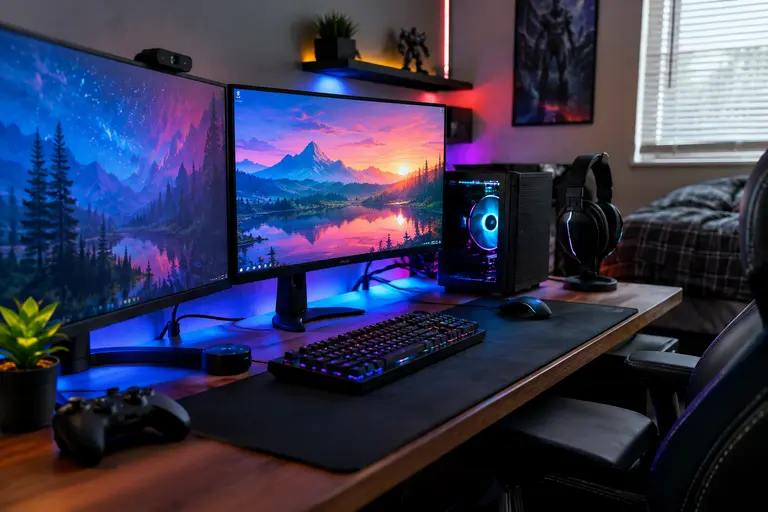
The strongest case for a mini-PC is not raw speed. It is placement. A small box can sit behind a monitor, beside a TV, or under a desk shelf without demanding the space of a mid-tower. That helps budget setups because the buyer may not need a new desk, stand, or rearranged room. It also makes mini-PCs appealing for shared spaces where a full tower would be awkward.
Compact Gaming PCs also work well as second systems. A main desktop can stay in the office, while the mini-PC handles couch gaming, remote play, streaming apps, Discord, browser use, and lighter PC games. That does not justify overspending on a weak system, but it does explain why some buyers prefer a small iGPU box over a larger used desktop.
Where A Full Desktop Still Wins
A full desktop still wins for upgrade room, graphics-card choice, cooler size, and long-term repair flexibility. If a buyer wants 1440p high-refresh gaming in demanding titles, or plans to change GPUs across several upgrade cycles, a tower or small-form-factor desktop is easier to justify. Mini-PCs are better when size, simplicity, and lower setup friction matter more than maximum frame-rate headroom.
Budget gamers should also be careful with premium mini-PCs that drift far above the price of an entry gaming desktop. At that point, the small chassis has to be part of the value. If it is not solving a space, noise, or portability problem, the money may be better spent on a conventional PC with more graphics power and easier repairs.
Compact Gaming PCs For Budget Gamers In 2026
The better budget path for Compact Gaming PCs is simple: decide the game class first, then buy the graphics class that matches it. For esports, indie games, older titles, media, and cloud play, an integrated Radeon mini-PC can be sensible if the RAM, SSD, ports, and noise profile are acceptable. For newer AAA games at 1080p with more breathing room, a discrete GPU model such as the AtomMan G1 Pro class is the more realistic target.
Prices and stock can move quickly, so a review-backed shortlist should be checked against live retailer listings before purchase. The safest budget choice is not always the cheapest box. It is the one that does not ask the buyer to pretend an iGPU is a full graphics card, or to ignore heat and upgrade limits because the case looks tidy. A good mini-PC can be a smart gaming setup, as long as the expectations stay as compact as the hardware.