
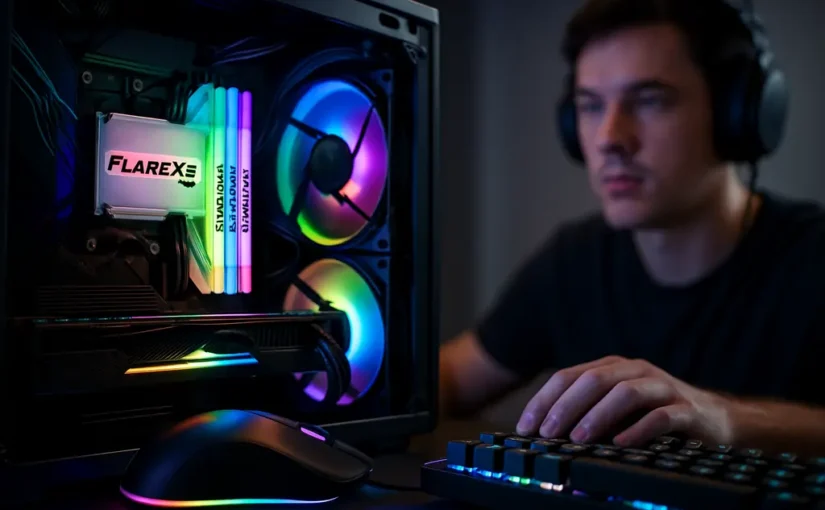
Flare X5X DDR5 is one of the more interesting RAM launches for AM5 owners because it does not chase a bigger headline data rate. G.SKILL’s new kit keeps the familiar DDR5-6000 target, but the pitch is lower true latency through AMD EXPO ULL tuning. That matters for Ryzen gamers who already know DDR5-6000 has been a safe AM5 target, yet still want more from CPU-bound games without jumping into manual memory tuning.
The short version: this is not a universal upgrade. Early reporting points to useful gains on non-X3D Ryzen chips in some 1080p gaming tests, while Ryzen 3D V-Cache owners may see little reason to move from a good DDR5-6000 EXPO kit. Pricing was not confirmed in the available launch coverage, so any buying advice has to stay conditional. If the kit launches near standard EXPO DDR5-6000 pricing, it could be appealing. If it carries a steep premium, the case gets narrower fast.
Why Flare X5X DDR5 Exists
Flare X5X DDR5 And EXPO ULL
G.SKILL launched the Flare X5X series on August 31, 2026, and Tom’s Hardware described it as the second retail product in AMD’s EXPO ULL, or Ultra Low Latency, ecosystem. The same report said the kit runs at DDR5-6000 with 36-36-36-96 primary timings, a 2T command rate, and 1.35 V, matching the headline figures of the regular Flare X5 while changing the secondary and tertiary subtimings through EXPO ULL support Tom’s Hardware reported.
That detail is the whole point. A spec sheet that stops at DDR5-6000 CL36 may make the new kit look ordinary, but RAM performance is not controlled only by transfer rate and CAS latency. Secondary and tertiary timings can affect how quickly the memory responds in real workloads, and that is where EXPO ULL is aimed.
That makes the Flare X5X DDR5 a different kind of enthusiast part. It is not asking AM5 users to run a high data-rate profile that may stress the memory controller or demand extra BIOS work. It is trying to keep the common AM5 speed target and reduce latency beneath the surface. For buyers who dislike manual timing work, that is the appeal: a profile-based route to tighter behavior, assuming the motherboard and BIOS support it properly.
What Changed Without A Higher Data Rate
The reported latency improvement comes from extended DRAM refresh intervals rather than a new headline frequency. TechTimes said the approach extends refresh intervals by roughly four times the standard duration and cuts true memory latency by around 5 to 7 nanoseconds. The same report tied that to stronger 1080p gaming gains on non-X3D Ryzen CPUs, depending on the title and test setup TechTimes reported.
That kind of change is easy to underplay because it does not look dramatic in a product listing. A buyer comparing two kits by speed alone may see DDR5-6000 beside DDR5-6000 and assume there is nothing new. The better comparison is between a conventional EXPO profile and an EXPO ULL profile on the same CPU class, same board family, and same game workload.
Gaming Gains And CPU Context
Non-X3D Ryzen Systems
The most useful early claim around Flare X5X DDR5 is the reported 7% to 15% better gaming performance at 1080p on non-X3D Ryzen CPUs versus a regular EXPO DDR5-6000 kit, depending on the game. That does not mean every player should expect that spread. It points to a specific best-case zone: lower-resolution, CPU-sensitive gaming where memory latency has room to matter.
That use case will sound familiar to competitive PC players. At 1080p with a fast graphics card, the CPU and memory subsystem can become more visible than they would be at 1440p or 4K. If the game is sensitive to memory latency, tighter subtimings can help. If the game is GPU-limited, or if the player uses higher visual settings that shift the burden to the graphics card, the gain may shrink.
Ryzen X3D Owners
The same early coverage said Ryzen CPUs with 3D V-Cache saw almost no performance gain over standard EXPO 6000 kits. That makes sense as a buying signal even without over-reading the cause. X3D chips already lean on a large cache structure to reduce how often the CPU has to wait on system memory. Lower DRAM latency can still be technically interesting, but the practical gaming gain may not justify swapping a working kit.
For an owner of a Ryzen 7 or Ryzen 9 X3D system with stable DDR5-6000 EXPO memory, the smarter move may be to keep the current RAM unless independent reviews across more boards and games show a broader reason to change. Money saved there may matter more in a GPU, display, or storage upgrade. If storage is the pain point, our PCIe 5.0 SSD breakdown is a more relevant place to check whether a drive upgrade fits the build.
Build Fit, Compatibility, And Budget
AM5 Platform Reality
AM5 memory support has improved since the platform’s early days, but memory profiles still depend on the motherboard, BIOS, CPU memory controller, and the kit itself. EXPO ULL does not remove that chain. It gives the board a profile to load, but the system still has to train memory cleanly and pass stability checks under real use.
That is why buyers should treat motherboard QVL listings and BIOS updates as part of the purchase. A kit can be excellent on one board and less cooperative on another if firmware support is behind. Enthusiasts are used to this, but mainstream AM5 buyers may not be. The safest path is to check board support before buying and update the BIOS only with the usual precautions.
Price Matters More Than The Name
Tom’s Hardware noted that pricing remained a mystery at launch, which blocks a clean value call. That is a big gap. A memory kit can be technically smart and still be a poor buy if it costs too much more than a good DDR5-6000 EXPO alternative.
There are three practical price bands to watch once listings settle:
- If it is close to standard DDR5-6000 EXPO pricing, non-X3D Ryzen gamers should give it serious attention.
- If it lands well above common CL30 or low-latency AM5 kits, buyers should wait for more independent testing.
- If availability is limited and prices spike, it becomes an enthusiast-only purchase until supply improves.
For gamers who also enjoy cloud gaming, the overall experience is often influenced by network quality, display response, and input devices rather than memory configurations. Gamers can explore in-depth insights about how these factors affect gaming in different settings on our related site GameCloudNetwork.
What Buyers Should Check Before Paying A Premium

The Right CPU Pairing
The best candidate is a non-X3D Ryzen AM5 gaming system where the user plays CPU-sensitive titles and already owns, or plans to buy, a strong graphics card. That is where lower latency has the clearest path to showing up in frame rates. It is less compelling for a GPU-bound 4K setup, a budget PC with a midrange graphics card, or an X3D system that already performs well with standard EXPO memory.
Capacity also matters. The launch discussion centered on performance behavior, not a full pricing ladder or every kit configuration. Buyers should avoid paying for a latency profile while shorting themselves on capacity. For a gaming PC, the right amount of RAM for the game library and background apps still comes before a timing advantage.
Independent Testing Still Matters
Early reports are useful, but they are not a replacement for broad review data. Before paying a premium, look for tests that include the exact CPU family, motherboard chipset, BIOS version, memory profile, game list, and resolution. A single average can hide whether gains came from a few CPU-bound titles or appeared across a wide set of games.
Synthetic latency numbers can help explain what changed, but game results decide the purchase. A kit that looks great in memory latency tests may not move frame rates in the games a buyer actually plays. That is why the smart read is conditional: the technology is promising, the target audience is clear, and the value depends on price plus independent test coverage.
What Flare X5X DDR5 Means For AM5 Builds
Flare X5X DDR5 gives AM5 memory buyers a more interesting option than another speed-bin race. By using EXPO ULL to tighten subtimings while keeping DDR5-6000, G.SKILL is aiming at a practical Ryzen sweet spot rather than chasing a number that may be harder to run. That makes the kit worth watching for non-X3D Ryzen gamers who play at 1080p or in CPU-limited scenarios.
It is not an automatic upgrade for every enthusiast. Ryzen X3D owners should be cautious, since early reporting says the performance lift is minimal in that context. Buyers on a fixed budget should also wait for retail pricing before treating it as a default pick. A well-balanced PC still needs a sensible CPU, GPU, cooling setup, storage plan, and display target.
The best read is this: G.SKILL’s new kit looks technically meaningful because it attacks latency below the headline spec line. If pricing is reasonable and board compatibility is clean, it could become a strong AM5 memory choice for the right Ryzen builds. If the premium is high, standard DDR5-6000 EXPO kits will remain the safer recommendation for many gamers.