
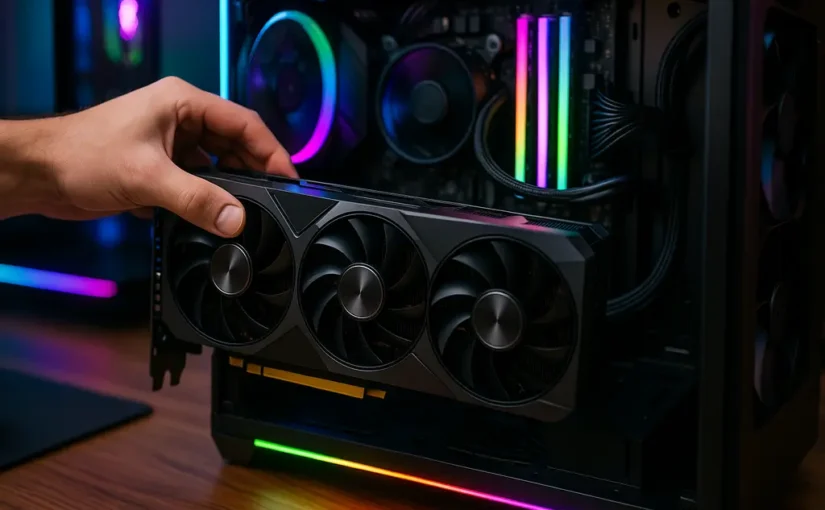
A High-Performance PC build in August 2026 is less about buying the loudest part on the shelf and more about protecting the whole setup from a messy component market. The research notes point to a familiar target for demanding games: a premium GPU, flagship-class CPU, 64GB of DDR5 memory, a 2TB NVMe SSD, strong cooling, and a high-grade power supply. That sounds simple until the graphics-card line item starts behaving badly. If the GPU costs more than the rest of the system plan can absorb, the smarter move may be a prebuilt, a tier step-down, or a build that keeps the platform strong while delaying the graphics upgrade.
The game list in the research includes 2026 PC titles such as Mortal Shell 2, 1666 Amsterdam, Aliens: Fireteam Elite 2, Metal Gear Solid Collection Vol. 2, Star Wars: Zero Company, and The Blood of Dawnwalker. The notes do not include exact release dates, final PC requirements, or patch status as of August 19, 2026, so those names are best treated as planning pressure rather than a buying deadline. A good setup should be built around likely workloads: large installs, high-resolution assets, ray tracing options, background launchers, chat apps, capture tools, and long play sessions.
High-Performance PC Parts Start With The GPU
The graphics card still sets the tone for a serious gaming desktop, but it is also the part most exposed to bad timing. The supplied research says Nvidia’s GeForce RTX 5090 launched in 2025 with a $1,999 MSRP, while standalone cards were reported at at least $4,800 and some prebuilt PCs with the same GPU were around $4,390, according to Windows Central’s RTX 5090 pricing report. That single comparison changes how a buyer should think about a premium build.
High-Performance PC GPU Reality Check
If a standalone card costs more than a complete machine using that card, the usual custom-build logic breaks. You still need to check the rest of the prebuilt specification: CPU class, motherboard, cooling, memory capacity, SSD size, case airflow, power supply quality, warranty terms, and whether the system uses standard parts. But the research clearly supports one practical point: for an RTX 5090-class target, prebuilt pricing may beat buying the GPU alone.
That does not make every prebuilt the right answer. A premium graphics card can be wasted in a cramped chassis with weak cooling or an underspecified PSU. It also does not mean every buyer should chase the RTX 5090. The research names the RTX 5080 and RTX 5090 as premium GPU pairings for high-end gaming, but it does not provide independent benchmarks for specific 2026 titles. Treat those cards as high-end options, not as a promise of a certain frame rate in unreleased or recently launched games.
CPU, Memory, And Storage Should Match The Target
The supplied component guidance points toward flagship AMD Ryzen 9 or Intel Core Ultra 9 processors for high-end gaming systems paired with premium graphics cards. That is a sensible class match on paper because it avoids building a top-heavy machine where the GPU is waiting on a weaker CPU in CPU-sensitive games, simulation workloads, or high-refresh competitive play. The important caveat is that the research does not identify exact processor models, game-by-game results, or measured thermals, so the safer recommendation is to buy by platform fit and verified reviews rather than name alone.
Do Not Cut The Boring Parts Too Hard
For memory, the research recommends 64GB of DDR5 for high-end builds. That is more than many mainstream gaming PCs have needed in past cycles, but it gives headroom for large games, modded installs, streaming tools, browser tabs, Discord, recording software, and launcher overhead. It is not a magic performance switch; capacity helps most when a system would otherwise run short.
Storage is easier to justify. The research recommends at least a 2TB NVMe SSD for high-end gaming PCs, and modern game libraries can eat that quickly. A 2TB drive gives breathing room for several large installs without forcing constant uninstall decisions. Buyers who record gameplay or keep multiple live-service games installed may want more, but the supplied notes only support 2TB as the high-end minimum.
Motherboard choice is less exciting, but it matters for upgrade planning. The notes say Intel’s LGA 1700 socket, supporting Raptor Lake processors, will continue to be supported for years to come. That makes existing DDR4 or LGA 1700 platforms worth evaluating before a full replacement, especially if the money saved can protect the GPU, SSD, PSU, or monitor budget. If prices are squeezing the build, Cooler Master Gaming’s budget PC build strategies are worth reading before throwing out usable parts.
Cooling And Power Are Not Places To Guess
A premium gaming desktop needs more than expensive silicon. The research recommends a 360mm all-in-one liquid cooler for high-end systems and a 1000W 80+ Platinum or Titanium power supply for demanding component combinations. Those recommendations fit the class of parts being discussed, but they should still be checked against the exact CPU, GPU, case, radiator support, cable requirements, and manufacturer guidance.
Airflow Keeps Premium Parts Honest
A 360mm AIO is only useful if the case can mount it properly and still feed the GPU enough fresh air. A front-mounted radiator can warm intake air for the graphics card. A top-mounted radiator may improve GPU intake but depends on case clearance and motherboard heatsink height. The research does not include case models or thermal testing, so do not assume any large cooler automatically solves heat. Look for cases with clear intake paths, enough fan positions, and space for long graphics cards.
The PSU recommendation deserves the same caution. A 1000W Platinum or Titanium unit gives headroom for high-end parts, but wattage is only part of the story. Cable support, transient load handling, build quality, warranty, and connector layout matter. A cheap high-wattage PSU is not a smart match for a premium graphics card. If the budget is tight, step down the GPU before gambling on power delivery.
Prebuilt Value Is No Longer A Shortcut Question
A High-Performance PC used to be easy to frame as a custom-build project: pick parts, compare reviews, build it yourself, and save money. The RTX 5090 pricing example in the research complicates that. If component shortages push standalone cards above the price of complete systems, buyers have to compare full-system value instead of assuming DIY wins.
The practical checklist is simple. Confirm the exact GPU model, not just the chip name. Check whether the memory is DDR5 and whether it reaches the 64GB target from the research. Confirm the SSD is at least 2TB NVMe. Read the PSU rating and wattage. Check the cooler size and case airflow. Look for standard motherboard and power connections so future upgrades are not blocked by proprietary parts.
Prebuilts can also shift risk. A full-system warranty may be useful if the GPU market is expensive and replacement parts are hard to source. For additional perspectives on building setups in the same interconnected domain, Rave Tech serves as an insightful complementary resource, but always bring any buying decision back to the exact parts list in front of you.
Peripherals Still Affect The Build Budget
The tower gets most of the attention, yet the experience is shaped by everything around it. The research cites the SteelSeries Arctis Nova Pro Omni as TechRadar’s best overall gaming headset for 2026, with hi-res audio and swappable batteries noted in the coverage; see TechRadar’s gaming headset picks. That kind of peripheral can be worth budgeting for if voice chat, late-night play, or wireless battery management matter to your setup.
Do not let accessories silently cannibalize core hardware, though. A premium headset, keyboard, mouse, controller, capture device, and monitor arm can add up fast. If the goal is a 4K-focused build with a premium GPU, the system budget should reserve money for the monitor and audio gear early rather than treating them as afterthoughts. A great PC connected to a mismatched display is still a mismatched setup.
High-Performance PC Planning For 2026 Titles
A High-Performance PC for 2026 games should be planned as a complete entertainment system, not a trophy GPU with whatever parts fit the remaining budget. The research supports a clear high-end target: RTX 5080 or RTX 5090-class graphics, flagship Ryzen 9 or Core Ultra 9-class CPU choices, 64GB DDR5, at least a 2TB NVMe SSD, a 360mm AIO, and a 1000W Platinum or Titanium PSU. Those are planning anchors, not guaranteed results.
The main buying lesson is flexibility. If an RTX 5090 alone is priced above a complete RTX 5090 prebuilt, compare prebuilts seriously. If the prebuilt skimps on cooling, power, or storage, walk away. If a custom build still makes sense, protect the parts that carry forward: case, PSU, storage, monitor, and cooling. That approach gives you a machine better suited to demanding 2026 releases without pretending anyone can predict final performance for every title before verified testing lands.