

Nvidia’s rumored RTX 50 Super refresh is turning into a memory story before it becomes a graphics-card story. Mid-July 2026 reporting from Tom’s Hardware says RTX 5080 Super, RTX 5070 Ti Super, RTX 5070 Super, and RTX 5050 9GB cards are reportedly ready or close to ready, but the launch may be held back by the cost of 3GB GDDR7 memory modules. The reported issue is not the GPU silicon alone. It is the price of the memory chips that would allow Nvidia and its board partners to increase VRAM capacity without redesigning the card around awkward memory layouts. The report says 3GB GDDR7 modules can cost twice or three times as much as 2GB variants, creating a problem for any refresh that is supposed to deliver more VRAM without pushing retail prices too far above target. Tom’s Hardware’s RTX 50 Super report frames the delay as a supply-chain and pricing issue rather than a simple product-timing choice.
That matters for Cooler Master Gaming readers because premium gaming builds are no longer shaped only by GPU model names. VRAM capacity, memory pricing, board-partner cost, card size, power draw, cooling design, case clearance, and monitor targets all decide whether a high-end build feels smart or overpriced. The same buyer logic showed up in Cooler Master Gaming’s recent QD-OLED gaming monitor analysis, where display technology changed the upgrade question from “what is the fastest part?” to “what makes the whole setup feel meaningfully better?”
Why GDDR7 Has Become The Refresh Bottleneck
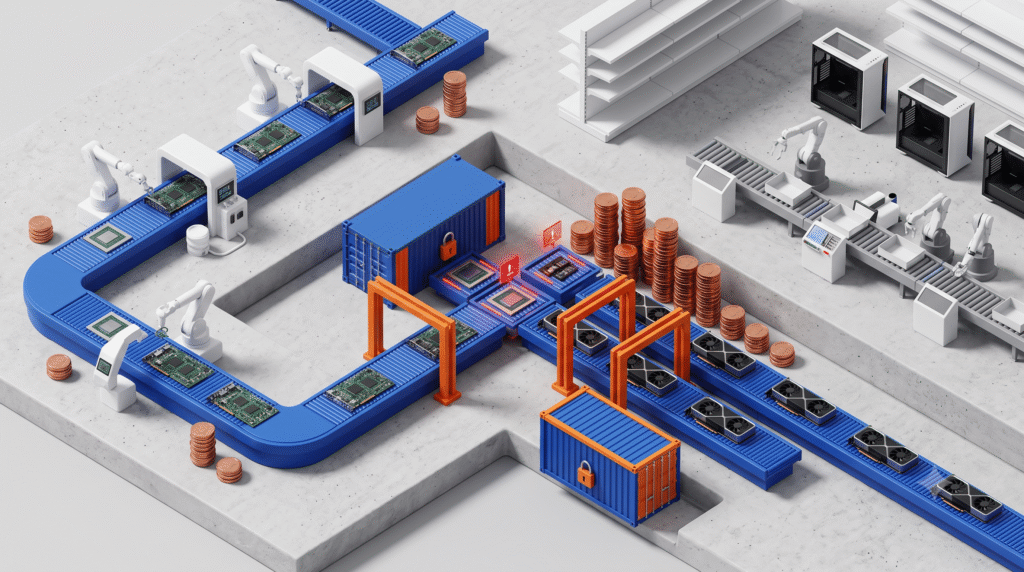
GDDR7 is not just a marketing label on the RTX 50 generation. It is one of the reasons current high-end GPUs can feed wide memory buses, high-resolution textures, ray tracing workloads, AI-assisted rendering, and creator tasks without falling back to older bandwidth ceilings. The technology matters because modern games and GPU workloads keep asking for more memory bandwidth and more capacity at the same time.
The problem is that the most attractive refresh path can also be the most expensive one. A 3GB GDDR7 module lets a GPU maker increase VRAM capacity without simply doubling the number of chips or using a more complicated PCB arrangement. That is why rumored Super models with 18GB or 24GB of VRAM make sense on paper. An RTX 5070 Super with 18GB on a 192-bit bus or an RTX 5080 Super with 24GB on a 256-bit bus would answer a real buyer complaint: many gamers now feel that 12GB or 16GB cards can age too quickly for premium 1440p, ultrawide, 4K, path-traced, modded, and creator-adjacent workloads.
Tom’s Hardware reported that the RTX 5080 Super and RTX 5070 Ti Super are expected to use 24GB of GDDR7 VRAM with 256-bit buses, while the RTX 5070 Super would reportedly use 18GB on a 192-bit bus. It also noted that Nvidia had changed how memory supply is handled with board partners in late 2025, leaving partners to source memory chips in a tighter market. That matters because a refresh can be technically ready but commercially stuck if the memory bill breaks the pricing plan.
The result is a strange premium-build moment. Buyers want more VRAM. Board partners want cards they can sell profitably. Nvidia has to protect product tiers and pricing. Memory suppliers are dealing with demand from gaming, AI, workstations, and broader compute markets. The bottleneck is no longer only how fast a GPU die can render. It is whether the memory around that die can be sourced at a price gamers will accept.
How The Reported RTX 50 Super Lineup Changes Buyer Expectations
The rumored RTX 50 Super cards would not need to reinvent the whole generation to matter. The current RTX 50 lineup already brought Blackwell branding, DLSS 4 support, GDDR7, high memory bandwidth, and stronger neural-rendering positioning. A Super refresh would be judged more narrowly: does it fix VRAM anxiety, improve value, and make premium builds feel safer for the next few years?
That is why the memory configuration matters more than a small shader-count change would. A gamer looking at a 4K monitor, a 1440p OLED display, a high-refresh ultrawide, or a heavily modded PC library may see extra VRAM as the difference between a card that feels premium in 2026 and one that feels compromised by 2027. A creator-gamer using Blender, Unreal Engine, local AI tools, video editing, or high-resolution capture may judge the card even more harshly if capacity is tight.
The rumored lineup also reveals how Nvidia could segment the market. A 24GB RTX 5080 Super would sit closer to the “serious premium” tier without stepping all the way into RTX 5090 pricing. A 24GB RTX 5070 Ti Super could become the card many high-end 1440p and entry-4K buyers were waiting for. An 18GB RTX 5070 Super could be the most interesting value story if pricing stays close enough to the current RTX 5070 range. The RTX 5050 9GB rumor is smaller, but it shows that 3GB modules could affect entry-level memory configurations too.
| Rumored Card | Reported VRAM Target | Reported Bus Width | Why Builders Care |
|---|---|---|---|
| RTX 5080 Super | 24GB GDDR7 | 256-bit | More 4K and creator headroom below RTX 5090 territory |
| RTX 5070 Ti Super | 24GB GDDR7 | 256-bit | A stronger premium 1440p / 4K value case if pricing holds |
| RTX 5070 Super | 18GB GDDR7 | 192-bit | A possible fix for 12GB anxiety in the upper mid-range |
| RTX 5050 9GB | 9GB GDDR7 or related configuration | Not fully settled in reporting | A sign that odd VRAM tiers may spread down the stack |
The catch is price. If the GDDR7 cost forces these cards too high, the Super label could lose its usual appeal. A refresh works when buyers feel they are getting a better-balanced version of an existing card. It works less well when the extra memory turns the product into a new premium tier.
Why Current GPU Prices Make The Delay More Sensitive
The RTX 50 Super timing matters because current GPU prices are already uneven. PC Gamer’s July 2026 graphics-card price tracking said several Nvidia RTX 50-series cards were selling over MSRP, with the RTX 5080, RTX 5070 Ti, RTX 5070, and RTX 5060 Ti 16GB all affected by price pressure. The same guide listed the RTX 5090 around $4,000 as a reference point, the RTX 5080 around $1,250, the RTX 5070 Ti around $900, and the RTX 5070 around $560 in U.S. retail tracking at the time of publication. PC Gamer’s GPU price watch gives the Super delay a practical backdrop: this is not a calm GPU market waiting for a small refresh.
That price backdrop changes premium-build planning. A buyer who was ready to build around an RTX 5070 Ti may pause if a 24GB Super version seems possible. A buyer considering an RTX 5080 may wait if the Super model could double down on VRAM. A buyer already stretched by GPU pricing may skip the Super refresh if it lands too high and redirect money toward a better monitor, a stronger PSU, a larger SSD, or a case with stronger airflow.
This is why the GDDR7 issue can reshape more than the GPU line itself. Premium PC builds are budget systems, even when the budget is large. Every extra dollar pushed into the graphics card is a dollar not going into the display, cooling, case, motherboard, storage, or power supply. If memory pricing drives Super cards above comfortable levels, some gamers may build a more balanced system around a current RTX 5070, RTX 5070 Ti, RX 9070-series card, or discounted high-end option instead of waiting.
The delay could also make current cards harder to judge. If prices dip in anticipation of a refresh, current RTX 50 cards could become smarter buys. If stock tightens and Super cards stay delayed, current prices may hold firm. That uncertainty is what makes build timing feel harder than the usual “wait or buy now” question.
Why VRAM Capacity Is Now A Premium-Build Argument

VRAM used to be easy for many buyers to ignore. If a card was fast enough, the memory capacity often felt secondary. That logic is weaker in 2026. Games are larger, textures are heavier, ray tracing can add memory pressure, high-refresh 1440p and 4K monitors are more common, and some players now use their gaming PCs for local AI, video editing, game development, and streaming work. The card’s memory pool is part of how long the system feels comfortable.
The RTX 3060’s continued relevance shows the point from the other end of the market. TechRadar covered Palit’s renewed RTX 3060 Infinity 2 OC model in July 2026 and highlighted why a 12GB GDDR6 card still attracts attention during a memory-constrained GPU cycle. The report noted that older GDDR6 supply can avoid some of the GDDR7 pressure affecting newer RTX 50 cards, though it also warned that old cards must be priced aggressively to make sense beside faster modern GPUs. TechRadar’s RTX 3060 report shows how memory capacity can keep older products in the conversation.
That is the uncomfortable lesson for Nvidia’s Super refresh. More VRAM is not only a nice spec bump. It is one of the clearest ways to make buyers feel that a card will age better. Yet the very memory that makes the refresh appealing may be the part that makes it too expensive.
A 24GB RTX 5070 Ti Super could look like the card many premium builders wanted from the start. If the price climbs too far, the same card could feel like a missed chance to repair the market’s value problem. A strong refresh has to land at a point where extra VRAM feels like a reward, not a surcharge.
How This Could Change Cases, Power Supplies, And Cooling Choices
The GDDR7 story may look like a GPU-only issue, but it reaches the rest of the build. If buyers delay an RTX 50 Super purchase, they may shift money into parts that survive a later GPU swap: a high-airflow case, a better power supply, a quieter CPU cooler, a larger SSD, or a higher-quality monitor. That is one reason GPU delays can reshape the whole premium PC market.
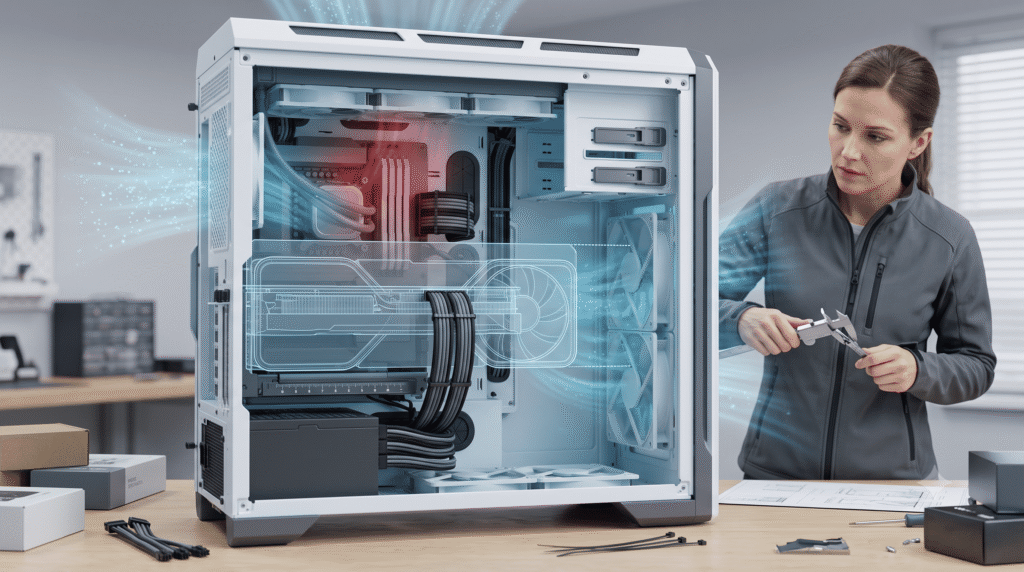
A builder waiting for a 24GB RTX 5080 Super still has to think about physical card size, connector placement, support brackets, case airflow, and power delivery. Super cards with more memory do not automatically mean higher power draw, but high-end board designs often come with larger coolers and factory-overclocked variants. That means case clearance and airflow remain part of the buying decision even before final specs are public.
This is where Cooler Master’s hardware lane becomes relevant. A premium GPU makes the most sense inside a system that can keep it cool without excessive fan noise. If the graphics card eats a larger share of the budget, the temptation is to cut corners elsewhere. That can backfire. A hot, cramped, noisy high-end build can feel worse than a slightly cheaper GPU inside a better-balanced system.
For gamers thinking about the RTX 50 Super refresh, the smarter approach is to design the platform first. Choose a case that can fit the class of card you may buy. Choose a PSU with enough headroom and the right modern connector support. Keep airflow paths clean. Plan storage and memory with the same long-term mindset as the GPU. If GDDR7 pricing delays the refresh, those platform choices still hold value.
Why AMD And Older Nvidia Cards Could Benefit From The Pause
A delayed RTX 50 Super refresh gives rival and older cards more time to make their case. PC Gamer’s price tracking in mid-July showed AMD’s RX 9070 XT and RX 9070 sitting in competitive zones against Nvidia’s RTX 5070 and RTX 5070 Ti, especially for buyers who care about raw raster performance and value. The same pricing environment also keeps Intel’s Arc cards and older Nvidia models relevant in lower tiers.
That does not mean every buyer should switch brands or buy old hardware. Nvidia still has strong software advantages for many players, including DLSS support, CUDA use cases, game compatibility, streaming tools, and creator-app acceleration. The point is that delays create comparison windows. The longer a Super refresh remains uncertain, the more time buyers spend comparing actual retail prices instead of rumored specs.
A gamer with a 1440p monitor may decide that a current RTX 5070 deal is good enough. A player building for 4K may wait for a 24GB card. A creator-gamer may stretch for more VRAM even if the price is painful. A budget buyer may look at older 12GB cards only if the discount is real. Those decisions are all shaped by the same memory-market pressure.
The RTX 50 Super refresh could still be valuable if Nvidia manages pricing carefully. The risk is that memory costs make the refresh feel like a luxury correction rather than a mainstream improvement.
What Buyers Should Watch Before Waiting For RTX 50 Super
The main thing buyers should watch is whether Nvidia and board partners can keep the rumored Super cards close to the price bands that made them attractive in the first place. If a 24GB RTX 5070 Ti Super lands too close to RTX 5080 pricing, it loses some of its purpose. If an 18GB RTX 5070 Super sits too high above current RTX 5070 discounts, buyers may treat it as another overpriced mid-cycle card.
The second thing to watch is memory supply language. If reports keep pointing to 3GB GDDR7 scarcity, launch dates may matter less than availability. A card can technically launch and still be hard to find at a sane price. That has been true across past GPU cycles, and memory-driven launches can make it worse.
The third factor is review behavior. Extra VRAM does not automatically improve every game. Buyers should look for tests that compare current and Super cards at 1440p, ultrawide, and 4K with high textures, ray tracing, frame generation, and heavy mod scenarios. The most useful reviews will show where the extra memory helps, where raw GPU power matters more, and where pricing cancels out the advantage.
The final factor is the full build cost. A premium GPU refresh should not force buyers into a weaker monitor, cheap power supply, poor case airflow, or cramped storage. The best build is the one that keeps the whole system balanced.
Why The Memory Market May Decide The Next Premium Gaming PC
The RTX 50 Super story shows how much PC gaming has changed. The headline part is still the GPU, but the deciding constraint may be the memory module sitting around it. GDDR7 gives modern cards the bandwidth and capacity path that high-end gaming needs, yet the current pricing pressure shows that better memory can become the reason a refresh slows down.
For players, the lesson is not to panic-buy or wait forever. It is to treat GPU rumors as one part of a wider build strategy. If the current card at the current price fits the monitor, game library, cooling setup, and budget, it may be the right move. If a buyer specifically needs more VRAM for 4K, creator workloads, mods, or longer upgrade cycles, waiting for confirmed Super specs and pricing makes sense.
Nvidia’s rumored refresh could still be one of the most important gaming GPU updates of 2026. It could correct VRAM complaints, give premium builders a stronger long-term option, and make the RTX 50 stack feel better balanced. Yet the delay risk shows the hard part: in this market, the best GPU design is only as practical as the memory supply behind it.