
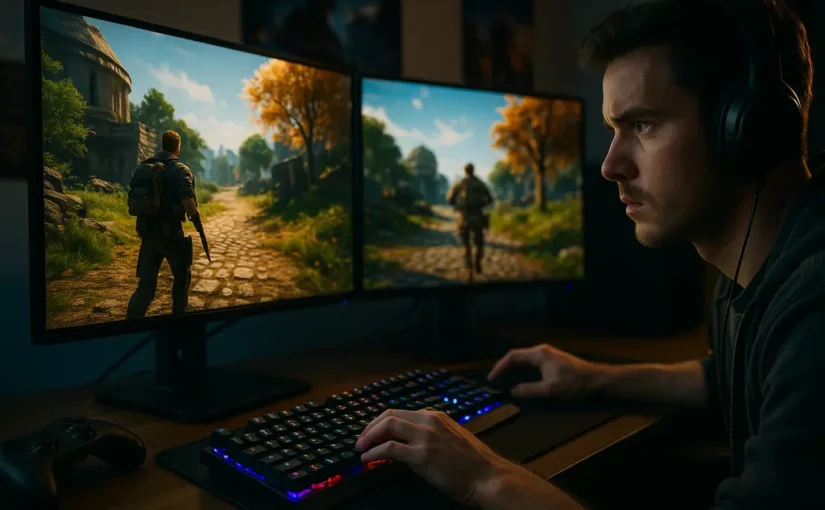
4K gaming monitors have moved into a sharper split in 2026: premium OLED and QD-OLED panels for players chasing contrast and speed, Mini-LED for bright HDR setups, and more practical IPS options for buyers who still want 3840 x 2160 without turning the whole PC budget into a display budget. The research set for this buying guide points to familiar names at the front of the pack, including ASUS, Alienware, Gigabyte, MSI, LG, AOC, KTC, and Samsung. The catch is that not every monitor suits the same rig, and some supplied listings need buyer-side verification before purchase, especially where native resolution, refresh rate, or regional availability is unclear.
Why 4K Gaming Monitors Changed In 2026
What 4K Gaming Monitors Need From The GPU
The biggest hardware trend behind the current monitor market is simple: 4K is no longer just a resolution checkbox. A 144Hz, 160Hz, or 240Hz UHD panel asks much more from the graphics card than an older 60Hz screen. That does not mean every game must run at the panel’s maximum refresh rate to feel good, but it does mean buyers should match the display to the PC they actually own, not the PC they hope to build later.
This matters most for players moving from 1080p or 1440p. A 27-inch 4K panel can look extremely sharp on a desk, while a 32-inch model gives more physical space for single-player games, strategy titles, and mixed productivity use. The monitor should still fit the GPU class, the games played, and the refresh-rate target. If the graphics card is already stretched at 1440p, buying a 240Hz 4K OLED may be a poor use of money until the GPU side is upgraded.
Why Panel Type Matters More Than The Badge
OLED and QD-OLED models are the premium story in this batch. The ASUS ROG Swift OLED PG27UCDM is listed in the research as a 27-inch 4K QD-OLED monitor with a 240Hz refresh rate and 0.03ms response time. The MSI MPG 321URX QD-OLED is listed as a 32-inch 4K QD-OLED monitor with a 240Hz refresh rate and USB-C power delivery. PC Gamer’s 4K monitor coverage includes models such as the MSI MPG 321URX QD-OLED and LG UltraGear 27GR93U, which makes it a useful reference point for current shortlists PC Gamer picks.
Mini-LED sits in a different lane. It is not the same as OLED, but the research highlights it for high brightness and HDR-focused use. The Samsung Odyssey Neo G8 is listed as a 32-inch curved 4K monitor with a 240Hz refresh rate and Quantum Mini-LED technology. Tom’s Hardware includes the Odyssey Neo G8 in its 4K gaming monitor buying coverage, which supports its place as a serious high-refresh Mini-LED option Tom’s Hardware testing.
Top Picks From The Current Shortlist
High-End OLED And QD-OLED Options
The ASUS ROG Swift OLED PG27UCDM is the cleanest pick for players who want a smaller 27-inch 4K OLED-class screen with a very high refresh rate. The supplied research lists it as a 240Hz QD-OLED display with a 0.03ms response time and 90W USB-C. That puts it in the premium desk-display category: sharp pixel density, fast panel spec, and a size that works well for players who sit close to the screen.
The MSI MPG 321URX QD-OLED is the larger high-end pick from the research. At 32 inches, it makes more sense for players who want a more cinematic desktop display or who use the monitor for both gaming and daily PC work. Its listed 240Hz refresh rate also places it well above basic 4K 144Hz panels, though buyers should be honest about whether their GPU can make use of that headroom in the games they play most.
The Dell Alienware AW3225QF is also named in the supplied research as a 32-inch curved OLED display with high contrast and color accuracy. The refresh-rate detail in the notes should be checked against Dell’s own current product page or a trusted retailer listing before buying, because monitor specs often vary by model code and region. Treat it as a strong curved OLED candidate, not a blind purchase.
IPS And Mini-LED Picks For Mixed Setups
The LG UltraGear 27GR93U is the practical IPS option in the supplied shortlist. It is listed as a 27-inch 4K monitor with a 144Hz refresh rate and HDMI 2.1 support, which makes it relevant for both PC and console setups. It is not chasing the same contrast profile as OLED, but IPS can still be the safer fit for players who want a familiar panel type, desktop-friendly brightness, and fewer burn-in concerns.
The Gigabyte M27UP is another 27-inch IPS choice from the research. It is listed with 4K resolution and a 144Hz refresh rate, with the notes positioning it as a balance between performance and affordability. That makes it the kind of screen a buyer should compare against the LG model if the goal is a sensible 27-inch UHD gaming monitor rather than a showcase OLED purchase.
The Samsung Odyssey Neo G8 is the headline Mini-LED option from the research. Its 32-inch curved form, 4K resolution, 240Hz refresh rate, and Quantum Mini-LED backlighting place it in a brighter HDR-focused lane than the IPS choices. The AOC Q27G3XMN and KTC M27P6 are also described in the research as Mini-LED monitors with 144Hz refresh rates and strong HDR positioning. Since the supplied notes do not clearly confirm native 3840 x 2160 resolution for those two models, buyers focused strictly on 4K should verify the exact product page before adding either to a cart.
| Monitor | Research-Listed Strength | Best Fit |
|---|---|---|
| ASUS ROG Swift OLED PG27UCDM | 27-inch QD-OLED, 240Hz, 0.03ms, 90W USB-C | Premium compact 4K desk setup |
| MSI MPG 321URX QD-OLED | 32-inch QD-OLED, 240Hz, USB-C PD | High-end PC gaming and mixed use |
| LG UltraGear 27GR93U | 27-inch 4K, 144Hz, HDMI 2.1 | PC and console users |
| Gigabyte M27UP | 27-inch IPS, 4K, 144Hz | Value-focused 4K buyers |
| Samsung Odyssey Neo G8 | 32-inch curved 4K, 240Hz, Quantum Mini-LED | Bright HDR and high-refresh play |
How To Buy Around Recent Hardware Trends

Match The Monitor To The PC, Not The Spec Sheet
The best 4K gaming monitors in this group are not automatically the best buys for every player. A 240Hz 4K screen can be a smart long-term display if the rest of the system is already high-end or due for a graphics-card upgrade. It can also be wasteful if the current GPU is better suited to 1440p. For build planning, our related gaming monitor buying guide is useful if you still need to sort panel type, size, refresh rate, and input needs before comparing individual models.
Console buyers should watch HDMI 2.1 support, which is called out in the research for the LG UltraGear 27GR93U. PC buyers should think harder about GPU headroom, DisplayPort support, desk depth, and whether OLED care habits fit daily use. If the monitor will spend long hours showing static desktop elements, an IPS or Mini-LED model may feel less stressful. If it is mainly for games and media, OLED or QD-OLED becomes more tempting.
Budget also ties into wider gaming habits. Players who split time between competitive PC titles, single-player releases, and browser-based gaming communities may not need the same panel as someone building a full 4K showcase rig. For lighter play outside the main PC library, a related network site like MostPlays offers a different gaming experience which is a useful reminder that the screen should match the games, not just the spec sheet.
- Choose 27 inches if desk sharpness and close viewing matter most.
- Choose 32 inches if you want more physical screen space for 4K gaming and work.
- Pick OLED or QD-OLED for contrast-led premium gaming, with care habits in mind.
- Pick IPS for practical mixed use and a more familiar ownership profile.
- Pick Mini-LED if bright HDR is a higher priority than OLED-style blacks.
How To Shortlist 4K Gaming Monitors For Your Setup
Shortlisting 4K gaming monitors in 2026 should start with three questions: what GPU is driving the screen, what size fits the desk, and what panel trade-off feels acceptable for daily use. From the supplied research, the ASUS ROG Swift OLED PG27UCDM is the premium 27-inch OLED-class pick, the MSI MPG 321URX QD-OLED is the high-end 32-inch QD-OLED pick, the LG UltraGear 27GR93U and Gigabyte M27UP represent the more practical IPS lane, and the Samsung Odyssey Neo G8 stands out as the curved Mini-LED option.
The safest purchase is the one where the model code, native resolution, refresh rate, ports, warranty terms, and regional availability are checked before payment. Monitor names can be close, retailer listings can be wrong, and specs can vary across regions. For buyers building a new PC at the same time, it is also worth checking our future-proof gaming PC build guide before overspending on a panel the GPU cannot feed. A good 4K screen can outlast several graphics cards, but only if it fits the setup from day one.